
WASHINGTON, APRIL 8, 2026 —
Hours after President Trump threatened that “a whole civilization will die tonight” if Iran did not reopen the Strait of Hormuz, the United States and Iran have agreed to a two-week ceasefire — the first halt in the 39-day war that began on February 28. Oil prices immediately plunged more than 6%, S&P 500 futures surged, and the first genuine off-ramp from the most dangerous military confrontation since the Korean War appeared to have opened.
The deal came together in a matter of hours on Tuesday evening, brokered at the last minute by Pakistani Prime Minister Shehbaz Sharif, who personally appealed to Trump to extend his deadline as the clock ran toward 8 PM Eastern. Trump agreed. Iran accepted. Peace talks are expected to begin Friday in Islamabad.
What Was Agreed
Trump announced the ceasefire on Truth Social Tuesday evening:
“Based on conversations with Prime Minister Shehbaz Sharif and Field Marshal Asim Munir, of Pakistan, and wherein they requested that I hold off the destructive force being sent tonight to Iran… I agree to suspend the bombing and attack of Iran for a period of two weeks. This will be a double sided CEASEFIRE!“
Trump added that the U.S. had received a 10-point proposal from Iran and believed it was a “workable basis on which to negotiate” — and that almost all points of past contention had now been agreed between the two sides.
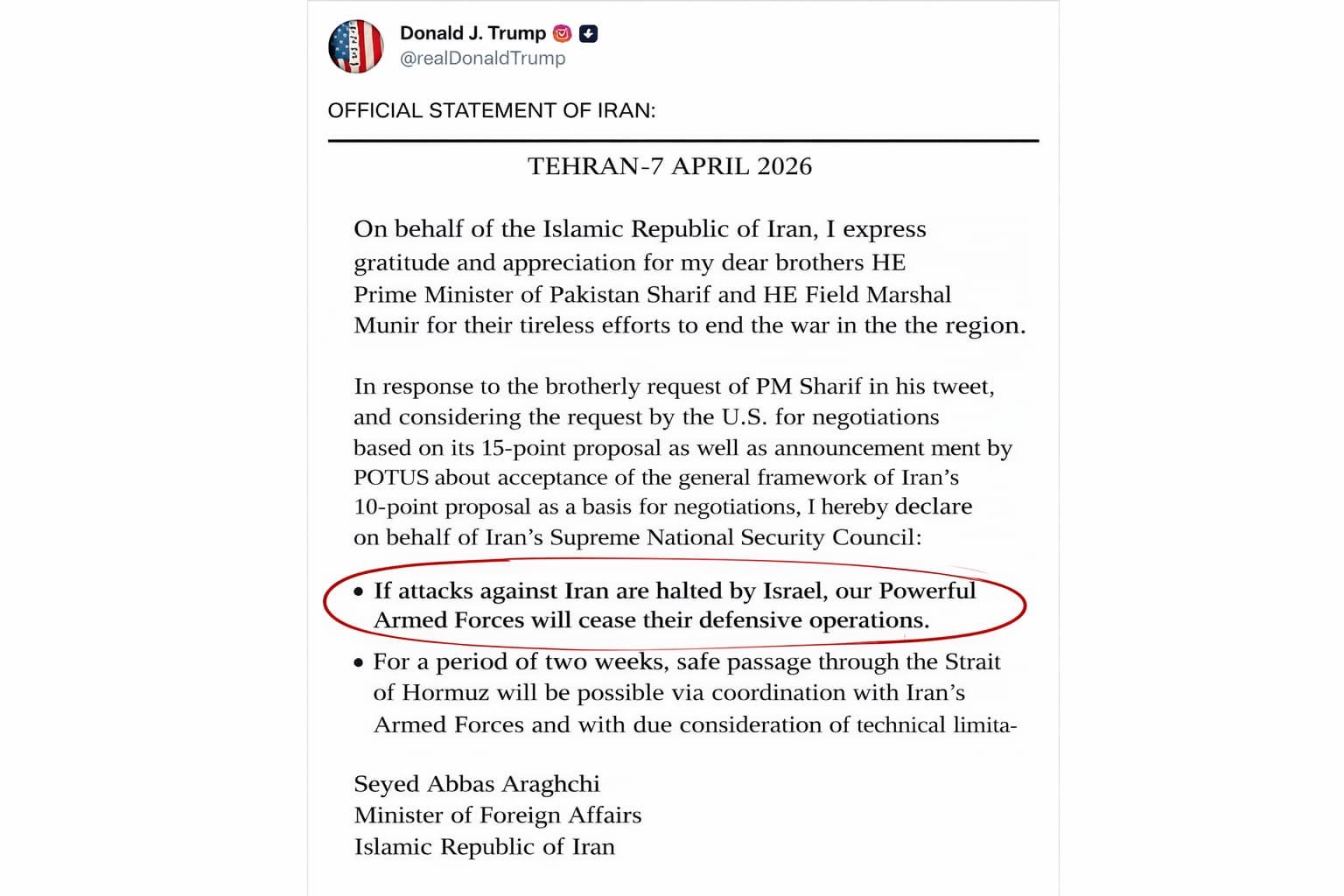
Iran’s Foreign Minister Abbas Araghchi confirmed acceptance within the hour: “If attacks against Iran are halted, our Powerful Armed Forces will cease their defensive operations. For a period of two weeks, safe passage through the Strait of Hormuz will be possible via coordination with Iran’s Armed Forces.”
Israel confirmed it would also comply with the ceasefire in Iran — though Prime Minister Netanyahu denied any ceasefire applied in Lebanon, where Israeli forces have been fighting Hezbollah.
A U.S. Defense official confirmed the ceasefire is now in effect and all U.S. strikes have been suspended.
How It Happened — The Last-Hour Diplomacy
The day began with Trump posting one of the most alarming social media messages of his presidency: “A whole civilization will die tonight, never to be brought back again.” He had set an 8 PM deadline for Iran to open the Strait of Hormuz or face what he described as the complete destruction of its power plants, bridges, and infrastructure.
Iran rejected the demand and called Trump’s threats “delusional.” Congressional Democrats called for Trump’s removal under the 25th Amendment. Even former Trump ally Marjorie Taylor Greene demanded he be removed from office. Dozens of world leaders urged restraint. The UN warned that targeting civilian infrastructure constitutes a war crime.
At approximately 3 PM ET, Pakistani Prime Minister Sharif posted a public appeal on X — tagging Trump, Vance, Rubio, and Iran’s top officials simultaneously — asking for a two-week extension and calling on Iran to open the strait as a goodwill gesture in return. “Diplomatic efforts are progressing steadily, strongly and powerfully,” Sharif wrote.
Trump said he had spoken with Sharif and Pakistan’s army chief. Talks accelerated through the afternoon. By early evening, Iran’s Supreme National Security Council had authorized Araghchi to confirm acceptance. Shortly before 8 PM, Trump posted the ceasefire announcement.
Oil — which had traded above $105 per barrel — immediately fell toward $98. Futures markets surged.
The Iran War — Where Things Stand Now
| Metric | Status as of April 8 |
|---|---|
| War duration | 39 days |
| Ceasefire status | In effect — two weeks |
| Strait of Hormuz | Opening — ships to coordinate with Iranian forces |
| US-Iran peace talks | Scheduled Friday — Islamabad |
| US delegation | VP JD Vance expected to lead |
| Iran’s 10-point plan | Accepted as basis for negotiation |
| US 15-point plan | Iran has agreed to framework |
| Oil price | Down ~6% on ceasefire news |
| US service members killed | 13 |
| Iranian civilian casualties | ~3,200+ |
| American journalist freed | Shelly Kittleson — released by Iraqi militia Tuesday |
What Happens Next — and What Could Go Wrong
The two-week ceasefire is fragile by design. Iran’s Foreign Minister said the Strait would reopen with “technical limitations” and ships must coordinate with Iranian armed forces — language that leaves significant ambiguity about whether full commercial shipping can actually resume immediately. The ceasefire also does not mention Lebanon, where Israel continues operating against Hezbollah.
Friday’s Islamabad talks will be the first direct diplomatic engagement between senior US and Iranian officials since the war began. Vice President Vance is expected to lead the American delegation — a significant elevation given that envoy Steve Witkoff had been handling Iran diplomacy until now.
The bigger question is whether the ceasefire holds long enough for a permanent agreement to be reached. The two sides are closer than they have publicly acknowledged — Iran’s 10-point framework and the US 15-point plan now have significant overlap, according to Trump’s own statement. But significant gaps remain on Iran’s nuclear program, its regional proxy forces, and the question of formal sovereignty over the Strait of Hormuz.
For the 25 to 30 million Americans whose household budgets have been squeezed by $4 gas for six weeks, the ceasefire is the first real signal that relief could be coming. Energy analysts say even a partial reopening of the Strait could reduce oil prices meaningfully within days. A full reopening could bring gas back toward $3.00 per gallon within four to six weeks, though analysts caution the energy market will not fully normalize until the military situation is genuinely resolved.