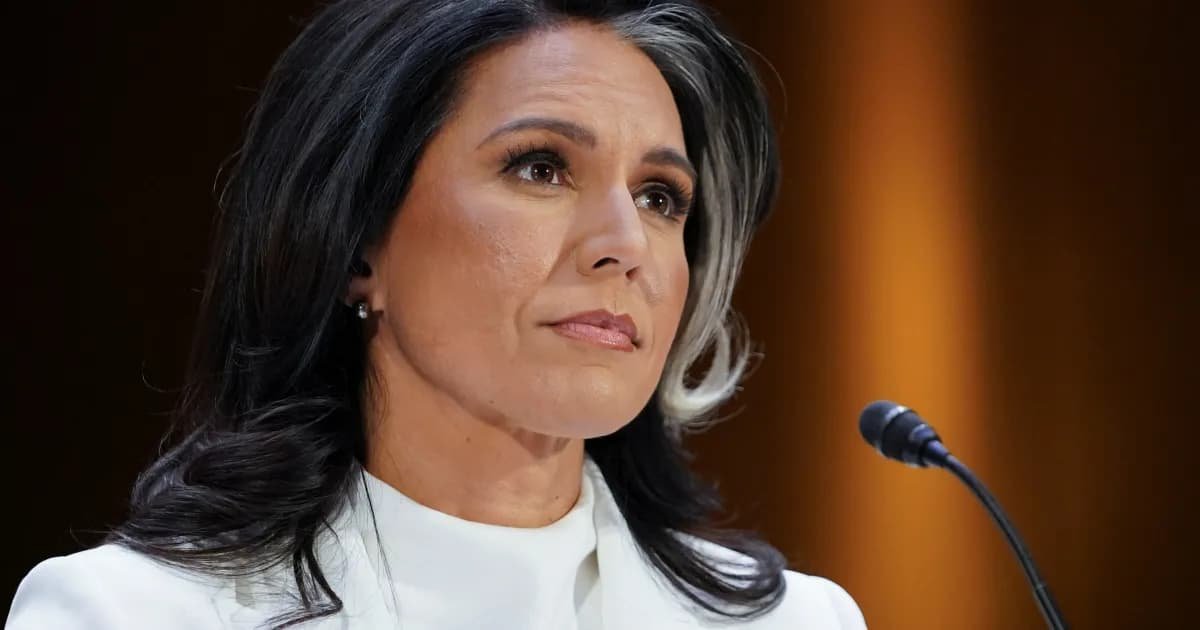

WASHINGTON, May 24, 2026 —
Tulsi Gabbard, the Director of National Intelligence and the senior-most figure in America’s intelligence apparatus, announced Friday that she is resigning effective June 30 — stepping away from a post she had held since February to care for her husband Abraham Williams, who has been diagnosed with an extremely rare form of bone cancer.
She is the fourth Cabinet-level official to leave the Trump administration, and the fourth woman.
What Gabbard’s Letter Said — and What It Didn’t Have to Say
Gabbard posted her resignation letter on social media Friday afternoon. The letter was personal. She described Abraham Williams as her rock through eleven years of marriage — through her deployment to East Africa on a Joint Special Operations mission, through multiple political campaigns, through her Senate confirmation and her tenure overseeing all eighteen of the nation’s intelligence agencies.
She wrote that she must step away from public service to be by his side and fully support him through his battle. She thanked Trump for the opportunity to serve and said she recognized there was still important work to be done, but that the timing required her to step away. She said nothing in the letter about the tensions that had defined her sixteen months in the role.
Trump responded on Truth Social. He called her tenure incredible, said he would miss her, expressed no doubt that her husband would recover, and announced that Aaron Lukas, the principal deputy director of national intelligence, would serve as acting DNI after Gabbard’s departure.
The Tenure That Was Never Quite What Either Side Expected
Gabbard was a complicated figure inside an administration that values loyalty above most other qualities. She had built her national profile as a Democratic congresswoman from Hawaii who opposed military intervention, appeared on Russian state television during the 2016 election cycle, and described American foreign policy in terms more commonly heard on the political left than the right. She shifted her allegiance formally to Trump in 2024, was nominated as DNI, was confirmed by the Senate in February, and then found herself overseeing the intelligence community during an administration that launched the Iran war — a conflict she had spent years of her political career warning against.
During pivotal moments when Trump deliberated over military action in Iran and watched live video feeds of operations, Gabbard was often not in the room. That detail, reported across multiple outlets covering the administration’s internal decision-making, said more about her standing than any public statement could. She clashed with CIA Director John Ratcliffe over authority and access. She faced calls from Democrats in Congress over controversial testimony. She narrowly survived being fired in April, reportedly after a personal intervention from Trump’s longtime outside adviser Roger Stone.
She did not get fired. She also never became the trusted inner-circle figure that the role historically demands.
Four Cabinet Departures. Four Women. The Pattern Worth Noting.
Gabbard is the fourth Cabinet-level official to leave the Trump administration during his second term, and all four have been women. Former Attorney General Pam Bondi was fired. Former Homeland Security Secretary Kristi Noem was fired. Former Labor Secretary Lori Chavez-DeRemer resigned amid an investigation into potential misconduct. Gabbard is resigning to care for her husband.
The circumstances are different in each case. The pattern is visible. The White House has not commented on it.
What is unambiguously true is that the Office of the Director of National Intelligence — one of the most consequential positions in American national security — will be led by an acting official for an indefinite period during an active conflict with Iran, ongoing nuclear negotiations, and a global threat environment that has grown more complex in every month since the war began. Aaron Lukas is a career intelligence professional with deep institutional knowledge. He is not a Senate-confirmed director with the political standing that comes from going through a confirmation process.
What Changes — and When the Senate Has to Act
The DNI position requires Senate confirmation for a permanent appointment. Lukas can serve in an acting capacity, but the administration will need to nominate and confirm a permanent director. Given the Senate’s current schedule — returning from Memorial Day recess the week of June 1, facing a legislative sprint on the One Big Beautiful Bill and the delayed immigration enforcement bill, and managing an active Iran negotiation — a confirmation hearing for a new DNI may not arrive until the fall.
| Tulsi Gabbard DNI Departure — Key Facts | Detail |
|---|---|
| Resignation announced | May 22, 2026 |
| Effective date | June 30, 2026 |
| Reason | Husband Abraham Williams diagnosed with rare bone cancer |
| Time as DNI | ~16 months (confirmed February 2025) |
| Acting DNI successor | Aaron Lukas (principal deputy DNI) |
| Senate confirmation required for permanent | Yes |
| Cabinet departures this term (all women) | 4 — Bondi (fired), Noem (fired), Chavez-DeRemer (resigned), Gabbard (resigned) |
| Intelligence agencies under ODNI oversight | 18 |
| Narrowly survived firing | April 2026 — Roger Stone intervened |
| Clashed with | CIA Director John Ratcliffe |
| Often excluded from | Iran war deliberations in situation room |
Gabbard came into the role as an outsider. She leaves as one too — departing not with a confrontation or a firing, but with a resignation letter about her husband that is entirely genuine and entirely removes her from the political battlefield at the same moment the most consequential intelligence decisions of the second Trump term are still being made. That timing is not anyone’s fault. It is simply what happened.