
GARDEN GROVE, Calif., May 26, 2026 —
The catastrophic explosion threat at the GKN Aerospace facility in Garden Grove, California ended Monday morning when emergency crews confirmed the tank holding 34,000 gallons of a highly flammable, toxic chemical had cracked just enough to release internal pressure without rupturing — sparing Orange County from what officials had described as a potential worst-case disaster affecting tens of thousands of residents.
But the crisis is not over. An estimated 16,000 people remain under evacuation orders as of Monday evening. The tank is still damaged. The chemical is still inside it. And a class-action lawsuit seeking billions in damages was filed last week on behalf of residents who lost the use of their homes and businesses for what has now stretched to five days.
What Happened — and What the Chemical Is
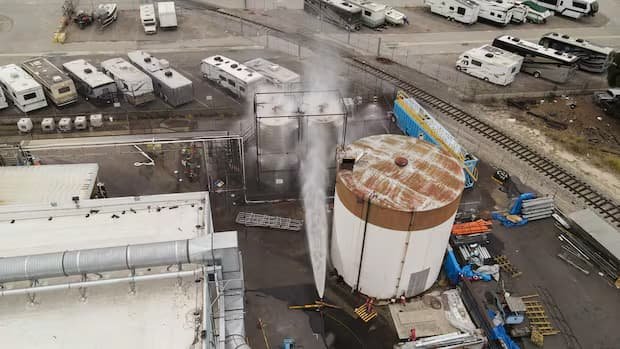
The incident began on May 21 when a storage tank at the GKN Aerospace manufacturing facility at 12122 Western Avenue in Garden Grove began to overheat and off-gas pressure. The tank held methyl methacrylate — a liquid chemical used in the manufacturing of plastics, acrylic glass, and aerospace composite components. Methyl methacrylate is classified as highly flammable, with a flash point below room temperature, and its vapors are heavier than air — meaning that in a spill scenario, the chemical would settle at ground level and spread horizontally rather than dissipating upward.
First responders from the Orange County Fire Authority arrived and began cooling the tank with water hoses to stop the off-gassing, but could not chemically neutralize or drain the contents because a faulty valve prevented access. Over the following two days, the internal temperature of the tank climbed past 100 degrees Fahrenheit — hotter than the firefighters’ gauges could measure. A crack was discovered in the tank during a monitoring operation.
Officials identified two possible outcomes. In the first, the tank would fail and spill tens of thousands of gallons of the chemical into the surrounding area, with vapor settling into nearby streets and storm drains. In the second, the tank would undergo a BLEVE — a Boiling Liquid Expanding Vapor Explosion — an event that would have sent a fireball and shock wave across a densely populated residential neighborhood. Mandatory evacuation orders covering 50,000 residents across a nine-square-mile area in Garden Grove and parts of Westminster, Stanton, and Anaheim were issued immediately.
The Overnight Operation That Eliminated the Explosion Risk
Overnight Sunday into Monday, crews took a calculated risk. They stripped the weather protection and insulation from the outside of the tank to allow the cooling water to contact the tank surface more directly. They then approached the damaged tank directly — something they had been unable to safely do in previous days — to monitor pressure and temperature trends during the daylight hours, when the internal temperature was most unstable.
The crack in the tank, which had been the cause of the greatest concern, turned out to be the event that resolved the situation. It was just large enough to release the internal pressure that had been building since May 21 without causing a catastrophic rupture or triggering a BLEVE. By Monday morning, the internal temperature of the tank was finally declining for the first time since the incident began.
Orange County Fire Authority Chief Craig Covey announced at a Monday morning press conference that the threat of a BLEVE was now off the table. The evacuation zone was reduced from 50,000 residents to approximately 16,000. Chief Covey was explicit that this did not mean the incident was resolved — a smaller explosion or a chemical spill remained possible as long as the damaged tank held the chemical it could not be drained of. Residents in the reduced zone were directed to remain away. Those outside the new boundaries were permitted to return to their homes.
No injuries to civilians or firefighters were reported at any point during the five-day incident.
The Federal, State, and Local Response — and the Lawsuit
California Governor Gavin Newsom declared a state of emergency in Orange County on May 23, unlocking state resources and formally requesting a Federal Emergency Declaration from President Trump. By May 24, 785 state and local first responders had been deployed to the scene.
The Trump administration confirmed that federal resources were engaged. The Environmental Protection Agency integrated with the local Unified Command and deployed air monitoring equipment at 20 locations around the affected area. FEMA deployed a Liaison Officer to coordinate with officials and deployed a team to the State Emergency Operations Center to support contingency planning. FEMA also activated the Interagency Modeling and Atmospheric Assessment Center to provide plume modeling of potential airborne hazards.
Garden Grove’s City Council canceled its regular Tuesday session and scheduled a special meeting for 5:30 p.m. Tuesday specifically to address the incident, the city’s response, and the latest available information. Translation services will be available at the meeting.
A class-action lawsuit was filed May 23 by X-Law Group P.C. and Presidio Law Firm on behalf of two Garden Grove residents who live in the evacuation zone. The suit names GKN Aerospace as the defendant and seeks damages in the hundreds of millions or potentially billions of dollars for residents facing evacuation orders, property disruption, health risks, loss of use of their homes and businesses, and diminished property values. The California attorney general’s office confirmed it is also monitoring the situation.
| Garden Grove Chemical Incident — Key Facts | Detail |
|---|---|
| Incident start date | May 21, 2026 |
| Facility | GKN Aerospace, 12122 Western Ave, Garden Grove |
| Chemical involved | Methyl methacrylate — 34,000 gallons |
| Chemical classification | Highly flammable; heavier than air vapor |
| Peak tank temperature | Exceeded gauge limits above 100°F |
| Peak evacuation order | 50,000 residents, 9 square miles |
| Current evacuation zone (Monday) | 16,000 residents |
| BLEVE threat status | Eliminated as of Monday morning |
| Remaining risk | Smaller explosion or spill still possible |
| Civilian injuries | None |
| Firefighter injuries | None |
| California state of emergency | Declared May 23 by Governor Newsom |
| First responders deployed (state/local) | 785 as of May 24 |
| EPA monitoring locations | 20 around the area |
| Class-action lawsuit filed | May 23 — seeking billions in damages |
| City Council special meeting | Tuesday May 26, 5:30 p.m. |
What Happens Next — and When Residents Can Return
The question every evacuated resident is asking is when they can go home. The answer depends on whether the remaining 34,000 gallons of methyl methacrylate inside the damaged tank can be safely removed, neutralized, or allowed to stabilize to a point where the evacuation zone can be fully lifted.
Engineers are evaluating options for removing the chemical from the tank now that the immediate BLEVE risk has passed. Those options include draining through an alternative access point if the faulty valve issue can be resolved, chemical neutralization, or controlled slow release into a contained area with appropriate environmental protections. The timeline for any of those approaches has not been publicly announced.
What five days of evacuation means practically for 50,000 people — hotel costs, lost wages, disrupted medication access, food spoilage, missed Memorial Day plans, and the generalized stress of not being able to return to your home — is what the class-action lawsuit is attempting to quantify. GKN Aerospace has not yet issued a public statement addressing the litigation. What caused the tank to begin overheating on May 21 — whether equipment failure, human error, maintenance deficiency, or some combination — will be the central question when investigators conduct their formal review of the incident.