
BEIJING, May 14, 2026 —
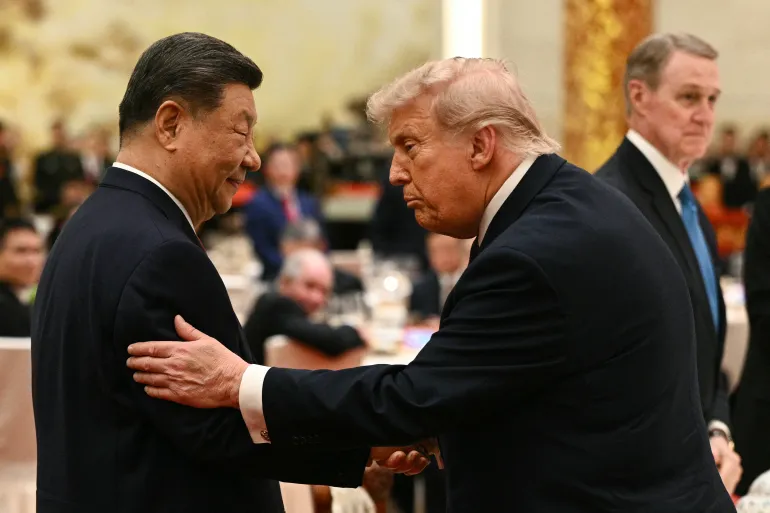
Chinese President Xi Jinping warned Donald Trump on Thursday that mishandling Taiwan could push the two superpowers toward “clashes and even conflicts,” even as both leaders struck warm, conciliatory tones at the opening of a high-stakes two-day summit at Beijing’s Great Hall of the People.
It was the first visit to China by a sitting U.S. president since Trump’s own 2017 trip — and the first face-to-face meeting between the two leaders since October.
Xi’s Taiwan Warning Opens the Session
The day began with Trump and Xi shaking hands outside Beijing’s Great Hall of the People, with a brass band, marching military units, and children waving American and Chinese flags. Then came the blunt message. Xi told Trump that Taiwan “is the most important issue in China-U.S. relations” and reiterated China’s position that Taiwan independence and peace in the Taiwan Strait “are as irreconcilable as fire and water.
The warning was direct. Xi stressed that if the issue is “handled poorly,” the two countries “will have clashes and even conflicts.” The closed-door session ran roughly two hours and fifteen minutes. The White House characterized it as “good.
Trade and Tariffs: From 100% Duties to “Open Wider”
Just over a year ago, the two countries briefly jacked up tariffs on each other’s goods to over 100%, and squared off over rare earth elements, semiconductors, student visas, fentanyl precursor chemicals, and Chinese soybean imports. Thursday’s tone was markedly different.
The two countries’ trade envoys — Treasury Secretary Scott Bessent and Chinese Vice Premier He Lifeng — reached “overall balanced and positive outcomes” at preparatory talks in South Korea on Wednesday. Xi said China’s door would “only open wider” to U.S. business, and a dozen American executives, including Elon Musk, Jensen Huang, and Tim Cook, joined Trump’s delegation. Musk told reporters that “many good things” had been achieved. Cook gave reporters a peace sign and a thumbs-up.
Iran, the Strait, and Strategic Stakes
The summit was never just about trade. Trump and Xi discussed trade, the Middle East, Ukraine, and the Korean Peninsula. Both leaders agreed that the Strait of Hormuz must remain open to support the free flow of energy, and that Iran can never have a nuclear weapon.
With the Iran war dragging on far longer than the Trump administration’s initial four-to-six-week prediction, some analysts see China gaining positional leverage — Beijing is Iran’s largest trade partner and the top buyer of its oil.
Xi and Trump agreed to develop a “constructive China-U.S. relationship of strategic stability” — a framework Beijing said would guide the next three years and beyond.
| Summit Agenda Item | Status After Day One |
|---|---|
| Taiwan | Xi warning issued; U.S. position unchanged |
| Tariffs / Trade | Preparatory talks yielded “positive outcomes” |
| Iran / Strait of Hormuz | Joint agreement: must stay open |
| Rare Earths | China agreed to halt export restrictions |
| U.S. Business Access | Xi pledged China’s market would “open wider” |
| Summit Duration | Day two continues Friday; Trump departs midday |
Trump Invites Xi to Washington for September 24
In a notable diplomatic gesture at the state banquet, Trump extended a September 24 invitation to Xi and his wife, Madame Peng, for a reciprocal White House visit. “This has been an amazing period of time,” Trump said. Xi called 2026 a “landmark year” for the relationship and extended congratulations on America’s 250th anniversary. “I firmly believe the common interests between China and the United States are bigger than our differences,” Xi said.
Day two of the summit continues Friday, with Trump expected to depart Beijing just after midday following a final private meeting with Xi. The outcomes — and what, if anything, was quietly conceded on Taiwan — will shape global trade and security calculations for years.