
WASHINGTON, May 12, 2026 —
Key Takeaways
- Cole Tomas Allen — the 31-year-old Caltech-educated engineer who charged a security checkpoint at the White House Correspondents’ Dinner on April 25 armed with a shotgun, a handgun, and multiple knives — entered a not guilty plea Monday to four charges including attempted assassination of the President of the United States, the most serious charge the Justice Department has filed against any individual in connection with a presidential security incident since the attempted assassination of President Ronald Reagan in 1981.
- U.S. District Judge Ana Reyes rejected the defense’s opening tactical move — an attempt to have Allen’s case assigned to a different judge through what the court described as a “judge shopping” maneuver — with Reyes calling the effort transparently procedural and declining to recuse herself from proceedings she said she intended to run “firmly and fairly.”
- The prosecution’s case rests on four counts: attempted assassination, using a firearm during a crime of violence (two counts), and assaulting a federal officer with a dangerous weapon — charges that collectively carry a potential sentence of life in federal prison if Allen is convicted on all counts.
The Arraignment — What Happened in the Courtroom
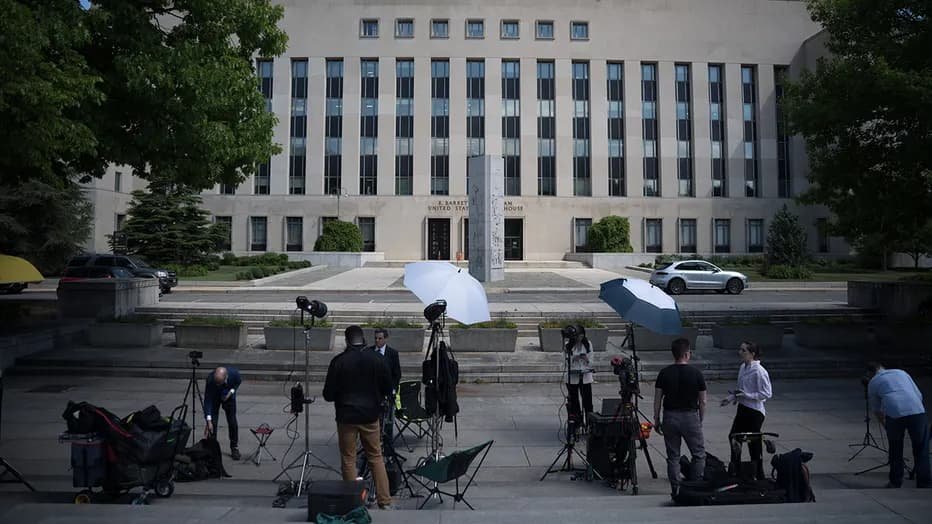
Cole Allen appeared in federal district court in Washington Monday for his arraignment — the formal proceeding at which a defendant enters a plea in response to the charges filed against them. Allen pleaded not guilty to all four counts. His attorneys entered the plea on his behalf without Allen making any public statement in the courtroom.
The proceeding’s most significant moment came before the plea itself, when Allen’s defense team attempted to have Judge Reyes removed from the case. The specific mechanism — which the judge and prosecutors characterized as judge shopping — involved a procedural challenge designed to trigger a reassignment to a different judge whose record and judicial philosophy the defense apparently preferred. Judge Reyes addressed the attempt directly from the bench, calling it a transparent procedural maneuver, declining to recuse herself, and indicating that the court would proceed on the merits.
The exchange set the tone for what both sides appear to recognize will be an exceptionally high-stakes, exceptionally scrutinized legal proceeding. The attempted assassination of a sitting president — or the attempted assassination of others at a presidential event, depending on how the prosecution frames the specific intent — is a category of federal crime that generates significant legal, political, and media attention at every stage.
The Four Charges — and What Each Requires to Prove
| Charge | Statutory Basis | Key Element the Government Must Prove | Maximum Sentence |
|---|---|---|---|
| Attempted assassination of the President | 18 U.S.C. § 1751 | Allen intended to kill President Trump | Life in prison |
| Using a firearm during a crime of violence (Count 1) | 18 U.S.C. § 924(c) | Firearm used in connection with attempted assassination | 10 years consecutive |
| Using a firearm during a crime of violence (Count 2) | 18 U.S.C. § 924(c) | Firearm used in connection with assault on federal officer | 25 years consecutive |
| Assaulting a federal officer with a dangerous weapon | 18 U.S.C. § 111 | Attacked Secret Service/law enforcement with weapons | Up to 20 years |
The attempted assassination charge is the most legally demanding for the government to prove. Section 1751 of Title 18 requires the prosecution to establish not merely that Allen attacked the checkpoint where a presidential event was occurring, but that he specifically intended to kill the president. The note Allen sent to family members — which prosecutors say “clearly stated” he wanted to target Trump administration officials — is the government’s primary evidence of intent.
The defense has not indicated publicly what theory it intends to advance. Standard defense strategies in cases involving this level of charged conduct include challenging the intent evidence — arguing that wanting to target “administration officials” is different from specifically intending to kill the president — challenging the constitutionality of the charges as applied, or raising mental state defenses that contest Allen’s capacity to form the specific intent required.
Who Judge Ana Reyes Is — and Why the Defense Wanted Someone Else
Judge Ana Reyes was appointed to the U.S. District Court for the District of Columbia by President Biden in 2022. She has built a reputation for direct, assertive courtroom management — she does not allow proceedings in her courtroom to drift or to be managed by counsel rather than the court. Her rejection of the defense’s judge-shopping attempt was direct and immediate, with no suggestion that she was open to reconsidering.
The defense’s desire for a different judge almost certainly reflects a calculation about how different judicial philosophies might handle the case’s most contested legal questions — including the admissibility of Allen’s note, the scope of the attempted assassination statute, and the government’s framing of Allen’s intent. A judge more skeptical of government overreach in criminal prosecutions would be more receptive to defense arguments that the attempted assassination charge overstates what the evidence supports. Judge Reyes’s record does not suggest she is that judge.
The Security Questions That Won’t Be Answered in Court
The criminal case against Cole Allen will determine whether he is convicted and sentenced. It will not determine — and is not designed to determine — the larger security questions that Saturday night’s attack raised and that remain unresolved.
How did Allen arrive at the Washington Hilton carrying a shotgun, a handgun, and multiple knives? What did the pre-event security sweep miss? What changes have been made to the Secret Service’s protocols for presidential events at off-site venues since the attack? Are those changes sufficient? These are questions for the Secret Service’s internal review, for the congressional oversight committees that have been briefed on the incident, and for any independent investigation that might follow.
The July 2024 assassination attempt at Butler, Pennsylvania — in which a gunman shot and wounded Trump from a rooftop overlooking a campaign rally before being killed by Secret Service agents — triggered the most significant overhaul of Secret Service protective protocols in decades. Whether those reforms proved sufficient in April 2026 depends on how you evaluate the outcome: Allen was stopped at the outer checkpoint before reaching the ballroom where Trump was seated. No one inside the ballroom was injured. The security perimeter held.
Whether a more thoroughly prepared attacker — one who had studied the checkpoint layout and developed a different approach — could have penetrated further is the question the Secret Service cannot answer publicly without revealing the gaps they are working to close.
The Political Dimension That Cannot Be Ignored
The Allen prosecution arrives in a political environment that has made the case simultaneously more and less straightforward than a comparable case under different circumstances. Trump’s supporters have characterized the attack as evidence of the political violence they argue the left has normalized against Republican officials. Trump’s critics have noted that the administration’s own rhetoric — including Trump’s repeated characterization of political opponents as enemies of the country — has contributed to a climate of political extremism.
Neither characterization is legally relevant to whether Cole Allen is guilty of the charges against him. Both will shape how the case is perceived and discussed throughout its duration — which, given the typical timeline of federal criminal cases involving serious charges, is likely to extend well into 2027.
Judge Reyes has signaled she intends to run the proceedings on the evidence and the law. Whether the political temperature surrounding the case allows that to happen without interference from the executive branch — whose leader is the alleged victim — is the question that will follow this case from arraignment to verdict.