
WASHINGTON, May 13, 2026 —
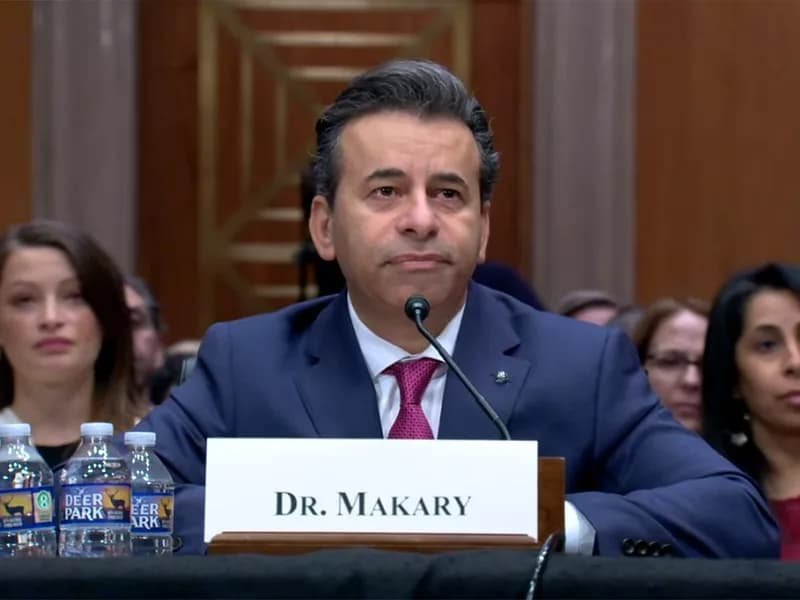
Dr. Marty Makary resigned as Commissioner of the Food and Drug Administration on Tuesday morning — the fourth high-profile departure from the Trump administration this year — as April consumer price index data released simultaneously showed inflation jumping to 3.8% year-over-year, the highest reading since early 2023, driven almost entirely by gasoline prices that have risen 31.5% since the Iran war began February 28.
The two developments arrived within hours of each other and together describe an administration entering one of its most consequential weeks — with the Trump-Xi summit in Beijing beginning Thursday — with a leaderless FDA and an inflation reading that makes the Federal Reserve’s path to rate cuts effectively impossible in the near term.
Why Makary Is Leaving — and What He Leaves Behind
Dr. Marty Makary was a Johns Hopkins surgeon and public health commentator appointed FDA Commissioner in early 2025. He arrived with a reform agenda centered on accelerating drug approvals, reducing regulatory burden on medical device manufacturers, and increasing transparency in the FDA’s review processes. He was widely regarded within the public health community as a serious scientist who had taken on a genuinely difficult job.
His resignation Tuesday — described in a brief statement as a personal decision made for family reasons — is the fourth significant departure from the administration this year, following the exits of the national security adviser, the deputy treasury secretary, and a senior official at the Department of Homeland Security. The specific circumstances surrounding Makary’s departure have not been detailed. His statement did not reference any policy disagreements.
What Makary leaves behind is an FDA at the center of some of the highest-profile healthcare policy battles in the country. The mifepristone case currently before the Supreme Court involves FDA regulatory authority over drug prescribing rules. The Medicare drug negotiation program — which has reduced costs on 10 drugs for 9 million beneficiaries — operates under FDA approval processes that the agency defends in ongoing litigation. The GLP-1 obesity drug coverage expansion under the BALANCE Model requires ongoing FDA coordination with CMS. Each of these issues now awaits leadership that does not yet exist.
The April CPI Reading — 3.8% and Rising
The Bureau of Labor Statistics April consumer price index report arrived Tuesday morning showing prices rose 3.8% year-over-year — the fastest pace since early 2023 and a significant acceleration from March’s 3.3% annual reading.
| April 2026 CPI — Key Components | Monthly Change | Year-over-Year |
|---|---|---|
| All items (headline CPI) | +0.5% | +3.8% |
| Energy | +4.2% | +31.5% |
| Gasoline | +5.1% | +35.2% |
| Food at home | +0.3% | +3.1% |
| Shelter | +0.3% | +4.1% |
| Core CPI (ex-food and energy) | +0.2% | +3.2% |
| Medical care | +0.1% | +2.8% |
| New vehicles | +0.4% | +2.1% |
The gasoline component — up 5.1% in April alone and 35.2% year-over-year — is the dominant driver of the headline acceleration. Core CPI, which excludes food and energy, rose a more modest 0.2% for the month and 3.2% year-over-year — above the Federal Reserve’s 2% target but not dramatically so. The Iran war’s energy price shock is showing up in headline inflation while core inflation remains relatively contained, creating the exact policy dilemma the Federal Reserve has been navigating since February 28.
What 3.8% Inflation Means for the Federal Reserve
Federal Reserve Chair Kevin Warsh — who took the chair on May 15 and is now in his first full week in the role — receives Tuesday’s 3.8% CPI reading as his first major economic data point as chair. It does not make his job easier.
The Fed’s dual mandate requires it to pursue both maximum employment and price stability — with price stability defined as 2% inflation. At 3.8% headline and 3.2% core, both measures are running above the target. The April jobs report showed a stronger-than-expected labor market. The economy is not in recession. There is no distress-driven case for emergency rate cuts.
There is also no case for rate increases — core inflation at 3.2% is elevated but not accelerating, and the source of the headline surge is an energy shock driven by a geopolitical event that could resolve within weeks if the Trump-Xi summit produces meaningful pressure on Iran’s negotiating position.
Warsh’s most likely posture — hold rates at 3.50%-3.75% through the June FOMC meeting, reassess at the July meeting based on whether energy inflation is peaking — is the same posture his predecessor would have taken. The 3.8% reading does not change the direction of policy. It confirms that the direction is on hold.
The Political Dimension — Gas Prices and Midterms
April’s 3.8% inflation reading will appear in every political advertisement run by every Democratic candidate in every competitive House and Senate race between now and November. The Iran war is now generating the highest sustained inflation reading in three years, at the same time that consumer sentiment has hit its lowest level since the 1950s, at the same time that Trump’s approval is at 39%.
The Trump administration’s best response to Tuesday’s data is the same as it has been for ten weeks: end the Iran war, reopen the Strait of Hormuz, and let energy prices fall. Every economic indicator that has deteriorated since February 28 — inflation, consumer sentiment, gas prices, Spirit Airlines — reverses if and when the Strait reopens and oil falls toward $80. The administration knows this. It is the reason the Beijing summit matters so much.
Whether Xi Jinping can be persuaded to apply meaningful pressure on Iran’s nuclear negotiating position — and whether that pressure produces movement in Tehran before May 22’s ceasefire review deadline — will determine whether Tuesday’s 3.8% inflation reading is a peak or a milestone on the way to something higher.