
WASHINGTON, MARCH 22, 2026 —
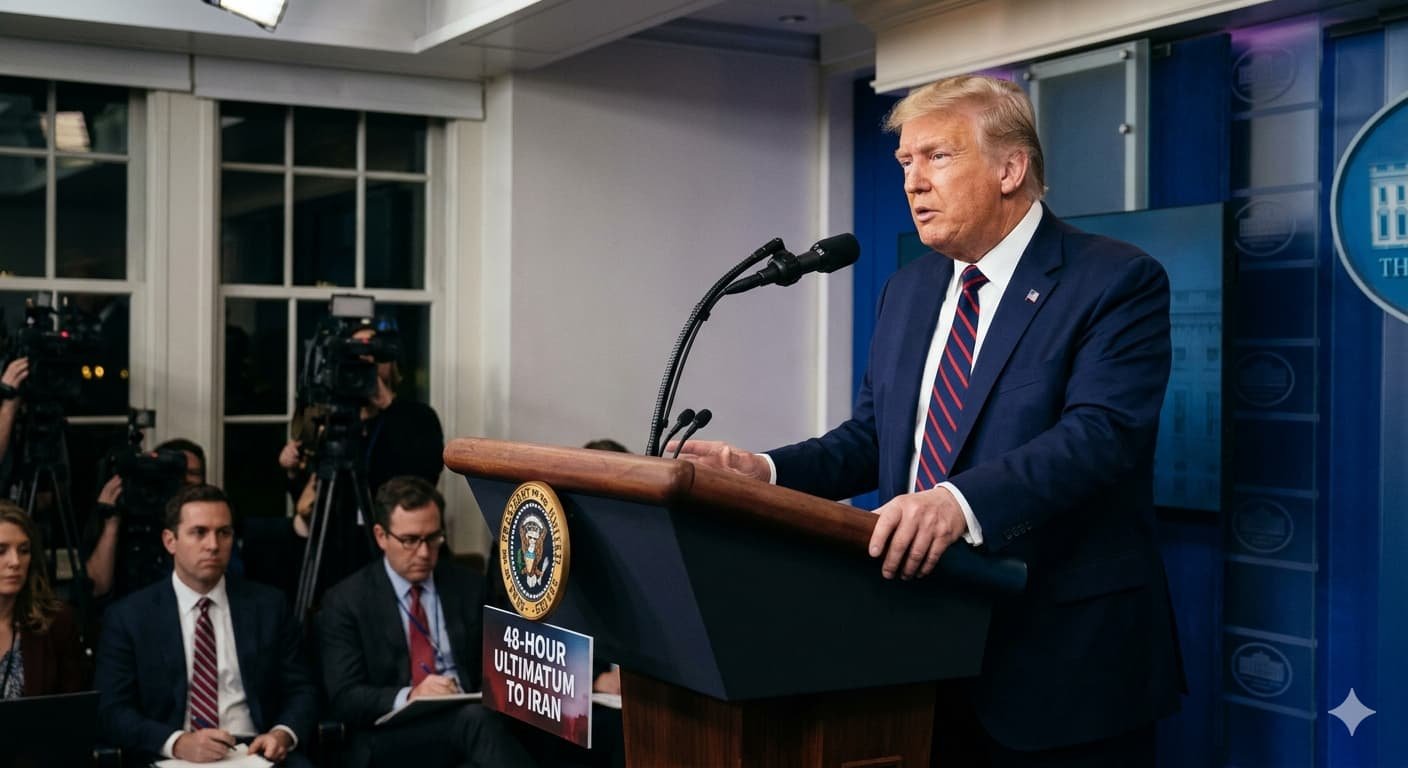
President Donald Trump issued the most explosive ultimatum of the Iran war on Saturday, threatening to “hit and obliterate” Iran’s power plants — starting with the largest one first — if Tehran does not fully reopen the Strait of Hormuz within 48 hours. Iran responded within hours, warning of “crushing blows” against U.S. allies across the region if Trump follows through.
The ultimatum, posted on Truth Social early Saturday morning, represents the most direct threat the United States has made against Iranian civilian infrastructure since the war began on February 28. It comes as Day 23 of the conflict brought fresh Iranian missile strikes on two Israeli cities near the country’s nuclear research center, injuries to nearly 100 people, and a new attack on the joint U.S.-UK Diego Garcia military base in the Indian Ocean — the farthest Iran has struck since the war began.
The Ultimatum — Word for Word
Trump’s post left nothing to interpretation. “If Iran doesn’t FULLY OPEN, WITHOUT THREAT, the Strait of Hormuz, within 48 HOURS from this exact point in time, the United States of America will hit and obliterate their various POWER PLANTS, STARTING WITH THE BIGGEST ONE FIRST!” he wrote.
Trump went further, claiming the U.S. was “weeks ahead of schedule” in its military objectives — saying Iran’s navy, air force, and air defenses are effectively destroyed, and that Iranian missile and drone attacks have dropped 90% from their peak in the early days of the war. He added that Iran “wants to make a deal” — a claim Iranian officials immediately and flatly denied.
The 48-hour clock began Saturday morning. It expires Monday, March 24.
Iran Strikes Near Israel’s Nuclear Site — 100 Wounded
The ultimatum did not arrive in a vacuum. Hours before Trump posted his threat, Iran launched a significant missile salvo targeting southern Israel — specifically the cities of Dimona and Arad, both of which sit near Israel’s Negev Nuclear Research Center, the country’s primary nuclear facility.
Israel’s Magen David Adom emergency service reported 64 people injured in Arad alone, with seven in serious condition and 15 in moderate condition. The Israel Defense Forces said Iranian missiles made direct impacts in both cities — breaking through Israel’s air defense network in a region that had previously been considered well-protected. Prime Minister Benjamin Netanyahu described it as “a very difficult evening in the battle for our future” and said he was reinforcing emergency and rescue forces operating in the affected areas.
The International Atomic Energy Agency confirmed it was monitoring reports of missile impacts near Dimona but said there were no indications of damage to the nuclear research center itself.
Iran War Day 23 — Where Things Stand
Iran War Escalation Tracker — March 22, 2026
| Development | Detail |
|---|---|
| Trump ultimatum | Open Strait in 48 hours or power plants hit |
| Iran missile strikes | Dimona and Arad, Israel — 100 wounded |
| Diego Garcia attacked | First-ever Iranian strike on Indian Ocean base |
| Bahrain total intercepts | 143 missiles and 242 drones since Feb 28 |
| Saudi Arabia | Shot down 47 drones in single day Thursday |
| Commercial ships attacked | 21 confirmed attacks since March 1 |
| Strait of Hormuz | Remains effectively blocked — “critical” threat level |
| Iran sanctions lifted | Trump lifted sanctions on Iranian oil until April 19 |
Iran Fires at the Diego Garcia Base — A Significant First
While Trump’s ultimatum dominated headlines Saturday, a separate development deserves attention. Iran launched ballistic missiles at the Diego Garcia military installation — the joint U.S.-UK base located in the Indian Ocean, roughly 2,500 miles from Iran’s coast. The UK Ministry of Defense confirmed the attack was unsuccessful.
A senior Iranian official told reporters Iran was not responsible for the Diego Garcia strikes — a denial that U.S. and UK officials dismissed. The attack, if confirmed as Iranian, would represent the longest-range strike Iran has conducted in the conflict — and a direct signal that American military assets far from the Persian Gulf are now within Tehran’s reach.
“Iran’s reckless attacks, lashing out across the region and holding hostage the Strait of Hormuz, are a threat to British interests and British allies,” a UK Ministry of Defense spokesperson said Saturday.
Trump Lifts Iran Oil Sanctions — A Contradictory Move
Even as Trump threatened to escalate the war dramatically, his administration took a simultaneous step in the opposite direction. The White House announced Friday that it is temporarily lifting sanctions on Iranian oil currently loaded on ships at sea — a measure designed to ease the worst disruption to global oil markets in years. The lifted sanctions apply only to Iranian oil already at sea and will last until April 19, 2026.
The move is a direct acknowledgment that the Strait of Hormuz blockade is causing serious economic damage inside the United States. Oil remains above $110 a barrel. Gas prices are approaching $4 a gallon at pumps across America. By allowing stranded Iranian oil to reach market, the administration is trying to increase global supply and take pressure off prices — while simultaneously threatening to escalate the military campaign that caused the blockade in the first place.
The contradiction is not lost on economists or foreign policy analysts. Trump is threatening to destroy more Iranian infrastructure with one hand while opening an economic relief valve with the other — a dual track strategy that reflects the impossible position the administration now finds itself in after 23 days of war with no clear exit.
What Happens If Iran Does Not Comply by Monday
The 48-hour deadline expires on Monday, March 24. Iran has given no indication it intends to reopen the strait. Iranian officials have rejected Trump’s claim that Tehran wants negotiations, and the Revolutionary Guard issued a direct threat Saturday — warning of “crushing blows” against the UAE port city of Ras al-Khaimah and other Gulf infrastructure if any further aggression is launched from regional territory.
Whether Trump follows through on the power plant threat — or whether the ultimatum is a negotiating tactic designed to pressure Iran toward back-channel talks — will define the next chapter of a war that has already killed more than 2,300 people, displaced over one million Lebanese, and pushed global energy markets to their most unstable point in years.
Monday is now the most consequential deadline in the Iran war. The world is watching.