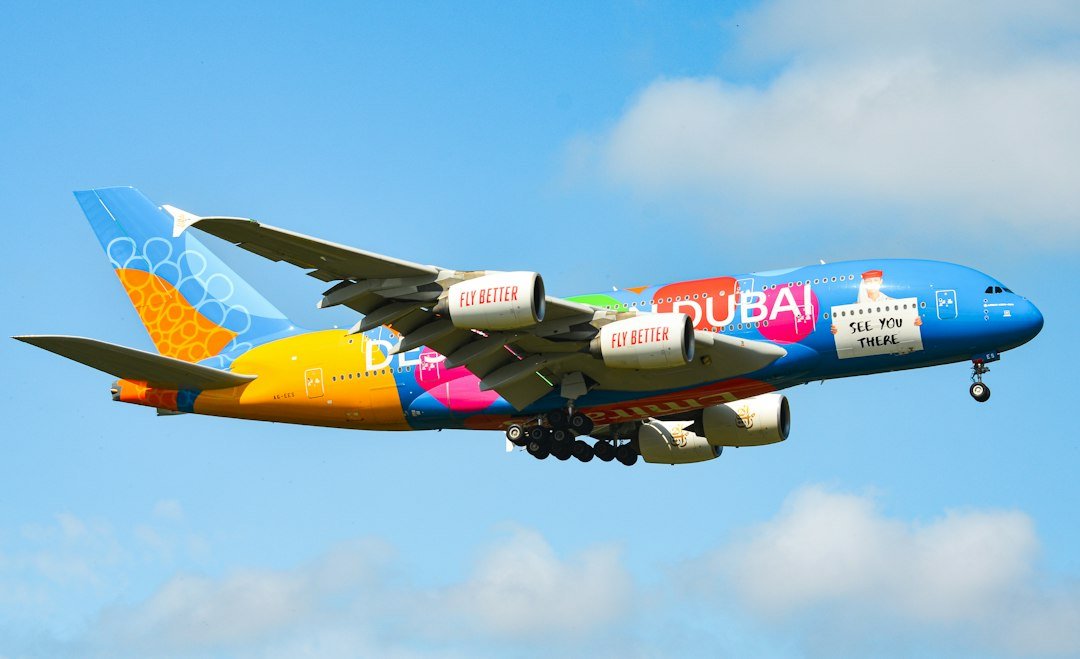

Photo by Henry Möllers on Unsplash
A Flydubai flight from Dubai to Tel Aviv was diverted this week after a violent altercation erupted in the cockpit, leaving a pilot stabbed and the plane temporarily out of control. The aircraft, flight FZ1073, was carrying passengers on a routine route between the two cities when the struggle broke out on Wednesday, according to passenger accounts and aviation reporting.
A Midair Struggle
Emirati investigators said the co-pilot used a “crash axe” — an emergency tool normally stored in the cockpit for safety purposes — to attack the pilot before attempting to seize control of the aircraft’s flight controls. The UAE Attorney General, Hamad Saif Al Shamsi, officially described the incident as an attempted “terrorist act,” a characterization that has shaped the scope of the ongoing investigation.
Israeli Prime Minister Benjamin Netanyahu offered a dramatic account of the moments inside the cockpit, saying the co-pilot stabbed the other pilot and tried to crash the plane with everyone on board. According to Netanyahu, the aircraft “went into a spin and began to plunge” before order was restored. The plane had 174 people on board, Netanyahu said, though some reports have put the number at more than 180.
Passengers Intervene
The wounded captain was identified as Smit Machchhar, an Indian national. Netanyahu praised him as a “true hero,” crediting him with helping prevent what he called “a catastrophic midair disaster.” Despite his injuries, Machchhar’s actions in the cockpit were central to stabilizing the situation long enough for others to respond.
Passengers and crew members did not wait for the crisis to resolve itself. They rushed into the cockpit, overpowered the attacker, and helped regain control of the aircraft, which landed safely about an hour later in Tabuk, Saudi Arabia. One passenger, Yaniv Hayoun, described physically restraining the suspect. He said he put the alleged attacker in a chokehold and dragged him out of the cockpit with the help of other passengers, an account that underscores how close the situation came to spiraling further out of control before bystanders intervened.
The swift, coordinated response from ordinary travelers turned what could have been a far deadlier outcome into a story of survival. Airlines rarely see passengers forced into such direct physical confrontation with crew members, and the incident has already drawn attention to how civilians can be the last line of defense when cockpit security fails.
Who Is the Suspect?
The suspected attacker has been identified as Hamam al-Hammami, an Omani national, according to multiple sources including a Gulf diplomat and a Western diplomat familiar with the investigation. His employment history has become a focal point of scrutiny in the days since the attack.
Al-Hammami was removed from a previous job at Oman’s national airline, Oman Air, last year over concerns about his extremist views, according to sources familiar with the matter. He is reported to have worked for Flydubai for only eight months before the incident, according to an Israeli official, raising questions about how thoroughly his background was vetted before he was cleared to fly.
A LinkedIn profile reportedly belonging to al-Hammami paints a more detailed picture of his career path. It states he worked at Oman Air for seven years before leaving in February 2025. He then joined Royal Air Maroc in June 2025, departing that position in January 2026 — shortly before starting at Flydubai. Royal Air Maroc has confirmed part of that timeline, stating that the suspect trained with the airline for three months in 2025 as part of its pre-employment process but was ultimately not selected for a permanent role.
The gap between his departure from Oman Air amid extremism concerns and his eventual hiring at Flydubai has fueled questions about information-sharing between airlines and aviation authorities across the region. How a pilot flagged for extremist views at one carrier could go on to work, even briefly, at another major airline has become a pressing concern for industry observers.
Investigation Continues
Israeli sources have told reporters that the co-pilot accused of the attack probably acted alone, suggesting investigators have found no evidence so far of a broader coordinated plot. Still, significant questions remain unanswered about what drove him to allegedly attempt to seize the aircraft.
Netanyahu said the co-pilot was believed to have undergone “Islamist radical indoctrination,” but he also acknowledged that the motive behind the alleged attack was not yet clear. That tension — between a strong public characterization of the attacker’s ideology and an admitted lack of clarity on motive — reflects the early and unsettled stage of the investigation.
Authorities in the UAE, along with Israeli officials, are continuing to piece together how al-Hammami was hired despite his earlier removal from Oman Air, and whether any warning signs were missed during his brief tenure at Flydubai. For now, the incident stands as a rare and alarming breach of cockpit security, averted only by the actions of an injured captain and a cabin full of passengers who refused to stand by.