
WASHINGTON, May 4, 2026 —
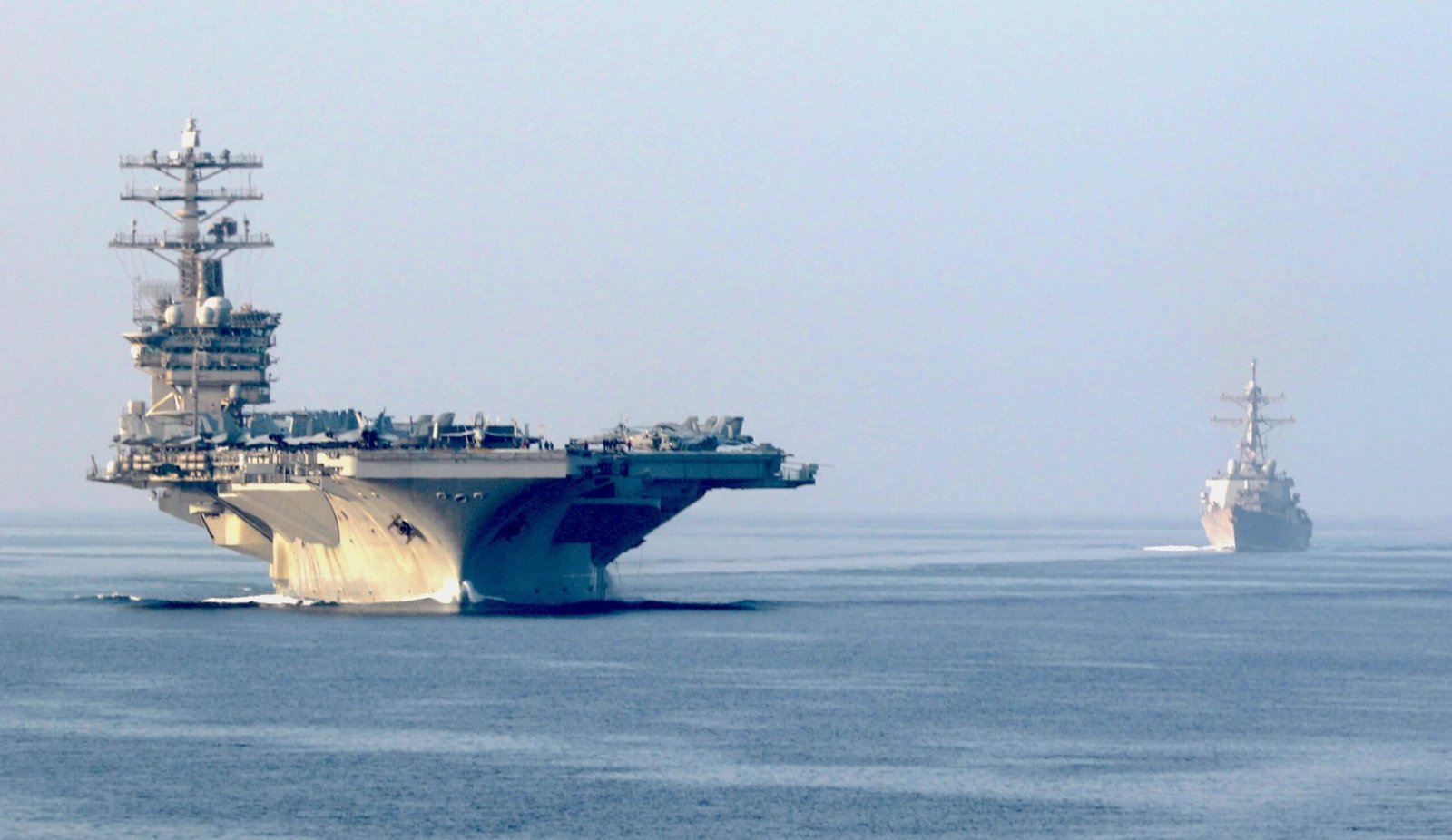
President Trump announced Sunday that the United States will begin helping stranded commercial vessels navigate through the Strait of Hormuz starting Monday morning — a statement that has sent shipping companies, insurance underwriters, and oil market traders scrambling to determine what exactly the U.S. military intends to do in one of the world’s most contested waterways.
Trump made the announcement on Truth Social Sunday afternoon, writing: “Starting TOMORROW, the United States will be GUIDING ships safely through the Strait of Hormuz. Many ships have been waiting. Time to get them moving!!!” The post contained no operational details, no description of the military assets involved, no explanation of how Iranian cooperation — or the lack of it — had been addressed, and no reference to the Rubio-Araghchi phone call that produced a preliminary deal framework earlier Sunday.
The White House did not immediately follow the post with a briefing or a statement from the Pentagon. The Navy has not confirmed what the guidance operation will involve. Iran has not responded publicly as of Sunday evening.
What “Guiding” Ships Through the Strait Could Mean
The Strait of Hormuz is approximately 21 miles wide at its narrowest point. At its peak before the war, it handled more than 21 million barrels of oil per day — roughly 20% of global seaborne oil. Since the conflict began, throughput has collapsed by more than 95% due to the combination of the U.S. naval blockade, Iranian harassment of commercial vessels, and insurance underwriters withdrawing coverage for ships transiting the area.
At least 200 commercial vessels — oil tankers, container ships, and bulk carriers — are currently anchored in the Gulf of Oman and the northern Arabian Sea, waiting for conditions that allow safe transit. Some have been waiting since mid-February. Their cargo includes crude oil, refined petroleum products, liquefied natural gas, and consumer goods. Their combined value runs into the tens of billions of dollars.
“Guiding” those ships through the Strait could mean several things operationally, none of which has been officially described:
| Possible Interpretation | What It Would Require | Risk Level |
|---|---|---|
| US Navy convoy escort | Warships flanking commercial vessels through the Strait | High — potential Iranian confrontation |
| Diplomatic safe passage agreement | Iranian commitment not to interfere | Requires Iran cooperation — not confirmed |
| Air cover only | US aircraft monitoring transit without surface escort | Medium — deterrence without direct confrontation |
| Unilateral passage declaration | US declares Strait open, dares Iran to respond | Very high — potential direct conflict |
| Combined US-Iran framework | Phase One deal implemented — Strait opened by agreement | Low risk — but deal not yet signed |
The most optimistic interpretation — and the one oil markets immediately priced in — is that Trump’s announcement reflects the Phase One framework that emerged from the Rubio-Araghchi call earlier Sunday: Iran suspends toll collection and harassment, the U.S. begins escorting ships, and both sides de-escalate simultaneously as the first step toward a broader deal.
Oil Markets Moved Before Anyone Had Details
The combination of Trump’s announcement and the Rubio-Araghchi call framework pushed Brent crude down sharply in Sunday trading. From its Friday close of $118 a barrel, Brent fell to approximately $107 by late Sunday afternoon — an $11 decline in less than 24 hours. U.S. gasoline futures fell in tandem.
If the Monday operation proceeds without incident — if ships begin moving through the Strait and Iran does not fire on them or block their passage — the price signal will be dramatic. Traders pricing in a sustained reopening of the Strait would push Brent toward the $85 to $90 range that Goldman Sachs projected as the post-deal equilibrium. At that level, U.S. pump prices would fall from $4.30 to approximately $3.40 to $3.60 a gallon within two to three weeks as refined product costs adjust.
If Iran fires on an escorted convoy, or if the Monday operation produces a confrontation rather than a passage, the opposite occurs — Brent spikes back above $120 and the brief diplomatic optimism of Sunday collapses entirely.
Iran Has Not Said Yes — or No
The silence from Tehran on Sunday evening is being interpreted in two very different ways by people watching the situation closely. One reading is that Iran has quietly agreed — through the back-channel framework involving Pakistan and Oman — to allow the passage without interference, and that its public silence is a face-saving measure that allows both governments to characterize Monday’s events in whatever terms serve their domestic audiences best.
The other reading is that Iran was not consulted or informed before Trump’s Truth Social post, and that the Monday operation is a unilateral American action that Iran’s military and political leadership are now deciding how to respond to in real time.
The IRGC has not issued a statement. Foreign Minister Araghchi, who posted after his call with Rubio that Iran was “ready to move quickly,” has not addressed the ship guidance announcement specifically. Supreme Leader Khamenei, who issued his first public statement last week pledging to protect Iran’s nuclear and missile capabilities, has been silent since.
Congress Returns Monday — Into This
Congress returns from its week-long recess Monday morning. Lawmakers on both sides will be briefed on the Rubio-Araghchi framework and the ship guidance operation within hours of returning to Washington. The questions that will dominate those briefings are the ones Trump’s Truth Social post left entirely unanswered: What exactly will U.S. forces do Monday? Has Iran agreed to cooperate? What happens if a ship is fired upon? What is the legal authority for escorting commercial vessels through a foreign nation’s claimed territorial waters?
Trump told Congress last Friday that Iran hostilities are “terminated.” If U.S. warships escort commercial vessels through the Strait under fire, that termination declaration will look even less credible than it already does. If the operation proceeds without incident, it will be the most visible evidence yet that the Iran war is genuinely moving toward resolution.
Monday morning will answer questions that Sunday afternoon raised. The ships are waiting. The Navy is presumably positioning. Iran is silent. And the most consequential 12 hours of the Iran war’s diplomatic phase are about to begin.