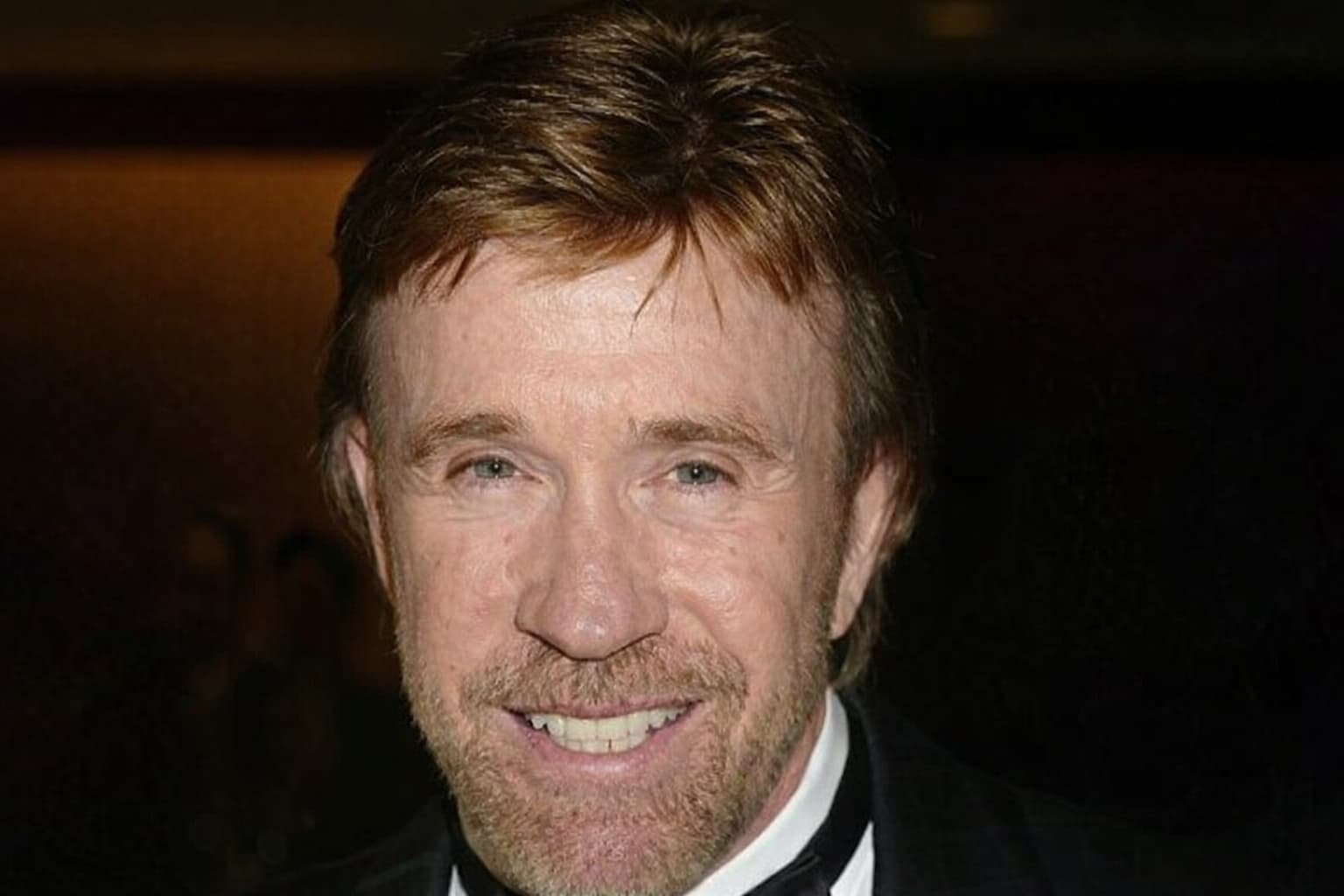

HONOLULU, MARCH 22, 2026 — He was the man who didn’t age. Ten days ago, on his 86th birthday, Chuck Norris posted a video on social media from Hawaii — sparring with an opponent, smiling, defying time the way he always had. On Thursday morning, surrounded by his family in that same state, he died suddenly. The world’s most indestructible action hero was gone.
Chuck Norris — born Carlos Ray Norris in Ryan, Oklahoma on March 10, 1940 — died Thursday in Hawaii following a sudden medical emergency, his family confirmed in a statement posted to Instagram on Friday. The cause of death was not disclosed. He was 86 years old. “While we would like to keep the circumstances private, please know that he was surrounded by his family and was at peace,” his family wrote.
From Oklahoma to Hollywood — The Real Chuck Norris
The legend of Chuck Norris was built on something most Hollywood action heroes could never claim: it was true. He was not playing a tough guy. He was one.
Born the oldest of three brothers to a homemaker mother and a World War II veteran father he described as an alcoholic, Norris grew up shy, introverted, and by his own account, anything but athletic. He enlisted in the U.S. Air Force in 1958 and was stationed at Osan Air Base in South Korea, where he began studying tang soo do — a decision that would reshape every year of his life that followed.
By the time he left the service in 1962, he had earned multiple black belts and developed the foundation for his own martial arts system, Chun Kuk Do. He went on to become the six-time undefeated World Professional Middleweight Karate Champion from 1968 to 1974 — a genuine competitive record built in real tournaments, not scripted fights.
His celebrity client list as a martial arts instructor read like a Hollywood directory: Steve McQueen, Bob Barker, Priscilla Presley, Donny and Marie Osmond. It was McQueen who pushed Norris toward acting — encouraging him to take classes at MGM and pivot from teaching to performing.
Bruce Lee, Missing in Action and the Making of an Icon
Norris made his breakthrough on screen opposite Bruce Lee in the 1972 classic The Way of the Dragon — playing the villain Colt in a climactic fight sequence set inside the Colosseum in Rome that remains one of the most celebrated martial arts film scenes ever recorded. Lee and Norris had trained together for years. Their friendship was genuine. Their fight scene was legendary.
The following decade transformed Norris from a credible martial arts actor into a genuine American box office phenomenon. Missing in Action in 1984 — in which he played a former POW returning to Vietnam to rescue still-captive American soldiers — struck a deep nerve with audiences processing the unresolved emotions of the Vietnam era. Code of Silence in 1985 earned some of the best reviews of his career. The Delta Force in 1986 cemented his status as the go-to action star for audiences who wanted an all-American hero with real fighting credibility.
In 1989, he received a star on the Hollywood Walk of Fame. In 2010, he was made an honorary Texas Ranger — the real kind.
Walker, Texas Ranger — Nine Seasons, a Generation Defined
In 1993, CBS launched Walker, Texas Ranger — and for nine seasons, Chuck Norris was the most reliable action star on American television. He played Sgt. Cordell Walker, an ex-Marine and Vietnam veteran raised on a Cherokee reservation, who dispensed Lone Star justice with roundhouse kicks and an unwavering moral code that audiences never tired of.
The show ran until 2001, spawned a reunion television movie in 2005, and was rebooted on The CW in 2021 with Jared Padalecki in the lead role. In syndication, reruns of the original series are still airing today — still finding new audiences, still generating the kind of loyalty that outlasts any single cultural moment.
The Internet’s Most Indestructible Man
In the mid-2000s, Norris became something entirely different — an internet phenomenon. The Chuck Norris Facts meme — a collection of absurdist jokes about his superhuman toughness — spread across the early internet with a speed that no publicist could have engineered. “Chuck Norris doesn’t do push-ups — he pushes the Earth down.” “Time waits for no man. But it will wait for Chuck Norris.” He embraced the jokes publicly, appeared in advertisements playing on the meme, and seemed genuinely amused by the mythology the internet had built around him.
President Trump, speaking to reporters Friday, called Norris a “tough cookie.” Texas Governor Greg Abbott said Norris “electrified generations of conservatives.” The tributes poured in from every corner of American public life — from film critics who had once dismissed his movies as B-level product and later reconsidered, from veterans who saw in his onscreen personas something of themselves, and from the millions of ordinary Americans who simply grew up watching him on Saturday nights and Sunday afternoons.
A Life That Earned Its Legend
In recent years, Norris had lost several people close to him — his mother in 2024 and his first wife, Dianne Holechek, just months ago in December. He is survived by his second wife, Gena O’Kelley, whom he married in 1998, and his children.
His family’s statement captured the man behind the myth with a simplicity that no action movie tagline ever could. “To the world, he was a martial artist, actor, and a symbol of strength,” they wrote. “To us, he was a devoted husband, a loving father and grandfather, an incredible brother, and the heart of our family. He lived his life with faith, purpose, and an unwavering commitment to the people he loved.”
Ten days before he died, Chuck Norris posted a birthday video of himself sparring in Hawaii and declared: “I don’t age.” He was wrong about that. He was right about almost everything else.