
WASHINGTON, June 4, 2026 —
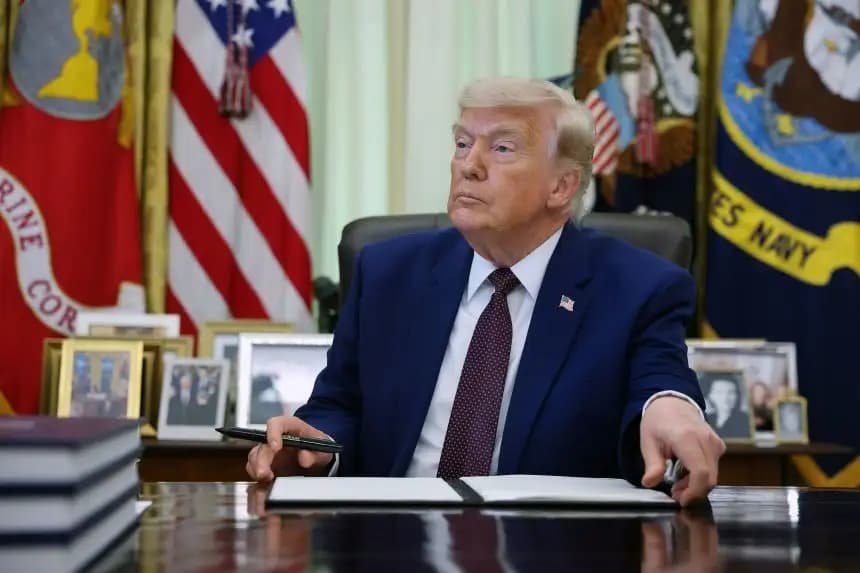
President Donald Trump signed an executive order Wednesday evening reclassifying approximately 8,000 of the most senior career civil servants in the federal government into a new employment category called Schedule Policy/Career — making them fireable at will, for any reason, with no civil service protections standing between them and a presidential decision to remove them.
The order targets workers at the GS-15 level — the highest pay grade in the career civil service — including economists, scientists, lawyers, engineers, intelligence analysts, and policy specialists who have spent careers building the institutional expertise that the federal government depends on to function. Nearly all of the 8,000 affected workers hold positions the administration describes as having significant policy influence. Critics describe it differently: these are the people who tell the president when his policies are not working.
What Schedule Policy/Career Does and Does Not Do
The executive order creates a new excepted service category — Schedule Policy/Career — that removes the civil service protections that have governed federal employment since the Civil Service Reform Act of 1978. Under those protections, career civil servants can only be dismissed for cause, after a documented process that includes notice, the right to respond, and access to appeal. The process is deliberately slow. That slowness is the point — it exists to insulate government experts from political pressure to reach conclusions that serve the administration rather than the facts.
Under Schedule Policy/Career, those protections are gone. The 8,000 affected workers can be dismissed for any reason or no reason, at any time, by department heads acting on the administration’s direction. The executive order does include language stating that employees in this category are not required to personally or politically support the current president, and are required only to faithfully implement administration policies. Critics noted immediately that the protection exists only in guidance — it is not statute, cannot be enforced by any independent body, and can be revoked by the same executive stroke that created it.
The order is the culmination of an effort Trump began in October 2020, when he signed an earlier version called Schedule F. President Biden revoked that order immediately upon taking office in January 2021. Trump reinstated it on January 20, 2025, his first day back in office. Wednesday’s order formalizes and expands the reclassification with a new name and a broader scope.
The Specific Firings That Show What the Order Will Be Used For
The civil service protection that Schedule Policy/Career removes is not theoretical. The administration’s record this term shows precisely what happens to federal employees who deliver unwelcome findings to the White House.
The head of the Defense Intelligence Agency was fired after the agency issued a preliminary assessment contradicting Trump’s claim that U.S. airstrikes had completely and totally obliterated Iran’s nuclear enrichment facilities. The finding — that the facilities were damaged but not destroyed — was accurate. The DIA director was removed for producing it.
The commissioner of the Bureau of Labor Statistics, a career economist who had worked in government for over two decades before being named to that role, was publicly ridiculed and then replaced by Trump after a disappointing jobs report. The jobs report contained the same data regardless of who ran the agency. The commissioner’s job was to produce accurate data. He was replaced for producing accurate data that was politically inconvenient.
Both of those individuals were political appointees or recent appointments who already lacked full civil service protection. The 8,000 workers now reclassified are career professionals who previously did have those protections. The question the order raises is whether economists, scientists, and analysts who now know they can be fired for delivering unwelcome findings will continue to deliver them — or whether the knowledge of that vulnerability will change what findings they produce and how they communicate them.
What Career Civil Servants and Government Experts Are Saying
The response from within and outside the federal government was immediate and specific. Democracy Forward, a legal advocacy organization, said the order would make it easier to purge experienced public servants and that when government experts can be fired without cause, it is not just federal workers who are harmed — it is the people across the country who rely on those essential services every day.
Ron Sanders, who served in Trump’s first term as chairman of the Federal Salary Council and resigned in protest over Schedule F in 2020, offered a more measured assessment this time. He said the new order’s guidance — that employees are not required to support the president politically, only to implement policies faithfully — addressed some of the concerns that drove his resignation. He added that civil servants are still going to be able to speak truth to power, while acknowledging immediately that this is more a hope than a fact, because it remains to be seen.
Donald Moynihan, a Princeton professor who studies public administration, put the concern precisely: if you were a career civil servant and there is bad news that you want to share with the president, you’re less likely to do so if you think the minute I share that bad news, I’m going to get fired. He said the DIA director and BLS commissioner examples were not abstract — they were real demonstrations of what happens when unwelcome truth reaches the White House.
| Schedule Policy/Career — Key Facts | Detail |
|---|---|
| Signed | June 3, 2026 |
| Workers affected | ~8,000 federal employees |
| Pay grade targeted | GS-15 (highest career civil service level) |
| Effect | At-will status — can be fired for any reason |
| Prior protection removed | Civil Service Reform Act 1978 protections |
| Prior order comparison | Schedule F (2020) — revoked by Biden 2021, reinstated Jan 20 2025 |
| Political support requirement | Order says not required — critics note unenforceable |
| DIA director example | Fired after contradicting Trump on Iran strike damage |
| BLS commissioner example | Replaced after disappointing jobs report |
| Legal challenges expected | Yes — multiple groups announced immediate litigation |
| Affected positions include | Economists, scientists, lawyers, intelligence analysts, engineers |
Legal Challenges Are Already Being Filed
Multiple civil service and legal advocacy organizations announced within hours of the signing that they were pursuing emergency legal action to block the order’s implementation. The primary legal theory in those challenges: that the executive order violates the Civil Service Reform Act of 1978, which is a statute — enacted by Congress — that the president cannot override through executive order alone.
Courts have addressed versions of this argument before, with mixed results. The Schedule F legal landscape in 2020 to 2021 produced several lower court rulings that limited the prior order’s scope before Biden revoked it. Whether the current federal judiciary — substantially reshaped by Trump appointees across both terms — will apply the same limits is the operative question that the litigation will answer.
The 8,000 workers affected by Wednesday’s order learned about their new employment status at approximately the same time the rest of the country did. Most of them did not know this was coming today. Most of them will go to work tomorrow and produce the same analysis, findings, and recommendations they produced yesterday. Whether that changes over time — as the reality of their new vulnerability becomes the context in which they do their work — is what no court ruling can fully address.