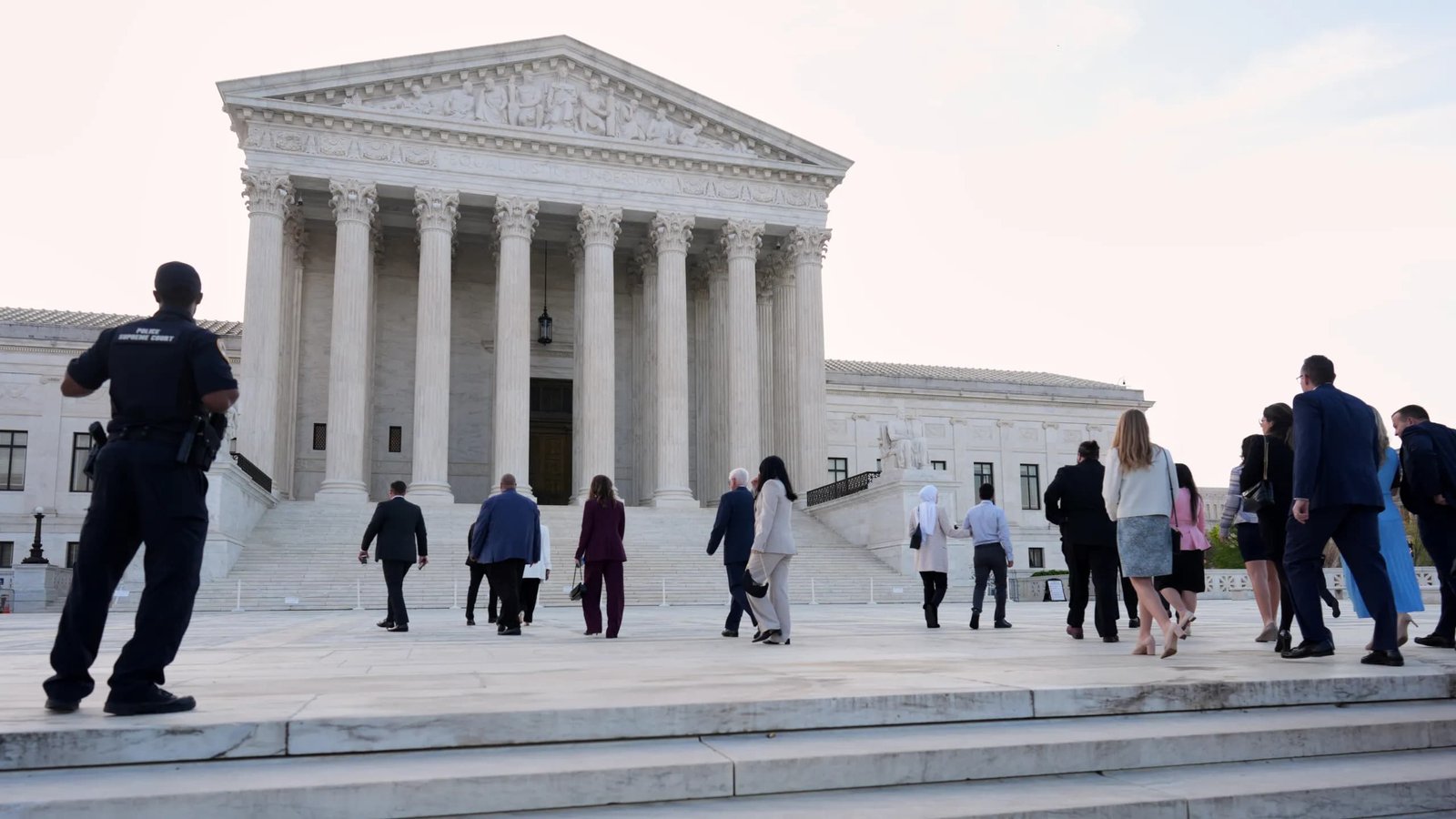

WASHINGTON, APRIL 29, 2026 —
The Supreme Court heard oral arguments Wednesday in two consolidated immigration cases that could give the Trump administration the authority to strip Temporary Protected Status from more than 350,000 Haitians and roughly 6,000 Syrians living and working lawfully in the United States — and potentially open the door to ending protections for more than a million people across seventeen nationalities if the administration prevails.
The cases, Mullin v. Doe and Trump v. Miot, turn on a single threshold question that the justices must answer before reaching the merits: whether federal courts have any authority to review the government’s decision to terminate TPS at all. If the answer is no — if the Supreme Court holds that such decisions are entirely insulated from judicial review — the practical consequence would be the largest single removal of legal immigration protections in American history, affecting people who have lived and worked in the United States legally for up to 16 years.
What TPS Is and How It Works
Congress enacted the TPS program in 1990. It gives the homeland security secretary the power to provide temporary, country-specific relief to foreign nationals who cannot safely return home because of war, natural disaster or other extraordinary and temporary conditions. Relief is limited to up to 18 months, but the secretary can extend it, and Congress placed no limit on how many times the protections can be renewed.
TPS does not work like most other immigration benefits. It applies only to people who have continuously lived in the US legally since the most recent designation for their country. To remain eligible, recipients must go through a vetting process that includes biometrics, a background check, and review against all government databases. Two misdemeanors and the protection ends. They must renew every 18 months and go through the entire vetting process again.
Haiti was designated for TPS for the first time by the Obama administration in 2010 following a devastating earthquake that affected roughly one-third of the country’s population of 9 million. The Biden administration extended Haiti’s TPS multiple times because of ongoing economic, health, and political crises, including the assassination of Haiti’s president in 2021.
Syria’s designation reflects the ongoing civil war and instability that has made return genuinely dangerous for years.
What the Trump Administration Argues
The Trump administration contends that under the 1990 TPS statute, none of the government’s judgments about TPS are subject to judicial review at all. As the administration put it in its briefs, the statute “covers the waterfront,” barring judicial review of all provisions of the law.
Specifically, then-Secretary of Homeland Security Kristi Noem terminated Haiti’s TPS status in response to a Trump executive order, citing two reasons: first, that there are no extraordinary conditions in Haiti that prevent Haitians from returning home safely, and second, that even if Haiti were unsafe, termination is still required because continuation is “contrary to the national interest.” Noem made similar findings for Syria, citing problems with vetting Syrian nationals.
Twenty-one Republican attorneys general are supporting the administration. Kansas Attorney General Kris Kobach argued that “temporary protected status was never intended to be a de facto amnesty. That status, as its name suggests, is temporary.
The administration’s broader position is that immigration decisions, particularly those involving national security assessments, are constitutionally committed to executive branch authority and that courts have historically been highly deferential to executive judgment on immigration. The Supreme Court’s conservative majority has largely followed that approach in prior cases during Trump’s second term.
What the Challengers Argue
Lawyers for the Haitians and Syrians counter that the provision barring court review applies only to one section of the TPS law, not the rest, and that the Trump administration has failed to comply with the procedures mandated in the TPS program and the Administrative Procedure Act — the 80-year-old law that sets the rules for how federal agencies develop, issue, and enforce regulations.
The lower court record is damaging for the government. US District Judge Ana Reyes found there was sufficient evidence that Noem’s decision to terminate TPS for Haiti was motivated in part by “anti-Black and anti-Haitian” animus, citing derogatory statements about Haiti from Trump including his comment calling Haiti a “s**thole country” and his amplification of a conspiracy theory that Haitian immigrants in Springfield, Ohio, were eating residents’ pets. A separate federal judge ruled that Noem had “endeavored to terminate TPS status whenever presented with an opportunity to do so,” producing decisions grounded not in law or fact “but in political considerations simply not relevant under the TPS statute.
The Stakes Beyond Haiti and Syria
The administration has already terminated or announced its intent to terminate TPS for more than one million individuals across seventeen nationalities. For now, courts have blocked some of those terminations from taking effect. A ruling in the government’s favor would remove judicial oversight as a check on those decisions — meaning future terminations could proceed immediately regardless of conditions on the ground.
Haitian TPS holders contribute approximately $6 billion annually to the US economy, while Syrian TPS holders contribute an additional $100 million. The people affected are not recent arrivals living in limbo — they are, in many cases, long-term residents with American-born children, mortgages, businesses, and careers built over more than a decade of legal status.
The Supreme Court last year allowed the administration to revoke TPS protections for hundreds of thousands of migrants from Venezuela, putting them at risk of removal, without ruling on the broader legality of the approach. Wednesday’s arguments go further — the justices must now decide the constitutional question directly.
A ruling is expected before the court’s term ends in late June. The decision will determine not only the fate of the Haitian and Syrian communities currently protected, but the future of every TPS designation in the country.