
WASHINGTON / LONDON / DOHA, May 10, 2026 —
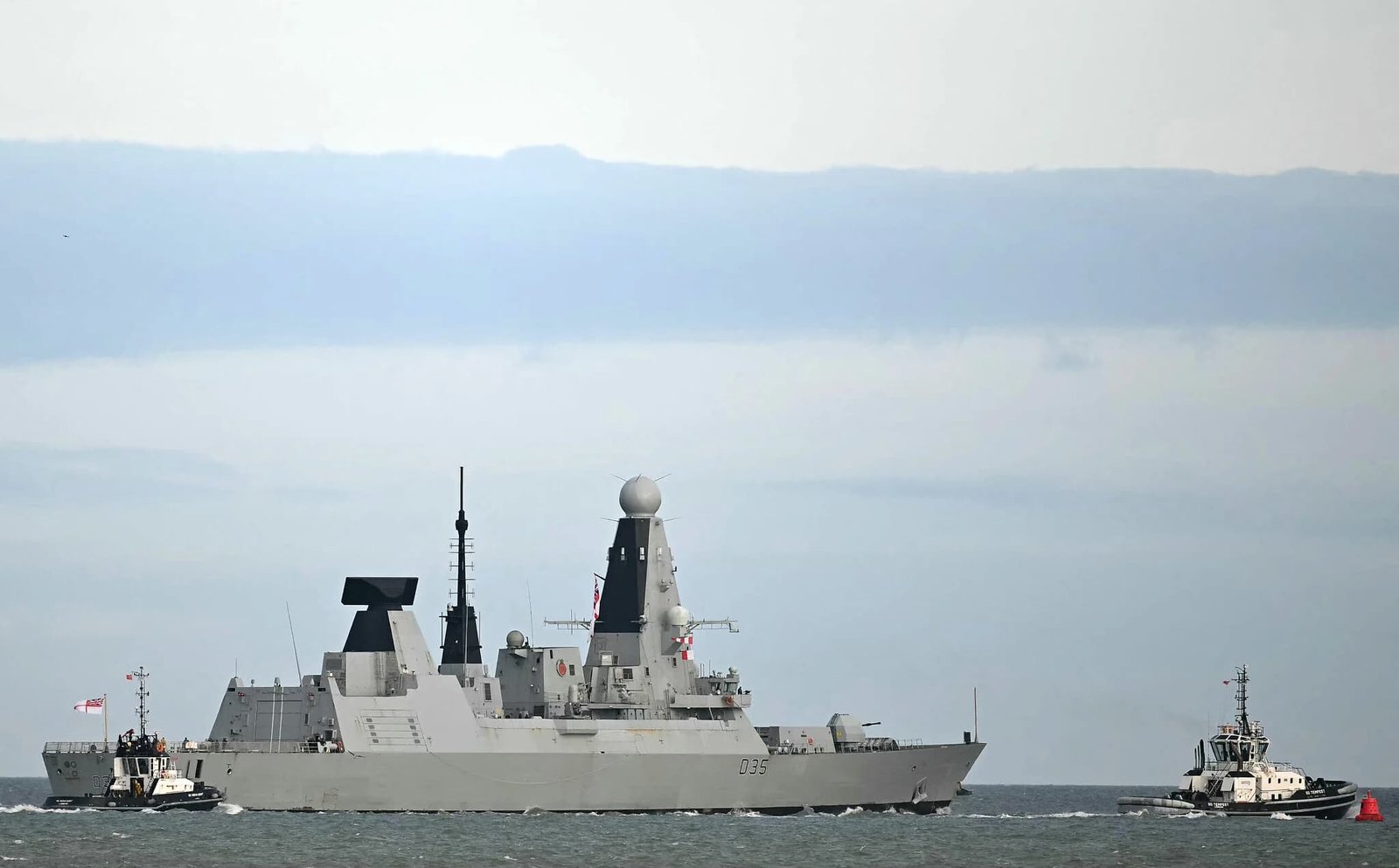
The United Kingdom deployed the Royal Navy warship HMS Dragon toward the Middle East on Saturday as part of a 40-nation coalition building the infrastructure to reopen the Strait of Hormuz the moment a deal between the United States and Iran is signed. Qatar’s Prime Minister Sheikh Mohammed bin Abdulrahman Al-Thani flew from Miami to Washington for private meetings with Secretary of State Marco Rubio, special envoy Steve Witkoff, and Vice President JD Vance — with sources telling multiple outlets that the Vance meeting was conducted one-on-one, no aides present. Iran threatened a “heavy assault” on U.S. assets in the Middle East if its tankers face further attacks. U.S. Central Command confirmed it has turned back 58 commercial vessels attempting to enter or exit Iranian ports since the blockade began.
The ceasefire is 27 days old. It has never been more militarily active.
What HMS Dragon Is Actually Doing — and What It Signals
HMS Dragon — a Type 45 destroyer equipped with the Sea Viper air defense missile system — departed Portsmouth on March 10 and is now being pre-positioned in the Middle East ahead of a potential mission to secure the Strait of Hormuz. The UK Ministry of Defense was explicit that the deployment is defensive and preparatory. The ship’s mission is not to force the Strait open. It is to be ready to protect commercial shipping the moment conditions allow transit to resume.
The distinction matters because it describes the diplomatic sequence both Britain and France are operating on: the deal happens through diplomacy, the Strait opens through agreement, and the multinational coalition provides the security guarantee that makes commercial operators and insurance underwriters willing to send their ships back through. HMS Dragon is not a trigger for reopening the Strait. It is the protection that follows a deal.
France’s aircraft carrier Charles de Gaulle is already positioned in the southern Red Sea for the same purpose. The UK and France are jointly leading the coalition, which now involves more than 40 nations. The scale and the joint leadership represent the broadest multinational naval coordination effort since the first Gulf War’s Coalition forces in 1991.
The Qatar Meeting — Why Vance Met Alone
Qatar’s Prime Minister flew to Miami — where Trump spent part of the week — and met with the White House team before traveling to Washington Saturday. The sequence of meetings is significant. He met Rubio. He met Witkoff. Then he met Vance — alone, one-on-one, no aides present.
Qatar has served as a back-channel intermediary in multiple U.S.-Iran negotiations over the past decade. Doha hosts the largest U.S. military installation in the Middle East — Al Udeid Air Base, which has served as a command hub for operations throughout the Iran war. Qatar also has direct diplomatic relationships with Iran’s leadership that most Western nations lack.
The private Vance meeting suggests the conversation involved either information Qatar was not willing to share in the presence of a larger audience, or a specific proposal — from Iran, through Qatar — that required the most senior possible American interlocutor to hear directly. A foreign prime minister does not conduct a private one-on-one with a U.S. vice president unless both parties believe the conversation is worth the political capital of that level of engagement.
Neither Qatar’s government nor the White House has described the contents of the Vance meeting.
Iran’s Military Posture — Still Threatening, Still Talking
| Iran War Military Status — May 10 | Detail |
|---|---|
| Ships turned back by US Navy blockade | 58 confirmed |
| Vessels disabled by blockade enforcement | 4 confirmed |
| Iran’s latest threat | “Heavy assault” on US Middle East assets if tankers attacked |
| Hezbollah attacks Friday | 26 claimed — 2 inside Israel for first time since Lebanon ceasefire |
| Israeli reservist injured | 1 — severely — from Hezbollah drone Friday |
| HMS Dragon | Pre-positioned — 40-nation coalition |
| Charles de Gaulle | Southern Red Sea — pre-positioned |
| Minesweeping coalition readiness | 40+ nations — awaiting deal |
| Iranian electricity/gas rationing | Confirmed — blockade disrupting energy supplies |
Iran’s threat of a “heavy assault” on U.S. assets in the Middle East arrived alongside confirmation that Iranian officials are asking their population to consume less electricity and gas — a signal that the blockade is producing real domestic economic pressure inside Iran. The two data points together describe a country that is militarily defiant in its public rhetoric while economically strained in its private conditions. That combination is the pressure structure the U.S. negotiating strategy was designed to create.
Global Food Prices — The War’s Reach Beyond Oil
The United Nations Food and Agriculture Organization released data Friday showing global food prices rose in April for the third consecutive month — driven by the Iran war’s disruption of fertilizer shipping through the Strait of Hormuz and the energy cost increases that flow through to agricultural production costs globally.
The FAO’s chief economist said global cereal supplies are expected to hold through 2026 with production forecast to rise 6% year-on-year. But the FAO simultaneously warned that next year’s wheat output faces uncertainty as energy and fertilizer costs — tied directly to the Strait’s closure — drive up production costs for farmers across the major grain-producing regions. The warning describes a food security risk that is building slowly and may not fully materialize until 2027 — by which point the Iran war may be resolved, or may not.
The Iran war’s economic bill includes gasoline at $4.46 a gallon, Spirit Airlines shut down, consumer sentiment at a 70-year low, and now a third consecutive monthly increase in global food prices. Every day the Strait remains effectively closed, that bill increases. The 40-nation coalition assembling outside the Strait is not just a military readiness exercise. It is an expression of how many countries’ economies are waiting for the same diplomatic event.