
WASHINGTON / STRAIT OF HORMUZ, May 5, 2026 —
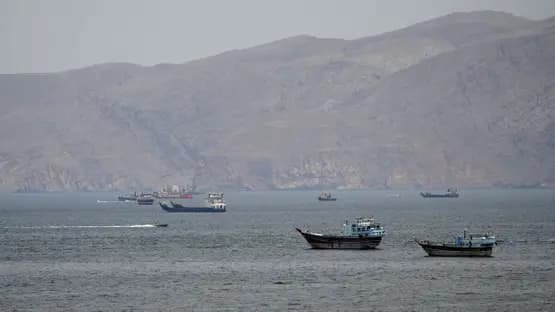
The first direct military exchange between U.S. and Iranian forces since Trump’s ceasefire declaration occurred Monday in the Strait of Hormuz, as American naval vessels escorting commercial ships under “Project Freedom” — the operation Trump announced Sunday — came under fire from Iranian fast-attack boats. A South Korean vessel was struck during the confrontation. Iran simultaneously launched missiles and drones at the port of Fujairah in the United Arab Emirates, hitting a major oil facility just beyond the Strait’s eastern mouth. U.S. gasoline prices hit $4.46 a gallon — the highest level in nearly four years.
Trump had declared Iran hostilities “terminated” last Friday. By Monday morning, both sides were shooting at each other.
What Happened in the Strait on Monday
Trump launched Project Freedom on Monday morning, directing the U.S. Navy to escort commercial vessels through the Strait of Hormuz. The operation was announced without Iranian coordination confirmed. Iran had not publicly agreed to allow U.S.-escorted ships to pass without incident.
Within hours of the first convoy moving through the Strait, Iranian fast-attack craft — the same IRGC Navy vessels Trump had ordered the military to shoot on sight in late April — approached the escorted ships. Gunfire was exchanged. A South Korean commercial vessel was struck, with the extent of damage and crew injuries not immediately confirmed by either government. U.S. Central Command said its forces “responded appropriately to hostile action.”
The UAE government confirmed that Iran fired missiles and drones at the port of Fujairah — a major oil export terminal located on the Gulf of Oman, just east of the Strait’s narrowest point, technically outside the Strait itself. The attack on Fujairah is the most significant strike on UAE territory since the Iran war began and represents a geographic escalation — Iran extending its targeting beyond the Strait corridor itself.
The Fake Warning That Added to the Chaos
The confrontation was preceded by a fake social media post that temporarily sent markets and shipping companies into a panic. An account on X purporting to belong to Iran’s army chief posted a warning that U.S. aircraft carriers approaching the Strait would be met with force — claiming “every inch of these waters is within the range of our will” and that cruise missiles and drones had been deployed. Iran’s semi-official Fars News Agency, linked to several Iranian military branches, subsequently confirmed the post came from a fake account impersonating the general.
The fake post was live for approximately 40 minutes before being identified as fraudulent. During that window, oil futures spiked 3.7%.
The Market and Economic Consequences
| Indicator | Level | Change |
|---|---|---|
| US gasoline price | $4.46/gallon | New high — highest since July 2022 |
| Brent crude | ~$122/barrel | Reversed previous day’s drop |
| Oil futures (June) | Surging | Fake post + real exchange triggered reversal |
| Fujairah port status | Damaged — operational status unclear | First UAE territory struck in war |
| Insurance rates for Hormuz transit | Surging | NorthStandard and Lloyd’s re-pricing |
| Goldman Sachs updated forecast | Pending | $85 target suspended indefinitely |
The $4.46 gasoline reading erases the brief optimism that followed Sunday’s Rubio-Araghchi phone call and the Project Freedom announcement. Every cent of the drop in pump prices that followed those announcements reversed Monday morning and then some. One oil market expert told CNN that pump prices could reach $5 a gallon if the Strait remains effectively closed — a level not seen since the summer of 2022 and one that would represent a politically catastrophic development for the administration six months before the midterm elections.
Trump’s Response — Approval at 32% on the War
Trump, speaking at a White House small business summit Monday, did not directly address the gunfire exchange or the Fujairah attack. He did address his approval numbers. “They give me fake polls,” he told the audience. “They did a poll on the war with Iran, and they said only 32% of people like it. Well I don’t like it and I don’t like war at all, but we’re equipped better and we have the greatest military in the world.”
The 32% approval for the war — down from 39% overall presidential approval reported last week — reflects public opinion data showing that the economic consequences of the conflict have overtaken its initial patriotic support. A war that opened with a rally-around-the-flag bump is now underwater by more than 2 to 1 among American adults, with $4.46 gasoline as the most visible daily reminder of its cost.
What Iran’s Foreign Minister Said — and the Ceasefire Review Date
Araghchi, appearing in public comments Monday, warned the United States and UAE against being drawn into what he called a “quagmire,” saying recent events in the Strait make clear there is no military solution to a political crisis. The comment is the first from Iran’s foreign minister since Sunday’s call with Rubio — and it suggests that whatever preliminary framework emerged from that conversation has not prevented the military escalation on the ground.
Iran’s foreign ministry simultaneously announced a ceasefire review date: May 8, 2026 — Friday. That date was described as the moment when “the current situation will be reassessed” to determine whether to extend the ceasefire period. The announcement implies Iran is treating the ceasefire as still technically in force even as its forces exchanged fire with U.S. naval vessels. The same logic that produced Trump’s “terminated” declaration while the blockade remained active is now producing Iran’s ceasefire claim while its fast-attack boats fire on escorted convoys.
Friday’s review will be the most consequential diplomatic moment since the war began.