
WASHINGTON / RIO DE JANEIRO, May 7, 2026 —
Key Takeaways
- A new study published in a peer-reviewed journal proposes a round-trip Earth-to-Mars mission that could be completed in just 153 days — roughly five months — using a rare 2031 orbital alignment involving near-Earth asteroid 2001 CA21 as a gravitational stepping stone.
- Current Mars mission architectures require two to three years for a round trip due to the planets’ orbital mechanics. The proposed trajectory slashes that timeline by more than 80% — potentially transforming Mars from a destination requiring multi-year crew isolation into one comparable to a long-haul Antarctic expedition.
- The mission would launch on April 20, 2031, arrive at Mars by May 23, spend approximately 30 days on the surface, depart on June 22, and return to Earth by September 20 — a schedule so specific that the researcher describes it as “not flexible,” because the orbital window opens once and closes permanently.
The Idea That Started With a Miscalculation
Marcelo de Oliveira Souza, a cosmologist at the State University of Northern Rio de Janeiro in Brazil, was not looking for a fast route to Mars. He was studying near-Earth asteroids in 2015 when one object caught his attention: 2001 CA21, a rocky body following an unusual path that crossed both Earth’s and Mars’ orbital zones.
Early estimates suggested the asteroid followed a trajectory that, during the October 2020 opposition — when Earth and Mars were aligned on the same side of the sun and closest together in their orbits — hinted at the possibility of ultra-short travel routes between the two planets. “This was a surprise for me — I was not looking for this,” Souza told Live Science.
Later measurements refined 2001 CA21’s actual trajectory, revealing that the 2020 window was not usable. But the geometry had revealed something more valuable: a methodology. By applying a standard technique called Lambert analysis — which calculates paths between two points in space — and constraining those paths to remain within about 5 degrees of the asteroid’s orbital tilt, Souza could identify specific windows when the alignment made ultra-short Mars missions feasible using near-term rocket technology.
Only one window emerged from that analysis. The 2031 alignment.
How the Mission Would Actually Work
The proposed trajectory is not a standard Hohmann transfer — the slow, fuel-efficient elliptical path that conventional Mars missions use and that requires crews to spend six to nine months in transit each way. It is a fast-transit trajectory that trades fuel efficiency for speed, launching at approximately 27 kilometers per second — nearly three times the speed of conventional Mars transfer vehicles.
| Mission Phase | Date | Duration |
|---|---|---|
| Earth departure | April 20, 2031 | — |
| Transit to Mars | April 20 – May 23 | 33 days |
| Mars surface operations | May 23 – June 22 | 30 days |
| Mars departure | June 22 | — |
| Return transit to Earth | June 22 – September 20 | 90 days |
| Total mission duration | 153 days | ~5 months |
A lower-energy alternative within the same 2031 window would extend the mission to approximately 226 days — still dramatically shorter than any conventional architecture — by launching at about 16.5 kilometers per second rather than 27. The tradeoff is time: a slightly longer transit in exchange for a vehicle that requires less propulsion capacity.
“Maybe this can change the idea that we need more than two years to go to Mars and return,” Souza said.
Why Duration Is the Central Problem in Human Mars Exploration
The 153-day figure matters because duration is the variable that makes human Mars exploration most dangerous — and most expensive. Every additional day a crew spends in deep space increases their cumulative radiation exposure beyond Earth’s protective magnetosphere. It increases the probability of a medical emergency in an environment where no evacuation is possible. It increases the psychological toll of isolation and confinement that mission planners identify as one of the most significant risks in long-duration spaceflight. It increases the mass of consumables — food, water, oxygen — that must be launched from Earth or produced in transit.
NASA’s current Design Reference Architecture for a human Mars mission assumes a surface stay of 500 days — necessary because crews must wait for the planets to realign in a favorable position for the return trip under conventional trajectory designs. Total mission duration in that architecture runs approximately 900 days. The crew spends more than two years away from Earth, absorbs radiation equivalent to approximately 300 chest X-rays, and faces physiological deconditioning from prolonged microgravity that requires months of rehabilitation on return.
A 153-day mission changes nearly every one of those parameters. Radiation exposure drops proportionally. The medical risk window narrows dramatically. The consumables mass requirement falls by more than 80%. The psychological profile of the mission shifts from an extended isolation experiment to something closer to a challenging but manageable expedition.
Can Current Rocket Technology Actually Do This?
The short answer is: possibly, if development continues on its current trajectory. The 27 kilometers per second departure velocity required for the 153-day mission is ambitious but not fantastical. SpaceX’s Starship is designed for deep-space missions and is intended to achieve departure velocities in this range with full propellant loading. NASA’s Space Launch System — which powered the Artemis II lunar mission in April 2026 — is capable of Trans-Mars Injection burns that approach the required performance with upper stage additions.
The study does not specify a particular rocket. It specifies an orbital geometry and a departure velocity. Whether any rocket system operational in 2031 can deliver a crewed vehicle at 27 kilometers per second to a precise interplanetary trajectory depends on development programs that are still in progress. What the study establishes is that the physics supports the mission timeline. Whether the engineering can match the physics is the question that the next five years of space development will answer.
The 2031 window does not recur. It is a consequence of a specific asteroid orbital configuration that will not repeat in any similar form for decades. For the space agencies and private companies now deciding which missions to prioritize between 2026 and 2031, the study represents a specific, time-bounded case for accelerating human Mars capability on a schedule that most had not considered seriously.
What 30 Days on Mars Could Actually Accomplish
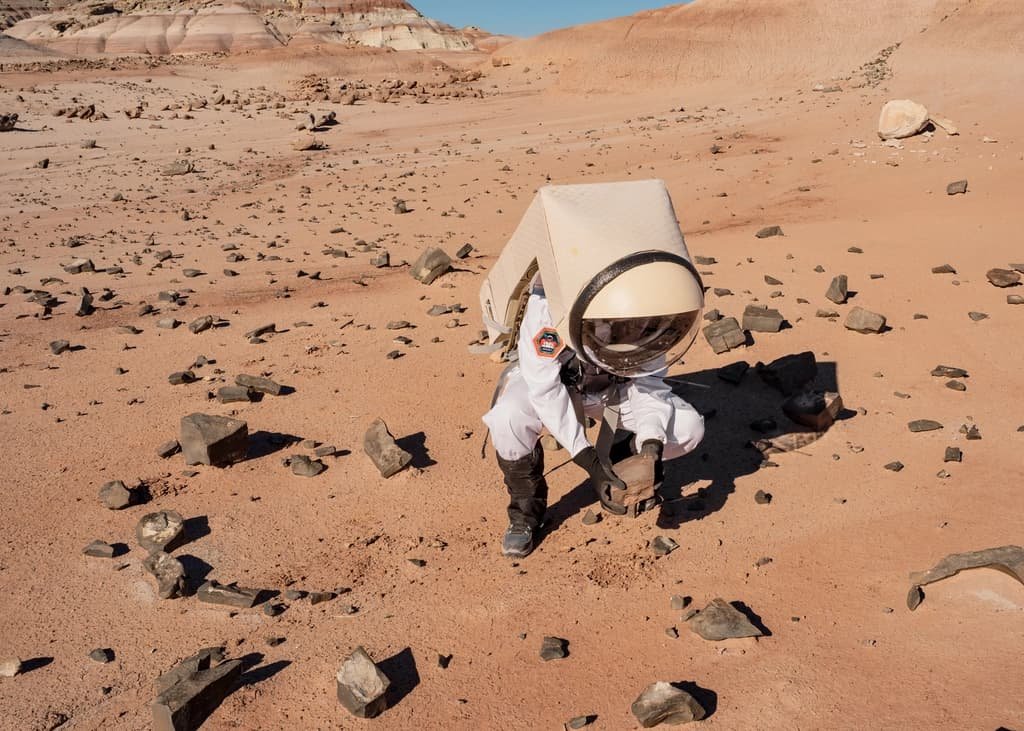
Surface time is the metric that determines scientific return. Current robotic missions — Perseverance, Curiosity — have operated on Mars for years and have covered distances measured in kilometers rather than hundreds of kilometers. A human crew with 30 days on the surface and mobile transportation could cover ground in a month that a rover takes years to traverse.
The scientific objectives that most directly benefit from human presence — sample collection across diverse geological contexts, drilling to depths that robotic arms cannot reach, real-time decision-making in response to unexpected findings — all compress dramatically when the explorer can see, touch, and improvise. A geologist who encounters an unexpected rock formation can deviate from the planned route, collect a sample, and make a judgment call that a robotic system transmitting commands at light-speed delay cannot.
Thirty days is not enough to establish permanent infrastructure or begin sustained resource extraction. It is enough to conduct the kind of reconnaissance mission that transforms our understanding of a planet from orbital and robotic data to direct human observation — the same transformation that occurred when Apollo astronauts stepped onto the lunar surface and brought back 842 pounds of samples that reshaped planetary science.
The 2031 window may be the closest humanity comes to that moment on Mars within the lifetime of most people alive today.