
WASHINGTON, April 25, 2026 —
Key Takeaways
- NASA’s Artemis II mission launched April 1, 2026 — carrying four astronauts around the moon and back in a nearly 10-day mission, the farthest humans have traveled from Earth since Apollo 17 in December 1972. The crew splashed down safely in the Pacific Ocean.
- Three weeks after splashdown, the Trump administration proposed cutting NASA’s total budget by $5.6 billion — 23% for fiscal year 2027, including a 47% cut to the science budget, the deepest proposed reduction in the agency’s history.
- A bipartisan coalition of 113 House members signed a letter condemning the cuts, and the Republican chairman of the House Science Committee — whose district includes NASA Mission Control — told the administration’s own NASA chief: “I simply do not believe this budget is capable of supporting what President Trump himself has directed NASA to accomplish.”
The Mission That Made History — and the Images That Proved It
On April 1, a Space Launch System rocket lifted off from Launch Complex 39B at Kennedy Space Center in Florida. Over the next ten days, four NASA astronauts flew farther from Earth than any humans since the final Apollo mission in 1972 — executing a lunar flyby that arced around the far side of the moon before returning home.
During the flyby on April 6, the crew photographed approximately 35 geological targets on the lunar far side — terrain never previously observed by human eyes from that vantage point. One photograph released publicly showed the moon backlit by the sun during a solar eclipse, with Earth visible at the lunar horizon, Saturn and Mars bright against the deep background, and the Orion spacecraft’s solar array wing visible in the foreground. NASA described it as one of the most scientifically and visually significant images in the history of human spaceflight.
The crew splashed down in the Pacific off California, completing a mission designed as the critical precursor to Artemis III — the planned lunar landing scheduled for 2028 that would put American boots on the moon for the first time in 56 years.
Two Days After Launch, the White House Released This
| NASA Budget Category | FY2026 Enacted | FY2027 Proposed | Change |
|---|---|---|---|
| Total NASA budget | $24.4 billion | $18.8 billion | -$5.6B (-23%) |
| Science programs | ~$7.3 billion | ~$3.9 billion | -$3.4B (-47%) |
| Artemis / lunar exploration | Funded | +$731M increase | ✅ Increased |
| Mars Sample Return mission | Active | Cancelled | ❌ Eliminated |
| Space Launch System rocket | Active | Phased out after 3 flights | ❌ Phased out |
| Gateway lunar space station | Active | Cancelled | ❌ Eliminated |
| Heliophysics research | Active | Deep cuts | ❌ Reduced |
| Climate research programs | Active | Deep cuts | ❌ Reduced |
The administration’s case for cutting the SLS rocket rests on cost. At $4 billion per launch and 140 percent over its original budget, the program is genuinely expensive by any measure. The White House proposes replacing it with commercial rockets — primarily SpaceX vehicles — which can lift comparable payloads at a fraction of the cost. On that narrow argument, the math is defensible.
The science cuts are harder to defend on any terms. Heliophysics research — the study of solar radiation and how it affects the human body in deep space — is not a discretionary program. It is the research that tells NASA’s mission planners how much radiation an Artemis III crew will absorb on a lunar surface mission and how to protect them. Cutting it to fund the lunar landing it supports is, as one congressional science advisor described it privately, like canceling driver’s education to pay for a new car.
The Republican Chairman of NASA’s Home Committee Said No
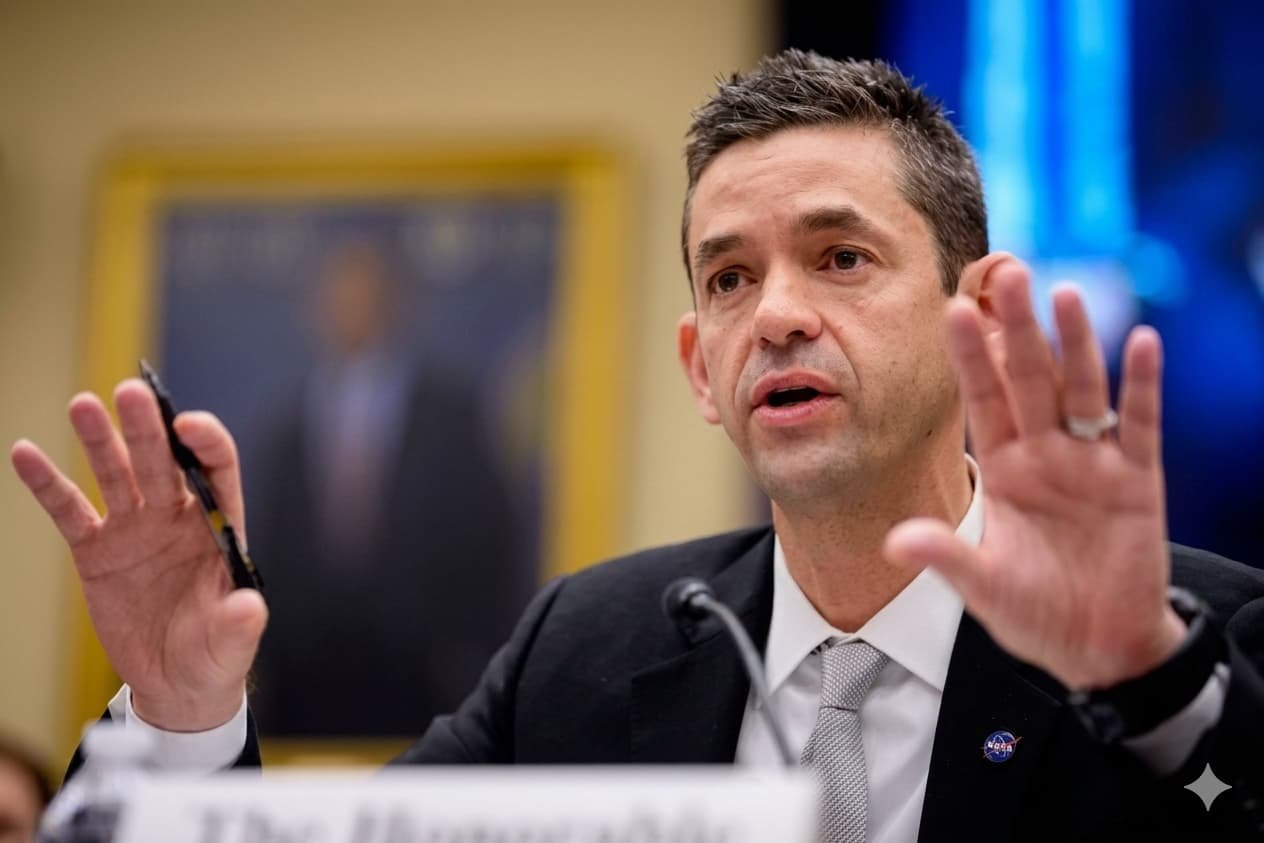
NASA Administrator Jared Isaacman testified before the House Committee on Science, Space, and Technology on April 22. Isaacman — a billionaire entrepreneur and private astronaut turned federal agency chief — arrived prepared to defend parts of the proposal. He did not get far before the room pushed back.
Committee Chairman Brian Babin, a Republican whose Texas congressional district includes NASA’s Johnson Space Center and Mission Control, was direct. “I simply do not believe that this budget proposal is capable of supporting what President Trump himself has directed the agency to accomplish over the course of his two terms, nor what Congress has directed by law,” Babin said.
Ranking member Zoe Lofgren, a California Democrat, sharpened the critique further. “Cuts totaling $5.6 billion, or 23 percent from the fiscal year 2026 enacted level, are not wise,” she told Isaacman. “Slashing space and Earth science, aeronautics, and space technology while our society increasingly depends on space assets — that’s just not a winning strategy.”
Senator Ted Cruz, at a separate NASA event, framed the geopolitical stakes more bluntly: “I don’t want to wake up one day and look up at the moon and realize the Chinese have beat us there.”
The Programs Being Cancelled Are the Ones That Make the Missions Work
The cuts proposed for fiscal year 2027 include the elimination of programs that operate as infrastructure for the human spaceflight missions being simultaneously funded. The Mars Sample Return mission — designed to retrieve geological specimens from the Martian surface and return them to Earth — has been cancelled for a second consecutive budget cycle. The Advanced X-ray Imaging Satellite, a mission designed to study black holes, was effectively killed when the team meant to work on it was dispersed during last year’s budget uncertainty before Congress could restore its funding. The Electrified Powertrain Flight Demonstration project was dismantled and only partially revived after Congress intervened.
Each of these programs represents years of scientific planning, contracted workforce, and international partnerships. When they are disrupted — even temporarily — the damage is not simply financial. Teams dissolve. Institutional knowledge walks out the door. Instruments sitting in cleanrooms waiting for launch windows miss them. The uncertainty built into a budget that is re-litigated every twelve months is, as one space policy expert put it this week, “inefficient almost by design.”
Congress Has Blocked These Cuts Before. It Will Try Again.
This is not the first time the administration has proposed deep cuts to NASA and the first time Congress has pushed back. Last year, the White House proposed a 25 percent cut to NASA’s budget for fiscal year 2026. Congress rejected the proposal and funded the agency at $24.4 billion — essentially flat to the prior year. Congress also added nearly $10 billion in human spaceflight funding through the One Big Beautiful Bill Act, covering Artemis IV, Artemis V, the Mars Telecommunications Orbiter, and International Space Station operations.
The 113-member bipartisan letter already submitted against the fiscal year 2027 proposal signals that the same dynamic is likely to play out again. NASA has unusually broad congressional support because its facilities, contractors, and workforce are distributed across dozens of states and congressional districts — making deep cuts politically costly regardless of party.
Whether that support translates into full funding restoration, partial cuts, or another year-long standoff will depend on how the broader appropriations process unfolds heading into November’s midterm elections. What is not in dispute is that the Artemis III crew scheduled to land on the moon in 2028 will need the science, the suits, the landers, and the radiation research to do it safely. Most of that work happens in the budget lines currently marked for elimination.