
TEHRAN / WASHINGTON, June 11, 2026 —
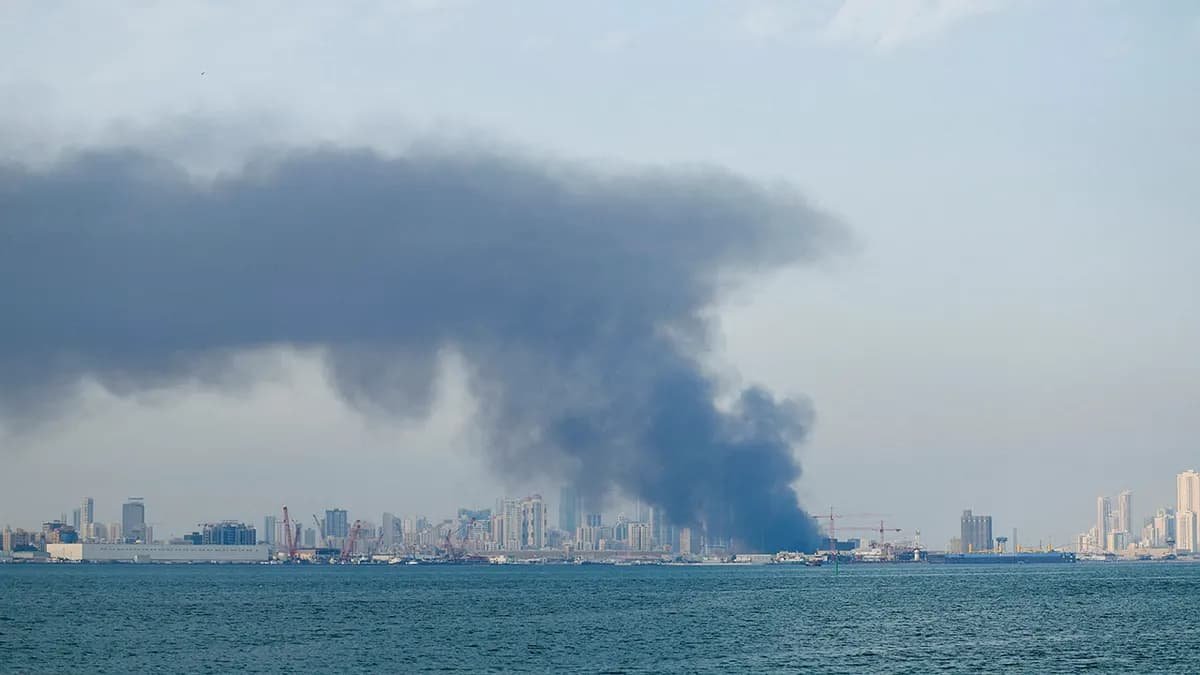
Iran’s Foreign Ministry issued a formal statement Thursday morning declaring that overnight American strikes had effectively rendered the April 8 ceasefire meaningless — the most explicit official acknowledgment yet that the diplomatic framework which had governed the conflict for 64 days is gone. The statement came as smoke was still rising over Karaj, a city northwest of Tehran, where Iranian news agencies reported explosions in multiple locations during the Wednesday night strikes.
A US official told ABC News that initial assessments indicated the United States intercepted nearly all missiles and drones launched by Iran in response — an assessment described as ongoing and not yet final.
What the USS Michael Murphy Did
The operational picture of Wednesday’s US strikes came into clearer focus Thursday morning. The USS Michael Murphy — a guided missile destroyer assigned to the US Fifth Fleet — launched Tomahawk cruise missiles as part of the CENTCOM operation that ran from 5:15 p.m. to 9 p.m. ET Wednesday. A US Navy video of the launch was released by CENTCOM alongside its operational announcement.
The Tomahawk strikes expanded the reach and precision of the operation beyond the close-air-support and fighter-launched munitions that characterized most earlier strike packages. Tomahawks are land-attack cruise missiles with ranges exceeding 1,000 miles that can be programmed to navigate terrain and strike hardened targets. Their use confirms that Wednesday’s operation was not a patrol-level self-defense response but a deliberate campaign-scale strike targeting Iranian military infrastructure.
CENTCOM specified the target set: ammunition depots, command-and-control nodes, and warehouses. Those categories of target represent Iran’s ability to sustain ongoing military operations — to supply proxies, to maintain air defense systems, and to plan and execute future strikes. The targeting logic is attrition, not just retaliation.
Explosions were reported in Bandar Abbas — the port city directly on the Strait of Hormuz that serves as the primary hub of Iran’s southern naval and commercial operations — as well as in Karaj, which sits in the Tehran metropolitan area approximately 40 kilometers northwest of the capital. Karaj’s inclusion in the strike pattern represents a geographic expansion toward Iran’s population and industrial center that previous strike packages had largely avoided.
Iran’s Declaration — and What It Means Diplomatically
Iran’s Foreign Ministry statement on Thursday was direct in its language in ways that diplomatic communications rarely are. The ministry condemned the strikes as a flagrant violation of international law and stated that the US administration would bear responsibility for the extremely dangerous consequences resulting from any escalation. The statement, published by the official Islamic Republic News Agency, specifically characterized the attacks as having effectively rendered the April 8 ceasefire meaningless.
That phrase — effectively rendered the April 8 ceasefire meaningless — is not a legal nullification. Iran has not formally declared war or announced a full resumption of the conflict’s opening phase. But it is a statement by the Iranian government’s official foreign policy voice that the framework which both sides had been nominally operating under no longer governs their behavior. The practical implication is that Iran is not constrained by ceasefire obligations in its future military actions.
Iran’s IRGC-affiliated Khatam al-Anbiya Air Defense headquarters vowed that further devastating and more wide-ranging strikes would follow if the US continued its attacks. The Quds Force — the IRGC’s expeditionary unit that coordinates proxy operations across the region — issued a separate statement warning of a new security arrangement that would cover a broader theater than previous operations.
What the US Intercepted — and What Got Through
A US official’s statement to ABC News that the United States intercepted nearly all of Iran’s Wednesday night missiles and drones is notable for what it acknowledges as well as what it claims. Nearly all means not all. The ongoing assessment language suggests that battle damage review is still being conducted. Iran’s claims of successfully targeting the US Fifth Fleet in Bahrain and a US base in Jordan — claims that CENTCOM has denied — remain disputed.
Jordan confirmed it intercepted and shot down five Iranian ballistic missiles launched from Iran toward Jordanian territory on Wednesday night, independently confirming that missiles reached Jordanian airspace even if they were intercepted before impact. Jordan’s air defense activation is the first use of Jordanian national air defense capabilities against Iranian missiles in the conflict’s history — a significant operational and political marker for a country that has maintained official neutrality.
The pattern of Iranian strikes — targeting Bahrain, Jordan, Kuwait — suggests that Tehran’s strategy is to expand the geographic cost of continued American military action by drawing US Gulf allies into direct exposure. The more allies that absorb Iranian strikes, the more difficult Washington’s coalition management becomes.
| Iran War — June 11 Morning Assessment | Detail |
|---|---|
| Iran Foreign Ministry statement | Ceasefire “effectively rendered meaningless” |
| USS Michael Murphy role | Launched Tomahawk cruise missiles June 10 |
| Targets | Ammo depots, C2 nodes, warehouses |
| Iranian cities with explosions reported | Bandar Abbas, Karaj (near Tehran) |
| US interception assessment | “Nearly all” Iranian missiles and drones |
| Iran’s stated future posture | “Devastating and wider strikes” to follow |
| Jordan role | Intercepted 5 Iranian missiles — first use of national air defense in conflict |
| Iran formal ceasefire status | Declared “meaningless” — not formally nullified |
| Strait of Hormuz status | Still closed — CENTCOM denies Iran’s closure claim |
| War day count | Day 103 |
| April 8 ceasefire framework | Functionally abandoned by both parties |
The IAEA Nuclear Signal That Is Now Buried Under the Smoke
One week ago, IAEA Director General Rafael Grossi indicated publicly that the United States and Iran appeared close to agreeing on a nuclear framework — a signal that carried weight because Grossi had previously been among the most skeptical voices about incomplete deal structures. That signal was the most hopeful public statement about the conflict’s potential resolution in weeks.
It is now buried under Wednesday night’s Tomahawk launches, Thursday morning’s formal ceasefire nullification, and the geometry of an expanding military exchange that has now placed Iranian missiles over Jordanian airspace. The diplomatic track and the military track have been running simultaneously for months. As of Thursday morning, the military track is running so loudly that the diplomatic track cannot be heard.
Grossi’s signal has not been withdrawn. Iran’s Foreign Minister Araghchi noted in a post Wednesday that the US bears responsibility for the escalation, implying that Iran’s door to diplomacy remains technically available. Whether the door that is technically available is the same door through which any framework agreement could actually be walked in the current operational environment is the question that the coming days will determine.