
WASHINGTON, June 12, 2026 —
Key Takeaways:
- The Federal Reserve’s June 16-17 FOMC meeting — Kevin Warsh’s first as chair — will almost certainly produce no rate change, with CME FedWatch data showing a 98.3% probability of a hold at the current target range of 3.50% to 3.75%, making the language of the policy statement and the dot plot the only real variables
- J.P. Morgan Global Research predicts the June meeting will mark an “explicit move away from a bias toward easing to a neutral stance on rates” — a shift in language that carries no immediate cost to borrowers but signals that the rate-cut timeline Wall Street had been pricing in for September is being pushed further out
- The June meeting will release a Summary of Economic Projections — the dot plot — updated for the first time since March; those projections will incorporate 4.2% May inflation, Brent crude at $94, an active military escalation in Iran, and a labor market adding fewer than 130,000 jobs per month, producing a set of economic forecasts that will be the starkest the Fed has published in three years
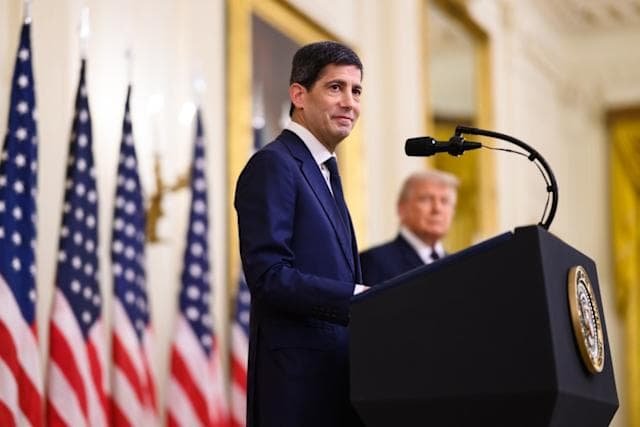
The most important financial event of the coming week is not an earnings report, not a data release, and not a geopolitical development. It is a press conference in Washington on Wednesday afternoon, June 17, at which Kevin Warsh will stand at a podium for the first time as Federal Reserve chair and tell the financial world exactly how he sees the economy, what the dot plot says about where rates are going, and whether the easing language that Jerome Powell carefully maintained through the final months of his tenure is surviving the transition.
The answer, based on everything the research community has published in advance of the meeting, is that it is not. The question is how explicitly Warsh communicates that shift — and what the market reads into the space between his words.
The Decision Nobody Is Waiting For — and the Statement Everyone Is Reading
The rate decision itself is settled. CME FedWatch’s real-time probability tracker puts the likelihood of a hold at 98.3%. J.P. Morgan, Goldman Sachs, Wells Fargo, and every major bank that publishes Fed meeting previews expects no rate change. The federal funds rate will remain at 3.50% to 3.75% on Wednesday evening. That is not news. It is the backdrop against which everything else at this meeting will be interpreted.
The policy statement — the written document the FOMC releases simultaneously with the rate decision — is where the real communication happens. Powell’s final statement, from the April 28-29 meeting, maintained language suggesting the committee judged that the risks to achieving its employment and inflation goals were roughly in balance. That language reflected Powell’s longstanding effort to keep the door to future rate cuts semantically open. Warsh is widely expected to remove or materially modify that balance language — replacing it with wording that acknowledges the inflation environment more explicitly without committing to a specific rate path.
What that change means in plain terms: the Fed is no longer hinting that rate cuts are coming sometime in 2026. It is acknowledging that the current economic conditions — 4.2% inflation, energy prices at post-2022 highs, a war that has been running for 103 days — require holding rates at current levels for the foreseeable future, not just until the next meeting.
The Dot Plot That Will Revise Every Projection From March
The Summary of Economic Projections — the document that shows each FOMC member’s anonymous forecast for the federal funds rate at year-end 2026, 2027, and over the longer run — is released four times per year. The March projections were the last published set. They were compiled before the Iran war escalation, before May’s 4.2% CPI, before Brent crude surpassed $90, and before the ceasefire was declared meaningless by Iran.
The June dot plot will incorporate all of those developments. Based on the market pricing described above — 98.3% chance of no move, less than 10% chance of any cut in 2026 — the median dot for 2026 will almost certainly show a year-end rate that is unchanged from today’s 3.50% to 3.75%. The median dot for 2027 will be the key data point. If the FOMC collectively expects to hold rates through 2026 and begin cutting in 2027, the dot plot confirms a timeline that pushes any relief for mortgage borrowers, car loan applicants, and credit card holders well into next year.
The GDP growth projection for 2026 will be revised downward. The inflation projection will be revised sharply upward. The unemployment projection will likely show a modest increase from March’s estimate. These revisions, taken together, produce the official Federal Reserve portrait of an economy that is growing more slowly, inflating more rapidly, and providing fewer jobs than the central bank forecast three months ago.
What Warsh’s First Press Conference Will Establish
Every new Federal Reserve chair’s first press conference establishes a communication style and a set of emphases that financial markets immediately begin analyzing for signals about future policy. Powell’s first press conference in 2018 established his preference for plain-language communication and his willingness to describe economic conditions directly without the layers of academic hedging that characterized earlier Fed communication. Janet Yellen’s established her focus on labor market conditions as the primary policy driver. Ben Bernanke’s introduced the concept of forward guidance as an explicit tool.
Warsh’s first press conference will establish whether he is hawkish on inflation in the Volcker tradition or whether his previously expressed dovish inclinations — he was described as generally dovish on rates before the Iran war changed the inflation picture — have been overridden by the current data. J.P. Morgan’s note says he will arrive at a more neutral Fed, not a hawkish one. The distinction matters enormously for the bond market, which prices future rate expectations in real time.
Warsh has also suggested privately to colleagues that he wants to reform the Fed’s forward guidance practice — potentially eliminating the explicit rate forecasting that the dot plot represents. Whether he uses Wednesday’s press conference to signal that structural change, or whether he preserves the dot plot format while changing its content, is among the more consequential institutional questions the meeting will address.
| June 16-17 FOMC Meeting — What to Expect | Detail |
|---|---|
| Rate decision | Hold — 98.3% probability (CME FedWatch) |
| Current federal funds rate | 3.50%–3.75% |
| Policy statement language change | Easing bias removed — neutral stance expected |
| Dot plot | Updated for 4.2% CPI, $94 Brent crude, Iran escalation |
| Projected 2026 year-end rate (consensus) | Unchanged at 3.50%–3.75% |
| GDP growth projection | Revised downward |
| Inflation projection | Revised sharply upward |
| Warsh’s communication style | First press conference — close market watch |
| J.P. Morgan prediction | “Explicit move away from easing bias to neutral” |
| Rate cut probability in 2026 (post-CPI) | Below 10% |
| J.P. Morgan full-year 2026 rate forecast | Hold — no cuts through December |
| Next rate hike possibility | JPM projects 25 bps hike in September 2027 |
| 30-year fixed mortgage rate (current) | ~6.30% |
| Meeting dates | Monday June 16 — Tuesday June 17 |
| Press conference | Wednesday June 17, afternoon |
What Monday’s Decision Means for Every American Borrower
The hold itself costs nothing to anyone who is already a borrower. The mortgage rate they locked in stays where it is. The car loan they closed on last month does not change. The credit card APR their issuer set last quarter is not automatically adjusted upward. A hold is a hold — it is the absence of action.
What changes with Monday’s decision is the forward guidance — the signal about what comes next. If Warsh’s dot plot and press conference confirm that the FOMC sees no rate cuts in 2026 and potentially a rate hike in 2027, every variable-rate borrower — HELOC holders, adjustable-rate mortgage borrowers, small business line-of-credit users — faces a longer horizon of elevated rates than they were pricing into their financial plans last month.
The resolution of that horizon remains in the Strait of Hormuz. If Iran and the United States reach a ceasefire framework that reopens commercial shipping — an outcome whose probability has not increased since Wednesday’s strikes and Iran’s declaration of the ceasefire as meaningless — energy prices fall, inflation decelerates toward 3%, and the September dot plot can begin to show cuts again. If the Strait stays closed through the summer and into fall, the June dot plot’s hold projection becomes the operative reality for American borrowers through the end of the year.
Kevin Warsh will take questions from reporters on Wednesday afternoon. The first question will almost certainly be about inflation and rate cuts. The answer will set the tone for the Federal Reserve’s communication for the next quarter. That is what the markets, the borrowers, and the economists are waiting for — not the rate decision, which is already known, but the language around it.