
WASHINGTON, June 18, 2026 —
The Federal Reserve held interest rates unchanged at 3.50% to 3.75% on Wednesday, as expected. That part of the story was settled before Kevin Warsh walked into the room. What was not settled — and what sent Treasury yields surging and stocks lower within minutes of the 2 PM announcement — was everything the new Fed chair did around the rate decision.
Warsh dropped the easing bias. He scrapped the old statement format. He refused to submit his own dot plot. And the updated projections showed that nine of the 18 FOMC officials now believe interest rates should be higher by December. Markets had not priced that. They are pricing it now.
What the Dot Plot Actually Said — and Why Wall Street Flinched
The dot plot — the Fed’s quarterly map of where each official expects rates to go — landed simultaneously with the rate decision at 2 PM. It was hawkish in a way that surprised even analysts who had braced for a tough read.
The median dot for year-end 2026 moved to 3.75%, implying that the next rate move, when it comes, is a hike rather than a cut. Nine of the 18 officials submitted projections showing the federal funds rate above its current range before January. Six of those nine projected two 25-basis-point increases before December. The March dot plot had pointed to one cut. That cut is now gone entirely, replaced by a hike signal that futures markets moved to price within the hour.
| Indicator | March 2026 Projection | June 2026 Projection |
|---|---|---|
| Median year-end 2026 rate | 3.375% (implied one cut) | 3.75% (implied one hike) |
| PCE inflation forecast, year-end 2026 | 2.7% | 3.6% |
| Core PCE inflation forecast, 2026 | 2.7% | 3.3% |
| Unemployment forecast, year-end 2026 | 4.4% | 4.3% |
| Real GDP growth, year-end 2026 | 2.4% | 2.2% |
| Officials projecting 2026 rate hike | 0 of 18 | 9 of 18 |
Sources: Federal Reserve Summary of Economic Projections, March 2026 and June 2026.
The inflation revisions are the starkest number. The Fed now expects headline PCE inflation at 3.6% by year-end — nearly a full percentage point above March’s forecast and nearly double the 2% target the Fed has held since 2012. Core PCE, which strips out food and energy, was revised up to 3.3% from 2.7%. Neither figure suggests a committee that sees relief arriving soon.
The Statement Warsh Rewrote — and the Language He Killed
The old Fed statement ran to several paragraphs of carefully calibrated forward guidance. Warsh replaced it with three paragraphs and approximately 114 words — the shortest FOMC policy statement in modern memory. Gone was the easing bias that had signaled the next move would likely be a cut. Gone was any reference to the committee being “attentive” to risks on both sides. What replaced it was spare, deliberate, and pointed directly at price stability.
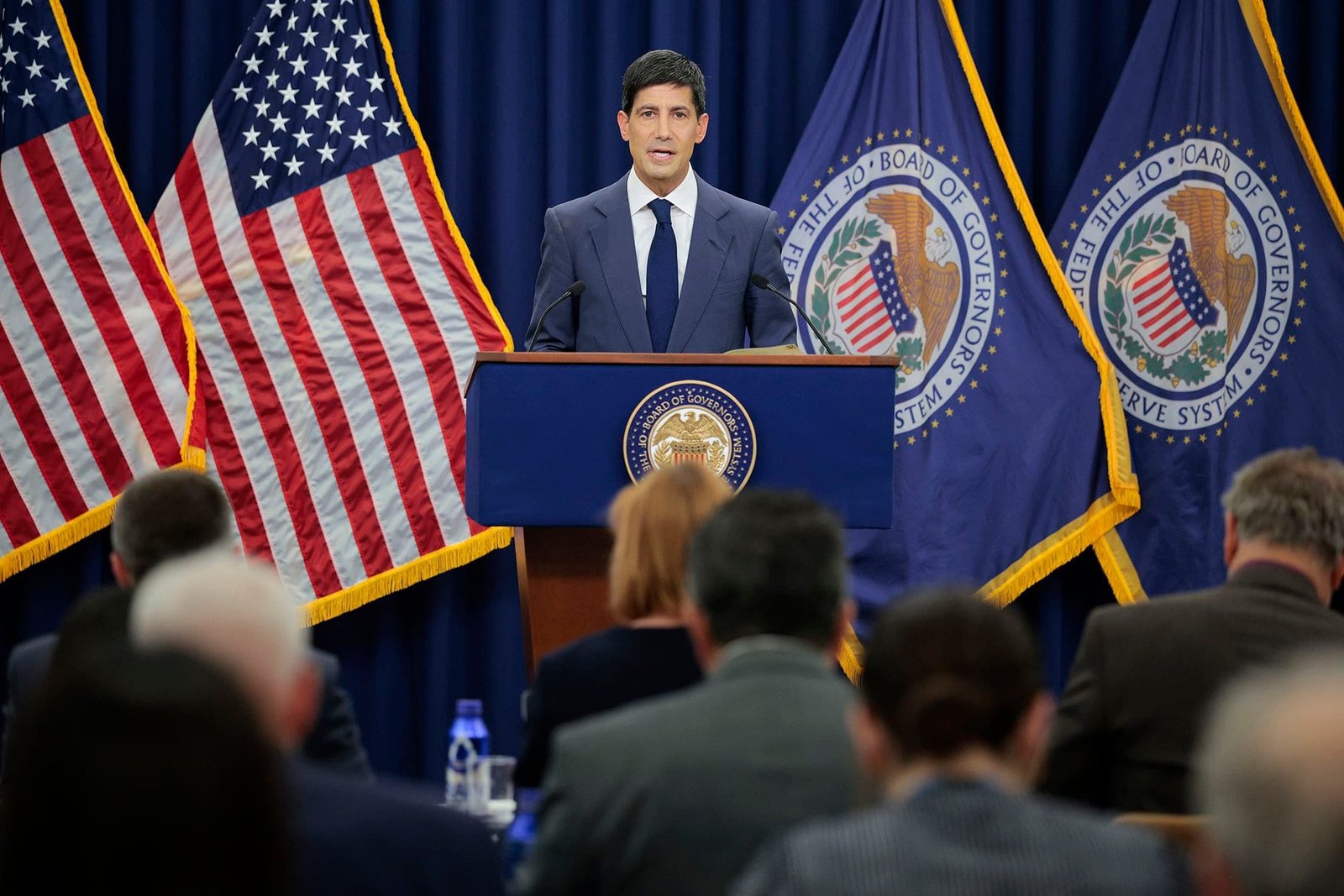
“The commitment to deliver is strong, unanimous, and unambiguous,” Warsh said at his 2:30 PM press conference. “That’s an important message we’ve missed for five years, and we’re going to fix that.”
He also confirmed the one detail traders had been speculating about for weeks: he declined to submit his own projection to the dot plot. “I have refrained from offering any projections of my own, consistent with my long-held views on the SEP, at least as currently structured,” he said. Warsh has been openly skeptical of the dot plot framework as a communication tool, and his refusal to participate in it while simultaneously announcing five task forces to overhaul Fed communications sent an unambiguous message: the institution is changing, and so is how it talks.
The Market Reaction Was Immediate
The S&P 500 dropped 0.6% in the first 30 minutes after the 2 PM announcement. The Nasdaq fell 0.7%. The Dow shed 160 points. Treasury yields moved sharply: the 2-year yield jumped nearly 11 basis points to 4.153%, its fastest single-session move in weeks. The 10-year yield rose 4 basis points to 4.469%.
Stocks clawed back some losses during the press conference as Warsh outlined his task force plans, and markets read his tone as measured rather than combative. But the day ended with all three major indexes in the red. Prediction markets, which had been pricing a rate hold as the dominant outcome through December, shifted overnight. By Wednesday evening, traders were pricing a 60.7% chance of a rate hike by October.
The Iran peace deal announcement Sunday had offered a brief window of relief — oil prices fell, and some analysts suggested energy disinflation might give Warsh room to hold a neutral stance through summer. Wednesday’s press conference suggested that window is narrower than hoped. The Fed cannot cut on a ceasefire that is not yet fully implemented. And it cannot ignore core inflation running at 3.3% while waiting for oil prices to normalize.
Five Task Forces and a Fed That Is Changing How It Operates
Beyond rates and the dot plot, Warsh announced five internal task forces to review and potentially overhaul how the Federal Reserve operates. The five areas: monetary policy communications, the Fed’s balance sheet, data sources, labor market analysis, and the causes and measurement of inflation.
The inflation task force is the one with the most immediate policy implication. Warsh indicated it will examine how inflation is measured and what drives it — but explicitly ruled out reconsidering the 2% target itself for now. “I see no reason until we have reestablished our commitment and ability to deliver on the 2% inflation objective to revisit that,” he said. He also noted that any reconsideration would come only after the target is actually met — not before.
Jerome Powell remains on the Fed’s Board of Governors and is still a voting member of the FOMC. He voted with the unanimous 12-0 majority on Wednesday’s hold decision. Whether Powell’s presence influences the pace or direction of Warsh’s institutional reforms remains to be seen.
The next FOMC meeting is July 28-29. If the June CPI report — due in mid-July — confirms that inflation remained elevated through the post-Iran-deal period, Warsh’s first rate hike could come before summer ends.