
DUBAI, June 9, 2026 —
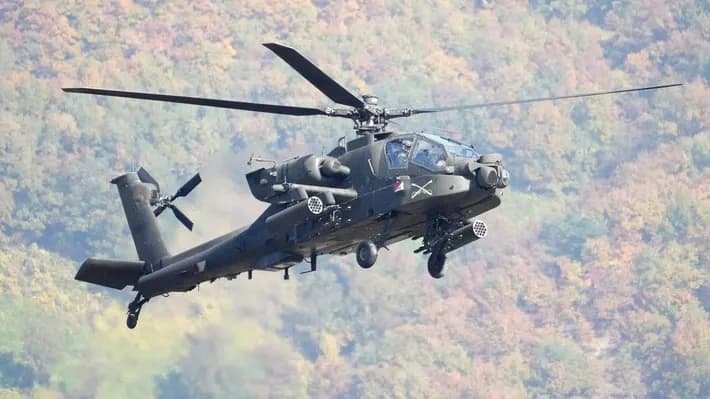
A United States Army AH-64 Apache attack helicopter went down near the Strait of Hormuz on Monday evening, sending both crew members into the water off the coast of Oman before a US Navy surface drone located and rescued them approximately two hours after the crash. Both soldiers are in stable condition.
What brought the helicopter down is not yet known. Two American officials and a third source with knowledge of the incident told reporters that investigators are examining whether Iranian fire struck the aircraft. That determination has not been made. A mechanical malfunction or another cause has not been ruled out. The Pentagon promised a full report Tuesday.
What Happened — and How the Crew Was Rescued
The Apache went down at approximately 5:30 p.m. local time Monday as it was conducting patrol operations over regional waters near the Strait of Hormuz. US Central Command confirmed the incident in a statement on X, saying the two crew members were safely rescued within approximately two hours and are in stable condition.
The rescue was conducted by a US Navy surface drone — an unmanned maritime vessel that located the crew in the water and brought them to safety. The use of an unmanned surface drone for a combat-adjacent rescue operation represents one of the more significant recent demonstrations of autonomous naval systems in an active operational environment.
Trump was at Madison Square Garden for Game 3 of the NBA Finals when reporters asked him about the crash on Monday night. He confirmed the crew was safe before the Pentagon’s formal statement had been released. The pilots are fine, he said. Nobody injured. We are going to issue a report tomorrow.
CENTCOM spokesman Captain Timothy Hawkins confirmed the rescue in a formal statement Tuesday morning, identifying the aircraft as a US Army AH-64 Apache that had been patrolling regional waters. The cause of the incident, Hawkins said, is under investigation.
The Iran Question — and Why It Matters More Than Usual
Apache helicopters have been deployed near the Strait of Hormuz specifically to counter Iranian fast-attack boats and one-way attack drones that have been operating in the region since the US and Iran began exchanging fire in the weeks following the April 8 ceasefire. CENTCOM has published footage of Apache operations against Iranian small vessels throughout the conflict. The helicopters are among the most active US military assets in the Strait corridor.
Axios reported, citing two American officials and a third source with direct knowledge, that investigators are specifically examining whether Iranian fire — a missile, a drone, or a direct weapons engagement — brought the aircraft down. Iran has not claimed responsibility for the crash. The IRGC has not publicly acknowledged any engagement with a US aircraft on Monday.
The timing is acutely sensitive. On the same day the Apache went down, Iran and Israel exchanged direct strikes for the first time since the April 8 ceasefire took effect — with Israel striking targets in Lebanon and Iran responding with missile launches. The regional environment in which the Apache was operating on Monday was the most volatile it has been since the ceasefire began.
Trump, speaking to reporters after the NBA Finals game and before he boarded Air Force One at JFK Airport in New York, went beyond the crew’s safety to address the broader Iran situation. He expressed optimism about negotiations, saying he prefers a diplomatic solution. He said if the US resumed bombing Iran, a lot of people are going to be killed. Who wants to do that, he said. I don’t.
That framing — a president who just watched one of his military helicopters potentially shot down near a hostile nation’s waters expressing preference for diplomacy over additional military strikes — captures the specific bind in which the administration is operating.
The Ceasefire That Is Not a Ceasefire
The April 8 ceasefire between the United States and Iran was never fully implemented. It has been violated repeatedly by both sides through the exchanges that CENTCOM characterizes as self-defense actions. The IRGC has fired warning shots at vessels attempting Strait transit. The US has struck Iranian radar sites, communications towers, and missile launch positions. Kuwait’s airport was hit by Iranian drones. The US Fifth Fleet headquarters in Bahrain was targeted. An Apache helicopter is now down in the Strait.
None of these events have formally ended the ceasefire. Each is characterized by the party conducting it as a response to provocation rather than an initiation. The pattern produces ongoing military activity under a nominal ceasefire framework that both sides cite when it serves their purposes and ignore when it does not.
Whether Monday’s Apache crash — if ultimately determined to have been caused by Iranian fire — crosses a threshold that changes the administration’s posture is what Tuesday’s Pentagon report will begin to answer.
| US Apache Helicopter Incident — Key Facts | Detail |
|---|---|
| Date and time | Monday June 8, 2026 — approx. 5:30 p.m. local time |
| Aircraft | US Army AH-64 Apache attack helicopter |
| Location | Near Strait of Hormuz, off coast of Oman |
| Crew status | Both rescued — stable condition |
| Rescue method | US Navy surface drone — within ~2 hours |
| Cause | Under investigation |
| Iranian fire possibility | Confirmed under investigation (Axios — 2 officials, 1 source) |
| Iran claimed responsibility | No |
| Trump statement | “Pilots are fine, nobody injured” — after NBA Finals Game 3 |
| Pentagon report promised | Tuesday June 9 |
| Same-day context | Iran-Israel exchange of strikes for first time since April 8 ceasefire |
| Apache role in Strait | Patrolling vs. Iranian fast-attack boats and drones |