
WASHINGTON, May 26, 2026 —
Social Security Disability Insurance is the program that stands between a disabling medical condition and financial catastrophe for 8.4 million Americans. It is not welfare. It is an insurance program funded by the payroll taxes every working American contributes throughout their career. When a qualifying disability prevents a person from working, SSDI is the system that replaces a portion of that lost income.
The system in 2026 is slower, more selective, and more difficult to navigate than it has been in over a decade. Understanding exactly how it works — and what the new 2026 rule changes mean for your claim — is the difference between an approval that comes in months and a denial that sends you through years of appeals.
Who Qualifies and What the Numbers Look Like
SSDI is not available to everyone who has a health condition. The Social Security Administration applies a strict five-step sequential evaluation to determine whether an applicant meets the federal definition of disabled. The central requirement is that the condition must be severe enough to prevent the applicant from engaging in Substantial Gainful Activity — defined in 2026 as earning more than $1,690 per month for non-blind applicants or $2,830 per month for blind applicants. The condition must also have lasted, or be expected to last, at least 12 months or be expected to result in death.
An applicant must also have sufficient work credits — earned through prior employment and payroll tax contributions. In 2026, one work credit is awarded for every $1,890 in earnings, up to four credits per year. Most workers need 40 total credits, with 20 of those earned in the 10 years immediately before disability onset, to qualify for SSDI. Younger workers require fewer credits because they have had less time to accumulate them.
The initial approval rate for SSDI claims is between 31% and 36% — meaning roughly two out of three applicants are denied at the first stage. That denial is not the end of the road. Applicants can request a reconsideration review, then a hearing before an Administrative Law Judge, and ultimately a federal court appeal if necessary. Approval rates improve substantially at the hearing level — ALJ hearings approve roughly 55% of the claims that reach them. But reaching that stage requires navigating a wait time that, in many parts of the country, exceeds 12 months from the date the hearing request is filed.
The 2026 Rule Change That Rewrites the Eligibility Math for Older Workers
The most consequential single change to SSDI eligibility rules in 2026 is one that has received almost no mainstream coverage: the SSA reduced the work history lookback period from 15 years to 5 years.
Under the prior rules, the SSA examined everything an applicant had done professionally for the past 15 years when determining whether they could perform past relevant work. A 58-year-old who spent the last three years as a data entry clerk — sedentary, relatively simple — but who spent the previous 12 years as a construction worker, could find their claim evaluated against their ability to perform data entry, not construction. The 15-year lookback captured all of that work history, and the SSA could determine that less demanding prior work was still available to the applicant.
Under the new 5-year lookback, only the most recent five years of work history are examined. That construction worker’s prior decade of physically demanding labor disappears from the eligibility equation. The SSA evaluates what the applicant did in the last five years — period. For older workers whose most recent employment was sedentary or clerical but whose bodies have been damaged by years of prior physical labor, this change is substantial. It removes a major basis for denial that has rejected thousands of legitimate claims over the past two decades.
The Backlog — and What DOGE Cuts Did to It
The Social Security Administration’s disability claims backlog was already a crisis before 2026. The Urban Institute estimated in early 2025 that the backlog was on track to exceed 2 million pending claims. The average wait time for an initial determination — not a hearing, just the first decision — was seven months for many applicants. Hearing-level waits in some regions exceeded 18 months.
Then the Trump administration’s Department of Government Efficiency initiative targeted SSA staffing. The agency lost significant portions of its workforce through buyouts, early retirements, and position eliminations. Fewer claims processors handling more claims means longer waits. The Urban Institute projected explicitly that DOGE-driven SSA workforce reductions would make it harder to receive approval and would assuredly produce even longer wait times for disability beneficiaries.
The practical consequence for applicants is visible in the timeline data. An initial SSDI application now takes three to six months for a first decision. If denied — which happens to 64% to 69% of initial applicants — a reconsideration review adds another three to five months. A hearing before an Administrative Law Judge, if that becomes necessary, adds another 12 months or more in most jurisdictions. The total timeline from initial application through hearing-level approval, for claimants who ultimately succeed, can exceed two years.
During all of that time, the mandatory five-month waiting period has not yet begun. SSDI does not pay benefits for the first five full months after the SSA determines the disability onset date — regardless of how long the application process took. An applicant whose disability began in January 2026 and who is approved after a 14-month process in March 2027 will receive their first SSDI payment covering July 2026 — five months after their established onset date, not the month they were approved.
What the 2026 Payment Numbers Look Like
The 2.8% cost-of-living adjustment that increased Social Security retirement benefits in January 2026 also applied to SSDI. The average monthly SSDI payment for a disabled worker in 2026 is $1,821 — up from $1,771 in 2025. Men receive an average of $1,990 per month. Women receive an average of $1,626 per month, reflecting the gender pay gap in the underlying Social Security earnings record on which SSDI payments are calculated.
For eligible dependents, a disabled worker’s spouse receives approximately $462 per month and each qualifying child receives approximately $521 per month. A disabled male worker with an eligible spouse and two children can receive a combined family benefit approaching $3,565 per month in 2026.
Supplemental Security Income — the companion program for disabled individuals who lack sufficient work history to qualify for SSDI — pays a maximum federal benefit of $994 per month for an individual and $1,491 per month for an eligible couple in 2026, up from $967 and $1,450 in 2025.
| 2026 SSDI Key Numbers | Detail |
|---|---|
| Total SSDI recipients | 8.4 million |
| Average monthly payment — disabled worker | $1,821 |
| Average monthly payment — men | $1,990 |
| Average monthly payment — women | $1,626 |
| Average monthly payment — spouse | $462 |
| Average monthly payment — child | $521 |
| 2026 COLA increase | 2.8% |
| Substantial Gainful Activity limit (non-blind) | $1,690/month |
| Substantial Gainful Activity limit (blind) | $2,830/month |
| Work credit value (2026) | $1,890 per credit |
| Initial approval rate | 31%–36% |
| ALJ hearing approval rate | ~55% |
| Initial application processing time | 3–6 months |
| ALJ hearing wait time | 12+ months |
| Total process (initial through hearing) | 18 months to 2+ years |
| Mandatory waiting period before first payment | 5 months after onset date |
| Backlog estimate (Urban Institute) | 2 million+ pending claims |
| Work history lookback (2026 new rule) | 5 years (reduced from 15) |
| SSI maximum — individual (2026) | $994/month |
| SSI maximum — couple (2026) | $1,491/month |
Pro Tips a Generic Article Would Miss
1. Filing with medical documentation that explicitly describes functional limitations — not just diagnoses — is the single most impactful thing an applicant can do to improve approval odds. The SSA does not approve claims based on diagnosis names. It approves claims based on the functional impact of those diagnoses — specifically, whether the impairment prevents the applicant from performing Substantial Gainful Activity. A medical record that says “patient has degenerative disc disease” is worth less in an SSDI evaluation than a record that says “patient cannot sit for more than 20 minutes without significant pain, cannot stand for more than 10 minutes, requires frequent positional changes, and cannot lift more than 5 pounds.” The second record describes functional limitations that map directly to the SSA’s evaluation framework. Applicants who ask their treating physicians to document specific functional limitations — using the language of the SSA’s residual functional capacity framework — consistently receive better initial outcomes than those who submit diagnosis records alone.
2. The five-year lookback rule change is retroactive in its application to pending and denied claims — and many previously denied applicants may now qualify under the new standard. The SSA’s reduction of the work history lookback from 15 to 5 years applies to claims currently in the system, including those at the reconsideration, hearing, and appeals stages. Applicants who were denied under the old 15-year lookback — where a prior sedentary job was used to establish that past relevant work was still available to them — may have grounds for a new application or an appeal that applies the new 5-year standard to their work history. An applicant who was denied in 2024 because they had performed clerical work 7 years earlier should consult with a disability attorney about whether the new lookback rule changes their eligibility picture.
3. A contingency-fee disability attorney statistically triples approval odds within 180 days — and costs nothing unless benefits are awarded. SSDI attorneys work on a federally regulated contingency fee: 25% of any back pay awarded, capped at $7,200 under 2026 fee limits. They receive nothing if the claim is denied. The SSA pays the attorney fee directly from the back pay award, meaning applicants pay no out-of-pocket costs at any point in the process. Research consistently shows that applicants represented by an attorney or advocate are significantly more likely to be approved at every stage of the process than those who apply alone — with some studies showing approval rates nearly three times higher for represented claimants at the hearing level. For a process this complex, with timelines this long and stakes this high, representation is the highest-value tool available to any applicant.
FAQ
Q: How long does it take to get approved for SSDI in 2026? A: Initial applications take three to six months for a first decision. If denied at the initial level — which happens to roughly 64% to 69% of applicants — a reconsideration review takes an additional three to five months. A hearing before an Administrative Law Judge, the next appeal level, adds 12 months or more in most jurisdictions. The complete process from first application through hearing-level approval can take 18 months to over two years. Even after approval, a mandatory five-month waiting period applies before the first payment is issued.
Q: What is the 2026 work history lookback change and how does it affect me? A: Beginning in 2026, the SSA now examines only the past five years of your work history when determining whether you can perform past relevant work, reduced from the prior 15-year lookback period. This change most significantly benefits older workers who performed physically demanding jobs earlier in their careers but have done lighter or sedentary work more recently. Under the old rules, that sedentary work could be used to deny your claim. Under the new rules, only your most recent five years of work count.
Q: Can I work while applying for SSDI? A: You can work while applying, but your earnings must stay below the Substantial Gainful Activity limit of $1,690 per month in 2026 for non-blind applicants. Earning above this threshold will result in denial because the SSA will determine you are not disabled under its definition. If you are currently working above the SGA limit, you should consult with a disability attorney before applying.
Q: What is the difference between SSDI and SSI? A: SSDI is an insurance program funded by payroll taxes. It pays benefits based on your Social Security earnings record and requires sufficient work credits to qualify. SSI — Supplemental Security Income — is a needs-based program for disabled individuals who lack sufficient work history for SSDI or whose SSDI benefit is very low. SSI eligibility depends on income and assets, with a maximum federal benefit of $994 per month for an individual in 2026. Some individuals qualify for both SSDI and SSI simultaneously if their SSDI benefit is below the SSI maximum.
Q: What happens if I am denied SSDI? A: A denial at the initial level is not a final decision. You have 60 days from the date of the denial notice to request a reconsideration review. If denied again at reconsideration — which happens to most applicants — you have 60 days to request a hearing before an Administrative Law Judge. ALJ hearings approve roughly 55% of cases that reach them. If denied at the ALJ level, the next steps are review by the SSA’s Appeals Council and then federal court. Missing any appeal deadline results in the claim being closed, requiring a new application from the beginning.
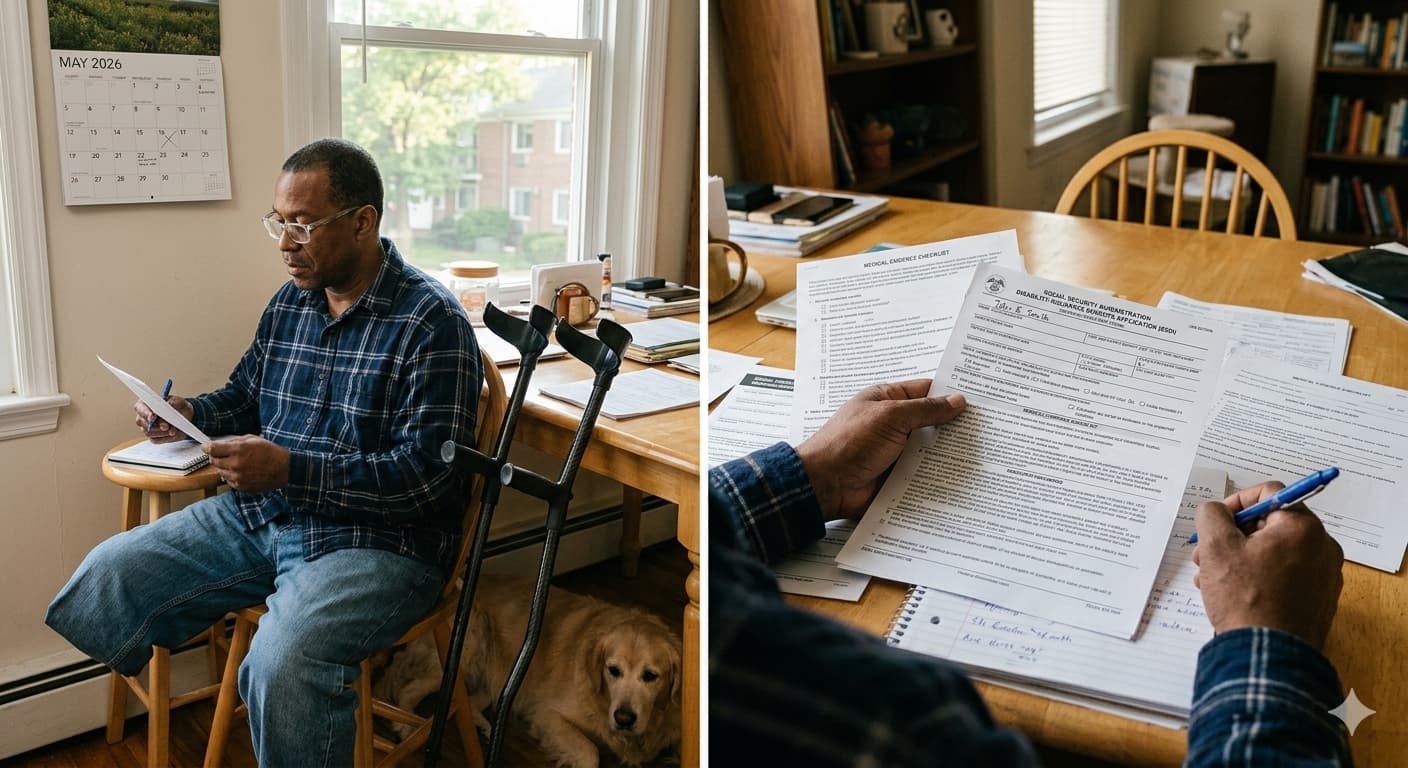
If you or a family member are unable to work due to a medical condition and are considering an SSDI application, the most important first step is not filling out the application form. It is gathering every piece of medical documentation your treating physicians have produced — diagnoses, treatment records, test results, and most importantly, any documentation of functional limitations — and organizing it chronologically before the application is filed. The SSA evaluates what it receives, not what exists. A complete, well-documented application that speaks the SSA’s functional language from the first page outperforms an incomplete application at every stage of the process. The backlog is real. The wait is long. Starting with the strongest possible application is the only factor entirely within your control.