
ZURICH / HOUSTON / LONDON, May 10, 2026 —
Key Takeaways
- The 2026 FIFA World Cup — starting June 11 across 16 North American cities — is 32 days away, and the injury list of top international stars has already reached a level that tournament organizers describe as unusually severe, with multiple Ballon d’Or contenders and key national team starters racing against recovery timelines that most sports medicine experts consider optimistic.
- The standard recovery window for a major knee ligament surgery runs six to twelve months — but returning to elite international form, with the physical confidence and explosive output required at World Cup level, typically takes several months longer, creating a hidden injury crisis where players may be declared “fit” while still operating at a fraction of their peak capacity.
- Brazil, France, and England enter as the three nations most exposed by their injury situations — each missing or nursing a player whose absence or below-par performance fundamentally changes their tactical shape, attacking output, and realistic ceiling in the tournament.
The Injury That Defines the Tournament Before It Starts
World Cups are defined by absences as much as arrivals. Pelé missing the 1962 tournament after just two games. Marco van Basten’s ankle preventing him from playing in 1990. Ronaldo’s convulsions before the 1998 final. Neymar’s back fracture in 2014. The injury story is always part of the World Cup story — because the tournament selects which version of the sport the world gets to watch, and injuries write that selection.
The 2026 edition’s injury narrative is taking shape weeks before a ball is kicked. The combination of a grueling 48-team format, an extended club season that pushed the final Premier League, LaLiga, and Serie A weekends to within three weeks of the tournament opener, and the physical demands of a campaign that involves up to seven matches over five weeks has produced a situation where national team managers are building their tactical plans around players they are not certain will be fully fit — or fit at all.
Brazil — The Nation Whose Entire Tournament Depends on One Man’s Knee
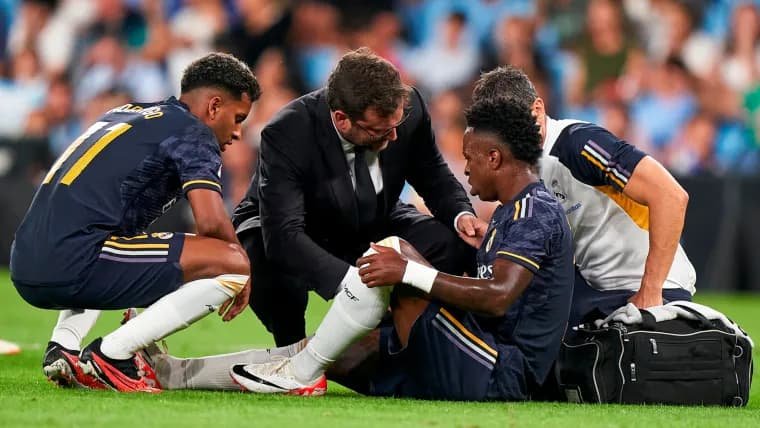
Brazil enters the 2026 World Cup as one of the bookmakers’ favorites but with a medical situation around Vinicius Jr. that national team medical staff have described as a genuine race against time. The Real Madrid forward sustained a knee injury in late March — a partial ligament sprain that did not require surgery but demanded eight to ten weeks of rehabilitation during precisely the period the national team needs him training at full intensity in preparation for June 11.
Brazil’s tactical system under coach Dorival Júnior is built around Vinicius’s explosive left-side runs, his ability to create chaos in one-on-one situations, and his output from the left channel in behind defensive lines. No other player in the Brazilian squad replicates what he does. The alternatives — capable, experienced, but different in their profile — produce a different Brazil: more structured, less unpredictable, easier for organized defenses to contain.
If Vinicius returns and is genuinely at full capacity, Brazil is a legitimate title contender. If he returns at 80% and his first instinct when pushed wide is to protect the knee rather than explode past a defender, Brazil is a different team. The medical staff will not make that public distinction. The first 20 minutes of Brazil’s opening group game will.
France — Mbappé’s Shadow and What Happens If It Doesn’t Lift
Kylian Mbappé has had the most scrutinized injury situation in European football for the past six months. The French captain sustained a thigh muscle injury at Real Madrid in February and returned to play in April — but his performance levels, by the statistical measures that analysts track, have not fully recovered to his pre-injury baseline. His acceleration data, his pressing intensity, and his direct goal contributions have all been lower since returning than in the equivalent period of the previous season.
France has depth that most nations would trade anything for — Ousmane Dembélé, Antoine Griezmann, Marcus Thuram, and a defensive unit led by Jules Koundé and William Saliba that is arguably the best back four at the tournament. But France with a fully fit, fully confident Mbappé is a qualitatively different proposition from France with an Mbappé managing his body through a five-week tournament. The mental dimension matters as much as the physical. A forward who has been injured once protects himself, consciously or not, in ways that change the calculations he makes at decisive moments — whether to go around the last defender, whether to take the shot, whether to let the knee take the full weight of a plant-and-drive.
England — The Bellingham Situation Nobody Is Willing to Name
England arrives in North America with Jude Bellingham as its defining player — the midfielder whose late-game interventions and Barcelona form have positioned him as the tournament’s most anticipated performer. He has also been dealing with a shoulder injury that caused him to miss several Barcelona matches in April and whose recovery status England’s medical team has described in the most cautious possible language.
The shoulder does not affect Bellingham’s running or technical ability in the way a knee injury affects a striker. What it affects is his aerial capacity, his ability to win physical duels, and his willingness to throw himself into challenges in the way that makes him so difficult to manage. An Bellingham who is protecting a shoulder in headed duels and physical contests is still an elite footballer. He is not the same player who threw himself at every moment of every match that carried England to the Euros final in 2024.
| Nation | Player | Injury | Status | Tournament Risk |
|---|---|---|---|---|
| Brazil | Vinicius Jr. | Partial knee ligament sprain | Racing to be fit | High |
| France | Kylian Mbappé | Thigh muscle — returned April | Below pre-injury performance levels | Medium-High |
| England | Jude Bellingham | Shoulder | Managed — protection concerns | Medium |
| Portugal | Bernardo Silva | Hamstring | Recovering — timeline uncertain | Medium-High |
| Germany | Leroy Sané | Knee — missed late season | Declared fit — form uncertain | Medium |
| Argentina | Angel Di María | Retired from club football | Fitness for tournament duration | Low-Medium |
| Spain | Pedri | Recurring hamstring | Managed carefully — risk of recurrence | Medium |
The “Fear Factor” — Why Fit Is Not the Same as Ready
Sports medicine specialists who work with international teams describe what they call the fear factor — the psychological adaptation that follows a significant injury and that is rarely discussed in the clinical language of fitness declarations and match readiness.
A player who has been injured at the moment of maximum physical exertion — the burst of speed, the sharp turn, the tackle — will have the memory of that injury at the exact moment they attempt the same movement in competition. That memory is not a conscious calculation. It is a motor-pattern level hesitation that changes the timing of the movement — fractionally, invisibly, but measurably in the data. It is why return-from-injury performance dips are consistent across sports, and why the first few competitive matches after a significant injury are almost never an athlete’s best.
At club level, that dip can be managed. A player coming back from injury can be eased in, protected from certain matchups, given minutes rather than matches. At a World Cup, with a nation’s expectations and a six-week fixed window, there is no easing in. The player who starts Group Stage Match One is expected to be the player who finishes Quarterfinal Match Six — at the same level. The injury list currently assembled across the tournament’s top nations means that expectation collides with physical reality in ways that will determine which national team coach made the best decision and which made the most optimistic one.
The Teams That Benefit — Morocco, Portugal Without Ronaldo, and the Dark Horses
Every injury crisis at a major tournament produces a corresponding opportunity for the nations that arrive healthy, cohesive, and operating at peak capacity. Morocco — the 2022 World Cup semifinalists — have had a relatively clean injury window and arrive in North America with the same defensive shape and collective intensity that made them the tournament’s revelation four years ago. Their addition of a more effective attacking threat, built around Paris Saint-Germain’s Hakimi and a more cohesive forward line, makes them a realistic quarterfinalist and a plausible semifinalist.
Portugal without Ronaldo — who retired from international football in January after a final-career-defining Copa America appearance — is a tactically reorganized side whose dependence on a single aging superstar has been replaced by a genuinely collective attacking system built around Bruno Fernandes, Rafael Leão, and Bernardo Silva. If Silva is fit, Portugal is one of the tournament’s most technically complete and tactically flexible sides. If he is not, they have the depth to absorb his absence better than most nations absorb the loss of a comparable talent.
The 48-team format’s three-match group stage creates a longer runway for teams to find their rhythm — and for injured players to manage their way through the group stage while reaching peak condition for the knockouts. The format that was designed to include more nations may accidentally produce the tournament’s most interesting subplot: which of the tournament’s injured stars peaks at exactly the right moment, and which falls short just when it matters most.