
ROME / WASHINGTON, May 7, 2026 —
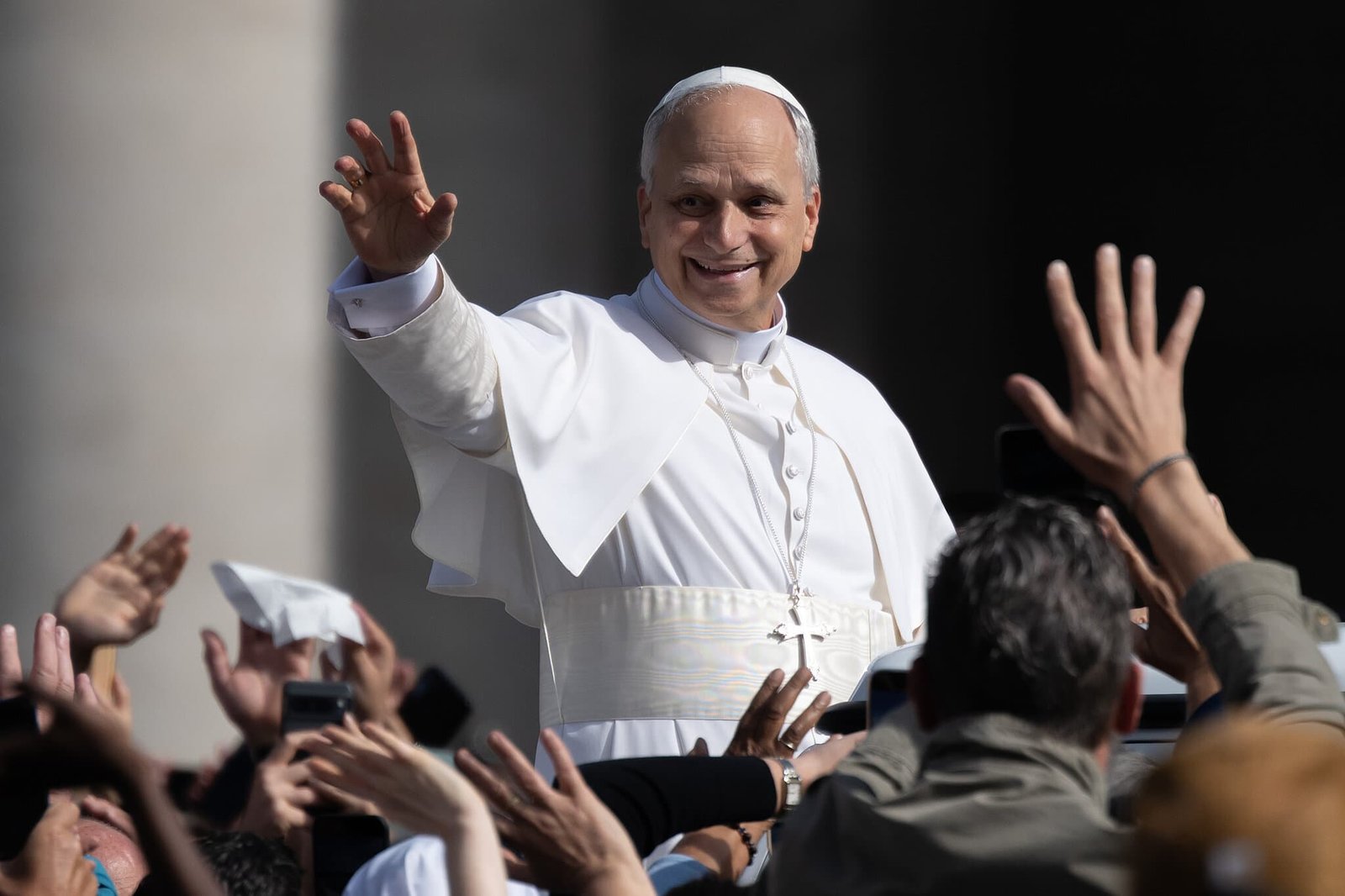
One year ago today, Robert Francis Prevost — a 69-year-old Augustinian friar from Chicago’s South Side who had spent two decades serving the poor in Peru — walked out onto the balcony of St. Peter’s Basilica and introduced himself to the world as Pope Leo XIV. He was the first American to lead the Roman Catholic Church in its 2,000-year history. He smiled a Midwestern smile. He said the church should build bridges. The crowd roared.
In the twelve months since, he has called Donald Trump’s war with Iran evil, condemned attacks on Iranian civilian infrastructure as signs of hatred and destruction, demanded that world leaders lay down their weapons, and told reporters he has “no fear of the Trump administration.” Trump called him “WEAK on Crime and terrible for Foreign Policy.” Secretary of State Marco Rubio is flying to the Vatican this week in an attempt to repair the relationship before it permanently damages U.S. standing with the world’s 1.4 billion Catholics.
The first American pope has turned out to be the American pope Washington least expected.
How the Year Actually Unfolded
The conclave that elected Leo XIV lasted four ballots. Cardinal Robert Prevost was not the frontrunner. He was, in the language of Vatican watchers, a compromise — a man who had spent so long outside the American church hierarchy in Peru and Rome that he was neither clearly progressive nor clearly conservative, neither a European insider nor an American outsider. He was, at 69, experienced enough to command respect and moderate enough not to alarm either wing of the College of Cardinals.
He took the name Leo XIV — invoking Pope Leo XIII, the 19th-century pontiff who wrote Rerum Novarum, the foundational document of Catholic social teaching on labor rights, workers’ dignity, and the obligations of the wealthy toward the poor. The choice of name was the first signal. It was not subtle.
In November 2025, he made his first papal visits to Turkey and Lebanon — commemorating the 1,700th anniversary of the First Council of Nicaea with Eastern Orthodox Patriarch Bartholomew I, and celebrating Mass in Beirut near the site of the 2020 explosion that killed more than 200 people. In the first six months of 2026, he visited Monaco, Algeria, Angola, Cameroon, and Equatorial Guinea. In April, he visited an Equatorial Guinea prison, telling inmates: “You are not alone.”
He is, by the accounts of people who have met him, exactly what he appears to be — a man formed by two decades of ministry in one of Peru’s poorest regions, who became a cardinal and then a pope without losing the habits of a parish priest.
The Moment That Defined His Papacy So Far
On Easter Sunday, April 5, 2026, Pope Leo XIV delivered his Urbi et Orbi blessing — the traditional Easter address to the city and the world — from the balcony of St. Peter’s Basilica. He asked world leaders to “lay down their weapons, choose peace, and engage in dialogue.” He asked specifically that the innocent be remembered — “children, the elderly, the sick, so many people who have already become, or will become, victims of this continued warfare.” He called attacks on Iranian civilian infrastructure “a sign of the hatred, division, and destruction that the human being is capable of.”
The Iran war was 37 days old when he said this. Trump had not yet threatened to bomb civilian infrastructure at a “much higher level.” He had, however, been conducting airstrikes on Iranian military and nuclear sites since February 28. The pope’s Easter message was, by any reading, a direct condemnation of the war Trump started.
The response from the White House was swift. Trump posted on Truth Social that Leo is “WEAK on Crime, and terrible for Foreign Policy” and claimed the pope “should be thankful” for his election, implying — with characteristic Trump bluntness — that Leo was chosen only because he is American and because Trump is president.
Leo XIV’s response came the next morning. Standing before reporters, he said: “I have no fear of the Trump administration or speaking out loudly of the message of the Gospel, which is what I believe I am here to do, what the church is here to do.”
A Chicago kid from the South Side, telling the president of the United States to mind his own business. Expressed in the language of theology, but unmistakably clear.
What America’s Catholics Think — and Why It Matters Politically
The United States has approximately 70 million Catholics — roughly 21% of the adult population. They are not a monolithic voting bloc. Latino Catholics lean Democratic. White Catholic men, particularly working-class voters in the Midwest and Northeast, have trended Republican for a decade. The political geography of American Catholicism is complex, contested, and consequential in exactly the states that decide presidential and Senate elections.
A pope who is openly critical of a sitting Republican president, who condemns a war the president started, who calls infrastructure bombing “evil,” and who tells reporters he has no fear of the administration is a political variable that neither party knows quite how to manage. Trump’s instinct — to attack — has historically worked against domestic opponents. It has never previously been deployed against a sitting pontiff who happens to share his citizenship and whose moral authority derives from an institution with 2,000 years of institutional staying power.
Rubio’s Vatican visit this week is an acknowledgment that the attack-the-pope strategy is not working. The Secretary of State arriving in Rome to repair a relationship that the president damaged with social media posts is the kind of diplomatic cleanup operation that reveals exactly how poorly calibrated the initial response was.
The Chicago Kid Who Became Everyone’s Pope
In Chicago, where Leo XIV grew up on the South Side and attended St. Mary of the Assumption Parish, the anniversary has produced something the city has not seen since the 1985 Bears: a civic pride moment that crosses every demographic line.
A year ago, the Chicago White Sox and the Archdiocese of Chicago hosted a Mass at Rate Field — the baseball stadium on the South Side — for more than 40,000 people celebrating the election of a Chicago kid to the papacy. The scene of Catholics and non-Catholics alike packing a baseball stadium to cheer for a pope captured something genuine about how Americans feel about one of their own reaching the most prominent religious office in the world.
A 26-year-old dog walker who lives near the cathedral told a reporter she was not religious but said “obviously, it’s good to have somebody hometown” and that she had “no complaints” about him. That unsolicited endorsement from a non-practicing millennial in Chicago may be the most precise distillation of what Leo XIV’s first year has produced: a pope who has made people who don’t care about popes feel something anyway.
That is not nothing. In a world being torn apart by wars, economic anxiety, and political rage, a man from the South Side who smiles a Midwestern smile and tells a sitting president he has nothing to fear from him is, for a lot of people, exactly what they needed.