
NEW YORK, May 4, 2026 —
Fashion’s biggest night of the year is happening tonight at the Metropolitan Museum of Art — and the story is not the outfits. It is the empty seats where some of the most prominent names in entertainment were supposed to be sitting.
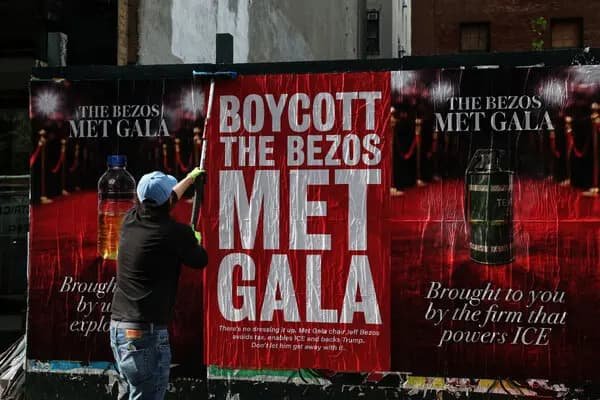
Zendaya is not going. Meryl Streep is not going. New York City Mayor Zohran Mamdani confirmed he will not attend. Activist groups have plastered “Boycott the Bezos Met Gala” posters at bus stops and street corners across Manhattan. Protesters lined the sidewalks outside the museum Monday evening. And at the center of all of it: Amazon founder Jeff Bezos and his wife Lauren Sánchez Bezos, who reportedly spent at least $10 million to become the event’s lead sponsors and honorary co-chairs — a sum that critics say effectively bought them the keys to fashion’s most prestigious social institution.
How a Charity Gala Became This Year’s Most Polarizing Event
The Met Gala has always generated controversy. In 2023, people debated whether Karl Lagerfeld was too problematic to serve as the theme. In 2024, TikTok’s sponsorship raised national security eyebrows. This year, the debate is bigger and harder to dismiss.
Bezos is the second-richest person in the world. His company Amazon has faced sustained criticism over worker conditions at its fulfillment centers. In January, Forbes reported that U.S. Customs and Border Protection and ICE purchased $140 million in cloud services from Amazon and Microsoft in 2025 — a figure that activist groups have used to frame Bezos’s Met Gala involvement as a direct extension of Trump administration policies that have generated widespread protest.
The activist group Everyone Hates Elon — named for its earlier campaigns against Elon Musk, not Bezos — organized much of the street protest campaign, calling Bezos an enabler of ICE. The Bezos Met Gala posters they placed across the city were designed to look like official Met communications, which amplified their reach significantly before they were identified as grassroots productions.
Individual tickets for tonight’s gala are priced at $100,000. A table costs $350,000. Co-chairs Beyoncé, Nicole Kidman, and Venus Williams are attending. The committee includes Sabrina Carpenter, Doja Cat, and ballerina Misty Copeland. The evening will go forward with or without the boycotters. But the boycott has already won the news cycle.
The Meryl Streep Timing That Nobody Could Have Planned Better
The most culturally loaded absence belongs to Meryl Streep. She will not be at tonight’s gala — and the timing is genuinely extraordinary.
The Devil Wears Prada 2 opens in theaters this week. Streep reprises her role as Miranda Priestly, the fearsome editor widely regarded as a fictionalized version of Anna Wintour, the real-world architect of the Met Gala as it exists today. In the sequel, the plot revolves around a tech billionaire who plans to acquire Runway — a stand-in for Vogue — and install his girlfriend as its editor, with Priestly finding her power waning as the magazine’s revenue collapses under the pressure of ultra-wealthy outside influence.
The film’s plot mirrors the actual situation at this year’s gala with an accuracy that would seem implausible if a screenwriter had invented it. Bezos is reportedly considering purchasing Condé Nast, Vogue’s parent company. When Lauren Sánchez was asked about the reports, she said “I wish” before denying them. Wintour, defending the Bezos sponsorship to CNN in November, said she was “very grateful for Lauren’s incredible generosity.” Priestly, in the film, says something considerably sharper.
Streep’s decision not to attend the gala the same week her film arrives — playing a character who is being displaced by exactly the kind of tech billionaire now funding the actual event — is either the most perfectly crafted statement in awards season history or a coincidence so perfect it has erased the distinction between art and reality. Either way, it is all anyone is talking about.
What the Gala’s Defenders Say — and Why It Does Not Fully Land
The Metropolitan Museum of Art’s director, Max Hollein, has addressed the controversy directly. “This is not a show on Amazon,” he told CNN. “This is not a show on Lauren Sánchez’s dresses. What our donors are supporting is the program of the Met, and the ideas of our curators, and the integrity of the institution.”
It is a defensible argument. The Met is a nonprofit institution. The Costume Institute exhibit — “Costume Art,” examining clothed bodies across the museum’s curatorial departments — is curated independently of any donor’s commercial interests. The money Bezos provided funds scholarship, conservation, and exhibition programming that would not otherwise exist at the required scale.
The counterargument is harder to dismiss: at $100,000 a ticket and $350,000 a table, the Met Gala’s guest list has narrowed to a pool of attendees defined almost exclusively by extreme wealth. The era when fashion designers were the leading sponsors — when the gala reflected the industry it was created to celebrate — has given way to an era where the richest people alive write the largest checks and receive the most prominent recognition. Whether that represents the natural evolution of a beloved institution or its corruption depends entirely on what you believe the Met Gala is for.
Tonight, as Beyoncé arrives and the cameras roll and the outfits are assessed and the social media posts accumulate, that question will not be answered. It will simply be performed — by everyone who showed up and everyone who pointedly did not.