
OAKLAND, May 4, 2026 —
Key Takeaways
- Elon Musk’s lawsuit against OpenAI CEO Sam Altman seeks up to $134 billion in damages and asks the court to remove Altman and Greg Brockman from their positions and reverse OpenAI’s conversion from a nonprofit to a for-profit company — a verdict that would directly threaten the company’s planned IPO at a valuation approaching $1 trillion.
- Musk spent three days on the witness stand in Week One — his central message delivered repeatedly: “You can’t just steal a charity.” Under cross-examination, he admitted that his own AI company xAI used OpenAI’s models to train its own systems, a process called distilling, drawing audible gasps in the courtroom.
- Prediction markets now put Musk’s odds of winning at 33% to 50% — a range that reflects genuine uncertainty about a case that legal analysts say turns less on the merits of the nonprofit argument and more on when Musk knew he had a claim and chose not to file it.
The Case in One Paragraph
Elon Musk helped found OpenAI in 2015 as a nonprofit committed to developing artificial intelligence safely for the benefit of humanity. He donated approximately $38 million. He left the board in 2018. OpenAI subsequently developed ChatGPT, became the fastest-growing technology product in history, attracted $10 billion from Microsoft, and is now valued by private investors at more than $850 billion as it prepares for an IPO. Musk sued in 2024, arguing that Altman and Brockman violated their founding commitments by converting a charitable organization into a profit-seeking commercial enterprise. OpenAI’s defense is that Musk is a competitor — he founded his own AI company, xAI — and that his legal claims are rooted in competitive jealousy rather than principled concern for charitable governance.
Both arguments contain truth. The trial is an attempt to determine which one contains more of it.
What Musk Said on the Stand — Three Days of Testimony
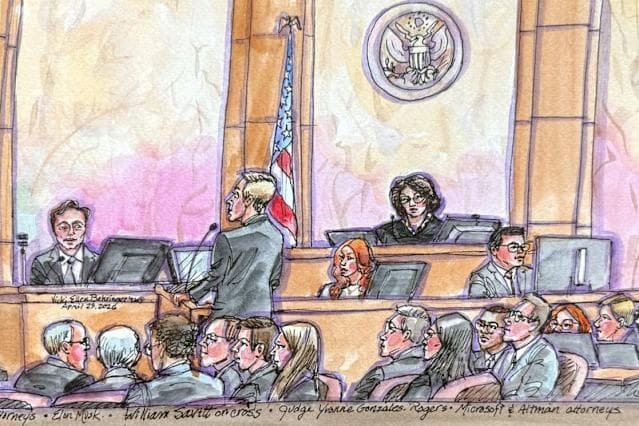
Musk testified for three full days in the first week of trial at the federal courthouse in Oakland — the centerpiece of an opening week that began with jury selection on Monday and concluded with the courtroom dark on Friday. He was calm, occasionally quippy, and relentless in his central framing.
“You can’t just steal a charity,” he told the jury repeatedly. “What you can’t do is have your cake and eat it too.”
He described founding OpenAI as a deliberate counterweight to Google, which he believed was developing AI with insufficient concern for safety risks. He said he had an argument about the subject with Google co-founder Larry Page — a former friend — who called him a “speciesist for being pro-human.” He said OpenAI would not exist without him: “I came up with the idea, the name, recruited the key people, taught them everything I know, provided all the initial funding.”
The dramatic moment came during cross-examination. William Savitt, OpenAI’s lead attorney — who had previously represented Musk and Tesla — asked Musk directly whether xAI had used OpenAI’s technology to train its own models. Musk said it was “partly” true. “It is standard practice to use other AIs to validate your AI,” he said. The courtroom produced an audible reaction. The world’s richest man, suing a company for stealing charitable resources, had just admitted his own competing company had trained on that company’s work.
What OpenAI Said — and the Evidence That Could Sink Musk
| Key Evidence Item | Source | What It Suggests |
|---|---|---|
| Musk email to Tesla VP, 2017 | Submitted by OpenAI | “The OpenAI guys are gonna want to kill me” after poaching OpenAI employee |
| Musk proposals for personal control of OpenAI | Internal documents | Musk sought majority control before departing board |
| Musk text to Altman: “What the hell is going on?” | Admitted by Musk | First protest came when Microsoft invested $10B |
| Musk founding xAI in 2023 | Public record | Direct competitor to OpenAI |
| Musk on losing influence: “I would’ve filed sooner if I thought they’d stolen the charity sooner” | Musk testimony | Statute of limitations question — when did claim arise? |
| Altman email to Musk: “You are my hero, I am hurt by your attacks” | Court exhibit | Relationship and timeline context |
OpenAI’s argument is straightforward and unflattering: Musk supported and knew about discussions regarding for-profit structures while on the board, left when he couldn’t secure control, founded a competing company, and filed a lawsuit only after ChatGPT became a cultural phenomenon and his own xAI needed competitive help. Savitt told the jury in opening statements: “We are here because Mr. Musk didn’t get his way with OpenAI.”
The statute of limitations defense is OpenAI’s strongest technical argument. If Musk knew — or should have known — that he had a legal claim against OpenAI before 2024, and he waited too long to file, the case can be dismissed regardless of the merits. Musk’s answer on the stand — “I would’ve filed a lawsuit sooner if I thought they’d stolen the charity sooner” — is designed to address that vulnerability, but whether the jury accepts it depends on when they believe the evidence shows Musk understood what was happening.
The Judge Who Is Running This Courtroom
Judge Yvonne Gonzalez Rogers has been the most unexpected presence in Week One. Appointed by President Obama, she has run her courtroom with a visible lack of patience for theatrics from both sides.
When Musk’s attorneys opened by invoking AI mass casualty risks to frame the stakes of the case, she shut them down: the contradiction of a man suing to stop a dangerous AI company while simultaneously building his own was too obvious to ignore, and she said so. When Musk spent part of Monday posting on X about the trial before jury selection was complete — calling Altman “Scam Altman” and Brockman “Greg Stockman” — she summoned him to the bench Tuesday morning and threatened a gag order.
The message was clear. This courtroom operates on evidence, not social media. Whether Musk can maintain that discipline over weeks of testimony — and whether Altman, who is expected to testify later this month, can survive cross-examination from Musk’s attorneys — will determine the case’s trajectory as much as any legal argument.
What a Musk Win Would Actually Mean for AI
The stakes of the verdict extend well beyond two billionaires and one company. Musk is asking the court to reverse OpenAI’s conversion to a for-profit structure — to turn back the clock on a transformation that has already attracted hundreds of billions in investment, created thousands of jobs, and produced AI systems used by hundreds of millions of people globally.
A court order requiring OpenAI to return to nonprofit governance would invalidate its planned IPO, potentially void its partnership agreements with Microsoft, and create a legal precedent that any nonprofit technology organization could be challenged if its activities evolve toward commercial success. As Musk told the jury: “This could set a precedent that risks losing every charity in America.”
Prediction markets, which aggregate the collective judgment of thousands of bettors with real money at stake, put Musk’s odds of winning at between 33% and 50% as of Friday. Total wagers across two prediction markets reached $723,000 by the end of Week One — a figure that will grow substantially as the trial continues. Altman and Brockman are expected to testify later this month. The former OpenAI board members who fired Altman in November 2023 — only to have him reinstated days later — will also appear.
Week Two begins Monday. The world’s two most prominent AI builders are about to face each other directly in a federal courthouse in Oakland, with the future structure of the most consequential technology company on earth as the prize.