
WASHINGTON, April 30, 2026 —
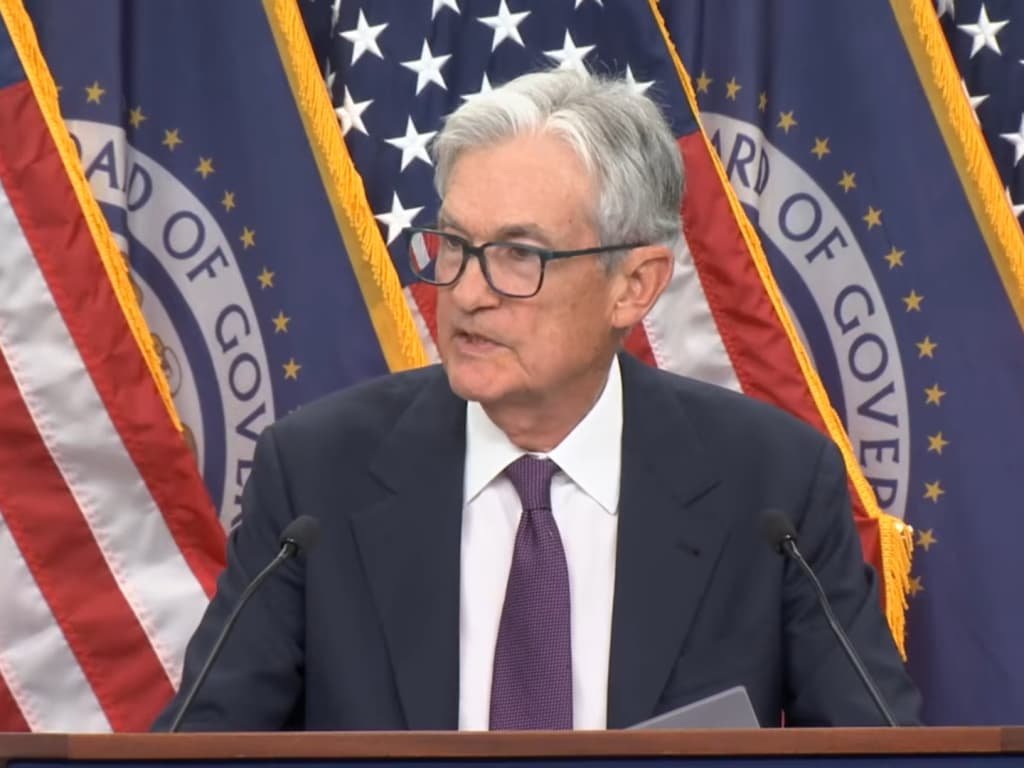
The Federal Reserve held its benchmark interest rate steady Wednesday in what may have been Chair Jerome Powell’s final meeting at the helm — but the vote was anything but routine. In what officials described as an unusually contentious session, the Federal Open Market Committee split 8 to 4, with four dissenting members expressing fundamentally different views on where monetary policy should be headed. The split is the largest in the Fed’s recent history and signals a central bank in transition heading into its most consequential leadership change in nearly a decade.
The benchmark federal funds rate remains in a range of 3.50% to 3.75%, exactly where it has sat since December 2025. Markets had priced in a 100% probability of no change. What they did not price in was the size of the internal divide — or the clarity with which Powell signaled he intends to stay on the Board of Governors beyond his chairmanship, indefinitely.
Why Four Members Dissented — and What They Each Wanted
The four dissenting votes reflected not a single unified position but a split within the split. According to reporting from multiple outlets and comments made at Powell’s post-meeting press conference, the dissenters fell into two camps: those who believed the Fed should signal more explicitly that rate cuts are off the table given persistent inflation, and those who believed the slowing economic data — with Q1 GDP tracking well below 2% — warranted either a cut or at minimum a stronger easing signal.
The split captures precisely the bind the Federal Reserve is in. Core PCE inflation came in at 2.7% for the 12 months ending in February — above the Fed’s 2% target — and energy costs driven by the Iran war have been pushing consumer prices higher for two months. At the same time, Q1 GDP growth is being reported this morning at 8:30 AM Eastern, and multiple forecasting models have it tracking below 1.5% annualized. Slow growth and above-target inflation simultaneously — the combination that makes every policy option the wrong one for someone.
Powell’s Final Meeting — and Why He Is Not Leaving
| Fed Decision | Detail |
|---|---|
| Rate decision | Hold — 3.50%–3.75% benchmark rate |
| Vote | 8-4 — largest dissent split in recent history |
| Powell’s status | Chairmanship ending — staying on Board of Governors |
| Kevin Warsh | Senate Banking Committee advanced nomination — full Senate vote imminent |
| Powell’s stated reason for staying | Waiting for Fed renovation investigation to conclude “with transparency and finality” |
| Powell’s term as governor | Expires January 2028 |
| Warsh’s Fed philosophy | More responsive to market signals — less reliant on lagging economic data |
Powell told reporters Wednesday that he intends to remain on the Board of Governors after Warsh is confirmed — an unusual decision that reflects a specific concern rather than a desire to extend his influence. The Federal Reserve is under investigation for what the Trump administration has characterized as improper renovation spending on Fed facilities. Powell said he will not leave the board until that investigation is “well and truly over with transparency and finality.”
The statement drew immediate commentary from former Fed officials and economists, many of whom noted that a departing chair remaining as a governor to monitor an investigation into his own tenure is without clear precedent. Whether Powell’s continued presence creates tension with the incoming chair will depend entirely on how Warsh chooses to manage the relationship — and how quickly the renovation investigation resolves.
Kevin Warsh: One Vote Away From Running the Fed
The Senate Banking Committee advanced Warsh’s nomination on a party-line vote Wednesday — the same day as the Fed’s rate decision. The full Senate vote is expected shortly, at which point Warsh becomes the 17th Chair of the Federal Reserve.
Warsh served as a Federal Reserve governor from 2006 to 2011, including through the 2008 financial crisis. His monetary policy philosophy has been described by analysts as more market-responsive and less data-dependent than Powell’s approach — meaning he is more likely to act on forward-looking market signals, including falling stock prices or widening credit spreads, rather than waiting for unemployment numbers or PCE readings to confirm a trend.
In the current environment — a stock market at record highs, an economy slowing, inflation above target, and a geopolitical conflict inflating energy prices — Warsh’s approach would likely produce a more dynamic and less predictable Fed than the one Powell ran. Whether that translates to faster rate cuts, a harder inflation stance, or something else entirely will become clear in his first public communications as Chair.
During his Senate Banking Committee testimony on April 21, Warsh called for a “methodical” approach to monetary policy and declined to give any signals on rate timing — a posture designed to avoid prejudging decisions before he is formally in the chair.
The GDP Number That Lands the Same Morning
The Federal Reserve’s rate decision coincides with the release of the Bureau of Economic Analysis’s Q1 2026 advance GDP estimate at 8:30 AM Eastern this morning. The Atlanta Fed’s GDPNow model has been tracking Q1 growth at 1.2% annualized as of April 29 — less than half the Q3 2025 growth rate of 4.4% and well below even the already-weak Q4 2025 reading of 0.5%.
Markets are watching both numbers simultaneously. A GDP reading below 1% would sharpen the argument for rate cuts and could reverse the recent rally in Treasury yields that has helped push mortgage rates below 6%. A reading above 2% — which some forecasters argue is possible given a March retail sales surge of 1.7% month-over-month — would reduce near-term rate cut expectations and potentially push borrowing costs back up.
The combination of the GDP print, the Fed’s 8 to 4 split, and the imminent Warsh confirmation makes this the single most consequential 24-hour window for U.S. monetary policy since the Fed’s December 2025 rate cut. By Thursday morning, the interest rate outlook for the rest of 2026 will look materially different than it did 48 hours ago.
What This Means for American Borrowers Right Now
For the 15 million Americans carrying variable-rate debt — adjustable-rate mortgages, home equity lines of credit, certain auto loans and personal loans — the Fed’s holding pattern means borrowing costs stay elevated. The 3.50% to 3.75% federal funds rate translates to a prime rate of 6.50% to 6.75%, which flows directly into the floor for most variable consumer lending rates.
Mortgage rates, which have fallen below 6% on the 30-year fixed in recent weeks, track Treasury yields more than the Fed funds rate directly. If today’s GDP reading is weak enough to shift expectations toward a June rate cut under Warsh, mortgage rates could fall further. If GDP surprises to the upside and the inflation data remains sticky, the recent sub-6% mortgage rate window may prove brief.
The Fed that Warsh inherits is a central bank with four dissenting members, an unresolved tension between slowing growth and stubborn inflation, a geopolitical energy shock with no clear end date, and a rate level that has sat unchanged for five months. His first rate decision as Chair — likely at the June or July FOMC meeting — will tell markets and households far more about the direction of borrowing costs for the rest of 2026 than anything Powell said Wednesday.