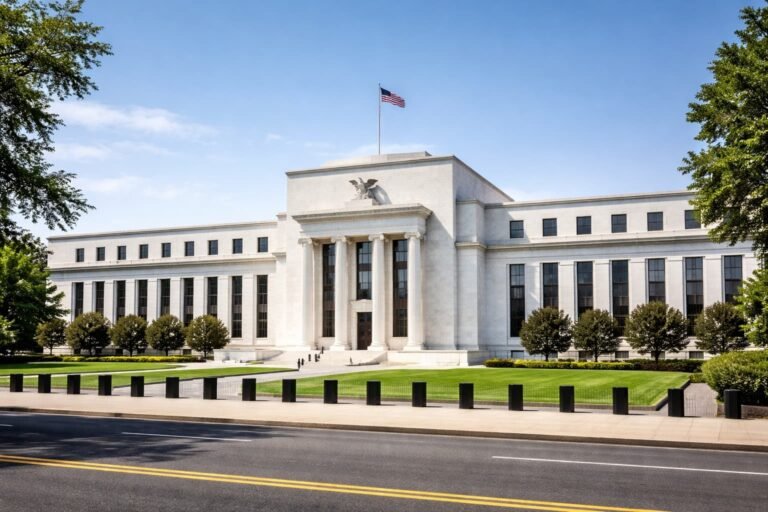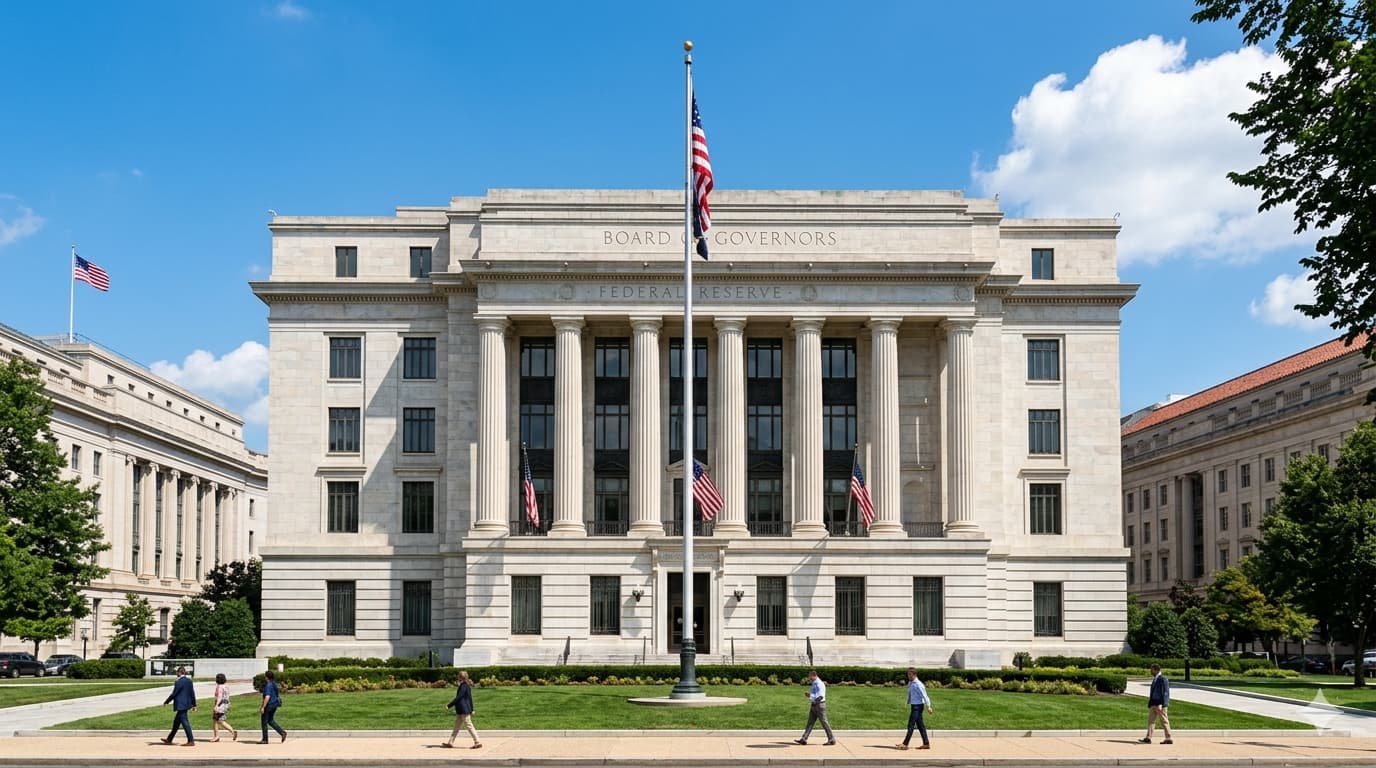

WASHINGTON, APRIL 19, 2026 —
Key Takeaways
- The Federal Reserve has held interest rates steady at 3.5% to 3.75% for two consecutive meetings in 2026 — pausing a rate-cutting cycle it began in 2025 — because the Iran war’s energy shock has pushed inflation back above the level at which the Fed feels comfortable reducing borrowing costs.
- Inflation is now running at 2.7% on both headline and core measures — above the Fed’s 2% target — and Fed officials have explicitly warned that a prolonged Middle East conflict could push inflation high enough to require interest rate increases, not decreases.
- With Fed Chairman Jerome Powell’s term expiring May 15, 2026 and his likely successor Kevin Warsh preparing to take over, the United States faces a rare transition in monetary leadership at the exact moment the economy most needs clear direction on inflation, growth, and rates.
The Federal Reserve’s job is deceptively simple in theory: keep inflation at 2% and employment high. In practice, 2026 has handed the central bank one of the most genuinely difficult macroeconomic environments it has faced since the pandemic — and the result is a Fed that is effectively frozen, unable to cut rates as it had planned and unwilling to raise them yet, waiting for a war it cannot control to determine the economy’s trajectory.
For 67 million Americans with mortgage debt, 120 million with auto loans, and 180 million with credit card balances, the Fed’s frozen position has direct financial consequences. Every month rates stay where they are is another month of elevated borrowing costs, higher minimum payments, and mortgage rates that keep homeownership out of reach for millions of would-be buyers.
How the Iran War Derailed the Fed’s Plan
Going into 2026, the Federal Reserve had a clear path. After cutting rates three times in 2025 to support a labor market that had slowed considerably, the Fed planned one additional cut in 2026 — bringing the federal funds rate from its current 3.5%–3.75% range down toward the 3.25% range it considered “neutral.” Markets expected that cut to come in the summer.
The Iran war changed the math. When U.S. and Israeli strikes began February 28 and Iran closed the Strait of Hormuz, oil prices surged. Crude went from approximately $75 a barrel to a peak above $119. Energy prices feed directly into headline inflation — gas, electricity, heating, and the transportation costs embedded in virtually every product Americans buy. The Fed’s March projections revised 2026 inflation upward from 2.4% to 2.7% — well above the 2% target — and some participants flagged the risk of inflation remaining elevated long enough to require rate increases.
At its March meeting, the Federal Open Market Committee held rates steady for the second consecutive meeting and issued a statement notable for its careful hedging: “The implications of developments in the Middle East for the U.S. economy are uncertain.” One dissenting member, Stephen Miran, voted for a cut — but he was alone. The rest of the committee judged it premature to ease with inflation still elevated and the war unresolved.
| Federal Reserve 2026 Economic Projections (March) | Projection |
|---|---|
| Federal funds rate target | 3.5%–3.75% (unchanged) |
| 2026 GDP growth forecast | 2.4% |
| 2026 unemployment forecast | 4.4% |
| 2026 headline PCE inflation | 2.7% (revised up from 2.4%) |
| 2026 core PCE inflation | 2.7% (revised up from 2.5%) |
| Fed’s inflation target | 2.0% |
| Expected rate cuts in 2026 | One (timing uncertain) |
| Next Fed meeting | May 6–7, 2026 |
What a “Frozen Fed” Means for Your Financial Life
The word “interest rates” can feel abstract until you trace its path into specific monthly expenses.
Mortgage rates remain above 6.5% for a 30-year fixed loan — a level that, combined with still-elevated home prices, has pushed the monthly payment on a median-priced American home to roughly $2,700, nearly double what it was in 2020. The housing market is effectively locked: homeowners with 3% mortgages from 2020 and 2021 have no financial incentive to sell, which keeps inventory low, which keeps prices high, which keeps buyers locked out. Until the Fed cuts rates, mortgage lenders have limited reason to drop below current levels.
Credit card interest rates are hovering near 21% to 22% — the highest in the history of the modern credit card market. With Americans carrying a record $1.28 trillion in credit card debt, those rates translate to approximately $270 billion per year in interest payments flowing from consumers to financial institutions. A family carrying a $10,000 balance and making minimum payments at 22% APR will pay roughly $2,200 in interest annually — money that does not reduce their principal meaningfully.
Auto loan rates for new vehicles average above 7%, contributing to an average monthly car payment that has crossed $800 for new vehicles. Used car financing rates are even higher. The combination of elevated prices and high rates has pushed auto loan terms — the number of months borrowers spread payments over — to historic highs as consumers try to reduce monthly obligations, a pattern that increases total interest paid over the life of the loan.
The Leadership Transition That Adds Uncertainty
Jerome Powell’s term as Federal Reserve Chairman expires on May 15, 2026 — less than four weeks away. His likely successor, Kevin Warsh, has been nominated by President Trump and is expected to be confirmed. The transition introduces an additional layer of uncertainty into an already uncertain monetary policy environment.
Warsh has expressed general support for lower interest rates in the past, but he has not commented on Fed policy since oil prices spiked in February. His views on how aggressively to cut rates given the current inflation picture are unknown. Markets are assuming the new Fed chair will signal one rate cut in the second half of 2026 — but if the Iran war is unresolved, oil prices remain elevated, and inflation stays above 2.5%, even that single cut may be pushed into 2027.
The IMF, in its April 2026 Article IV consultation for the United States, warned that “with the policy rate close to neutral, there is little room to cut interest rates in 2026” given energy price risks and inflation. The fund emphasized that rate cuts should only come if both inflation falls and the labor market deteriorates — two conditions that have not simultaneously materialized.
The Narrow Path Forward
The Fed’s frozen position ends one of two ways. Either the Iran war ends, oil prices normalize over several months, and inflation falls back toward 2% — allowing the Fed to cut once this year as planned. Or the war continues, oil stays elevated, inflation stays above target, and the Fed either holds rates steady through 2026 or, in the worst case, raises them to combat an energy-driven price surge.
The difference between those two outcomes is entirely a function of what happens in Islamabad in the next 72 hours. A signed U.S.-Iran peace deal does not immediately lower gas prices — the Strait reopening takes weeks to normalize supply chains — but it removes the upside risk to oil prices that is currently keeping the Fed frozen in place. And it opens the door to the rate cuts that millions of American mortgage borrowers, car buyers, and credit card holders are waiting for.
The Fed cannot negotiate peace in the Middle East. It can only watch, hold rates, and wait for a resolution that is beyond its control.