
NEW YORK, APRIL 16, 2026 —
Wall Street hit an all-time high Wednesday as blockbuster bank earnings collided with growing optimism about a U.S.-Iran peace deal — pushing the S&P 500 to a fresh record and capping one of the most remarkable two-week market recoveries in recent memory.
The S&P 500 closed at 7,022.95 points, rising 0.8% on the day and eclipsing the previous all-time high set in January. The Nasdaq Composite surged 1.59%, closing at 24,016 points in what analysts described as the index’s strongest 11-day stretch on record. The Dow Jones Industrial Average slipped slightly, dipping 72 points, as blue-chip industrials lagged the technology-led surge.
The twin engines of Wednesday’s record — strong bank earnings and Iran war diplomacy — represent a striking contrast to where markets stood just three weeks ago. In late March, the S&P 500 was down nearly 10% from its January peak, a drop large enough to qualify as a market correction by Wall Street’s standard definition. Since then, it has roared more than 10% higher.
Morgan Stanley Posts Its Best Quarter in History
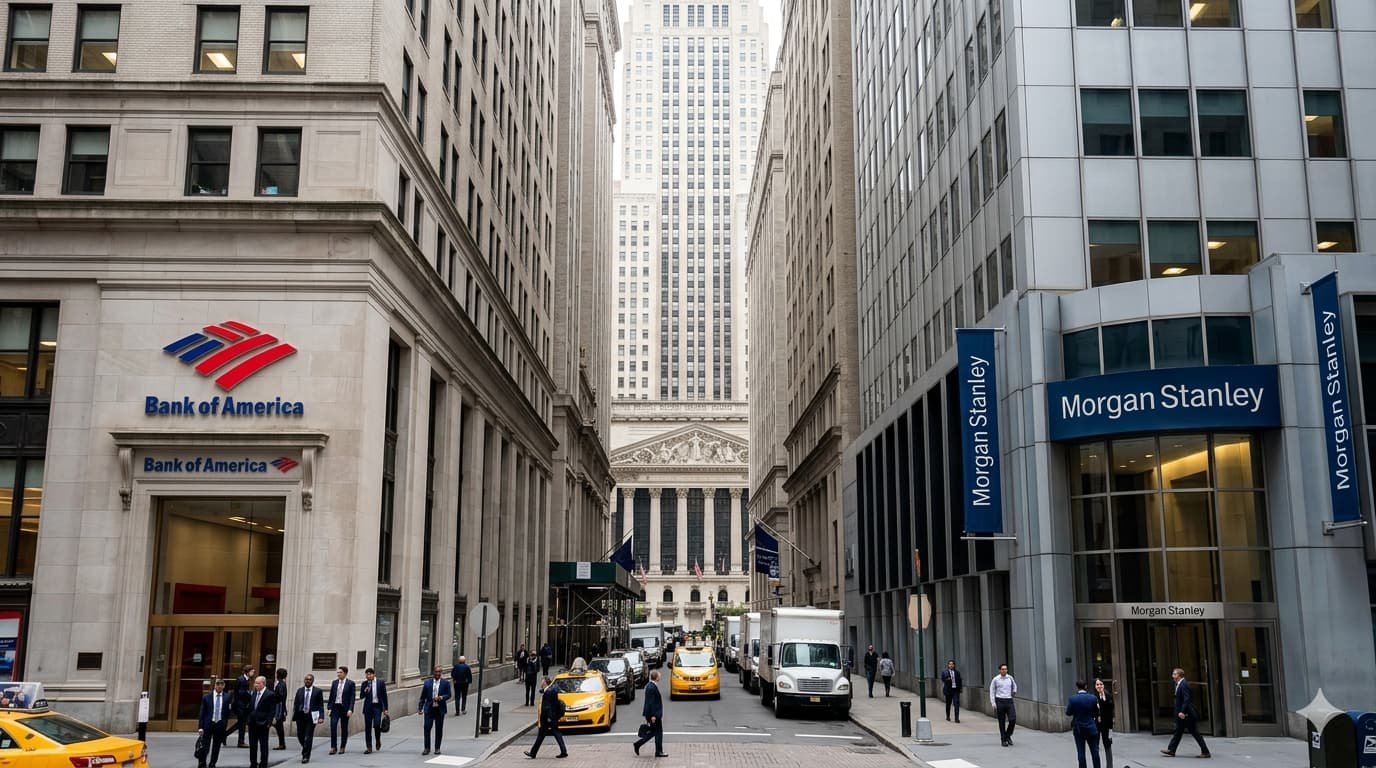
Morgan Stanley delivered what its leadership called a record quarter by every meaningful measure. The investment bank reported earnings per share of $3.43, beating analyst estimates of $3.02 by nearly 14%. Total revenues crossed $20.58 billion — the first time the firm has cleared the $20 billion threshold in a single quarter — on a 16% year-over-year revenue gain.
Equities trading was the standout, generating $5.15 billion in revenue — a new quarterly record that came in roughly $450 million above analyst projections. Fixed income trading added $3.36 billion, about $540 million above expectations, with energy market volatility during the Iran war generating significant trading activity and client demand for risk management products. Investment banking revenue surged 36% to $2.12 billion, driven by a wave of mergers, acquisitions, and IPOs that had been delayed during the high-inflation years of 2023 and 2024.
Wealth management delivered $8.52 billion — a record — as rising asset values and fee-generating transactions drove the division higher. Overall profit jumped 29% to $5.57 billion. The firm’s stock rose more than 4% in after-hours and Wednesday trading.
Bank of America Beats Expectations for 23rd Consecutive Quarter
Bank of America continued its own streak of consistent outperformance. The second-largest U.S. bank by assets reported earnings per share of $1.11 against analyst forecasts of $1.01 — a 9.9% positive surprise — while total revenue reached $30.3 billion, up 7% year-over-year and ahead of the $29.92 billion projection.
The bank earned $8.6 billion in profit during the first quarter. Its equities trading desk also set a record during the period, joining Goldman Sachs, JPMorgan, and Citigroup in what Bloomberg described as the first quarter in history where all four of the largest U.S. banks simultaneously set records in stock trading. Investment banking fees jumped 21%, reflecting the reopening of a dealmaking pipeline that had been largely frozen during 2023 and 2024 as high borrowing costs chilled M&A activity.
Bank of America CEO Brian Moynihan described signs of a “resilient American economy” and pointed to solid consumer spending as the backbone of the quarter’s performance. Digital banking reached a milestone, with 71% of consumer banking sales completed through digital channels.
| Q1 2026 Bank Earnings Scorecard | Earnings Per Share | vs. Estimate | Profit Change |
|---|---|---|---|
| Morgan Stanley | $3.43 | +14% beat | +29% YoY |
| Bank of America | $1.11 | +10% beat | +17% YoY |
| Goldman Sachs | Record equities | Strong beat | +14% revenue |
| JPMorgan Chase | Record markets revenue | Beat | +13% profit |
What Drove the Two-Week Stock Recovery
The rally that delivered Wednesday’s record did not come from economic data alone. It came primarily from two sources: peace optimism and earnings reality.
On the Iran front, investors have been pricing in a growing probability that the U.S.-Iran war ends before it permanently remaps global energy markets. Pakistan’s army chief arrived in Tehran on Wednesday carrying a new diplomatic proposal, and the White House confirmed continued productive engagement with Iranian officials. Oil prices, which had spiked above $119 at the war’s worst moment in March and briefly crossed $103 after last weekend’s Islamabad talks collapsed, settled near $94.93 a barrel Wednesday — still elevated from the pre-war level of $75, but down enough to suggest markets believe the worst-case energy shock is behind them.
The S&P 500 has now gained more than 10% across the past 11 sessions. The Nasdaq’s 11-day winning streak is the longest on record. Both indexes are now higher than they were when the war began on February 28.
For Americans with 401(k) accounts, IRAs, or any index-linked investments, Wednesday’s record means the paper losses from the war’s initial shock have been fully recovered. Whether those gains hold depends almost entirely on what happens in the next few days — and whether the ceasefire, which expires April 21, produces a genuine framework agreement.