
HOUSTON, MARCH 18, 2026 —
Key Takeaways
- NASA astronauts Jessica Meir and Chris Williams stepped outside the International Space Station today for a six-and-a-half-hour spacewalk — the first of 2026 and the 278th in the station’s lifetime
- The spacewalk was delayed nearly 10 weeks after the first-ever medical evacuation from the ISS forced a complete crew reshuffling
- Meanwhile, NASA’s Artemis II moon rocket — carrying four astronauts on America’s first crewed lunar mission in 54 years — is now targeting a rollout to the launchpad as early as March 19, ahead of an April 1 launch
Two things that have never happened before in human history are unfolding simultaneously at NASA this week. In orbit, 250 miles above Earth, two astronauts are floating outside the International Space Station in the vacuum of space to upgrade its power system. On the ground at Kennedy Space Center in Florida, the most powerful rocket America has ever built is being prepared to carry humans to the Moon for the first time since 1972.
For a space agency that has endured years of delays, setbacks, and budget battles, this week feels different.
The Spacewalk That Almost Did Not Happen
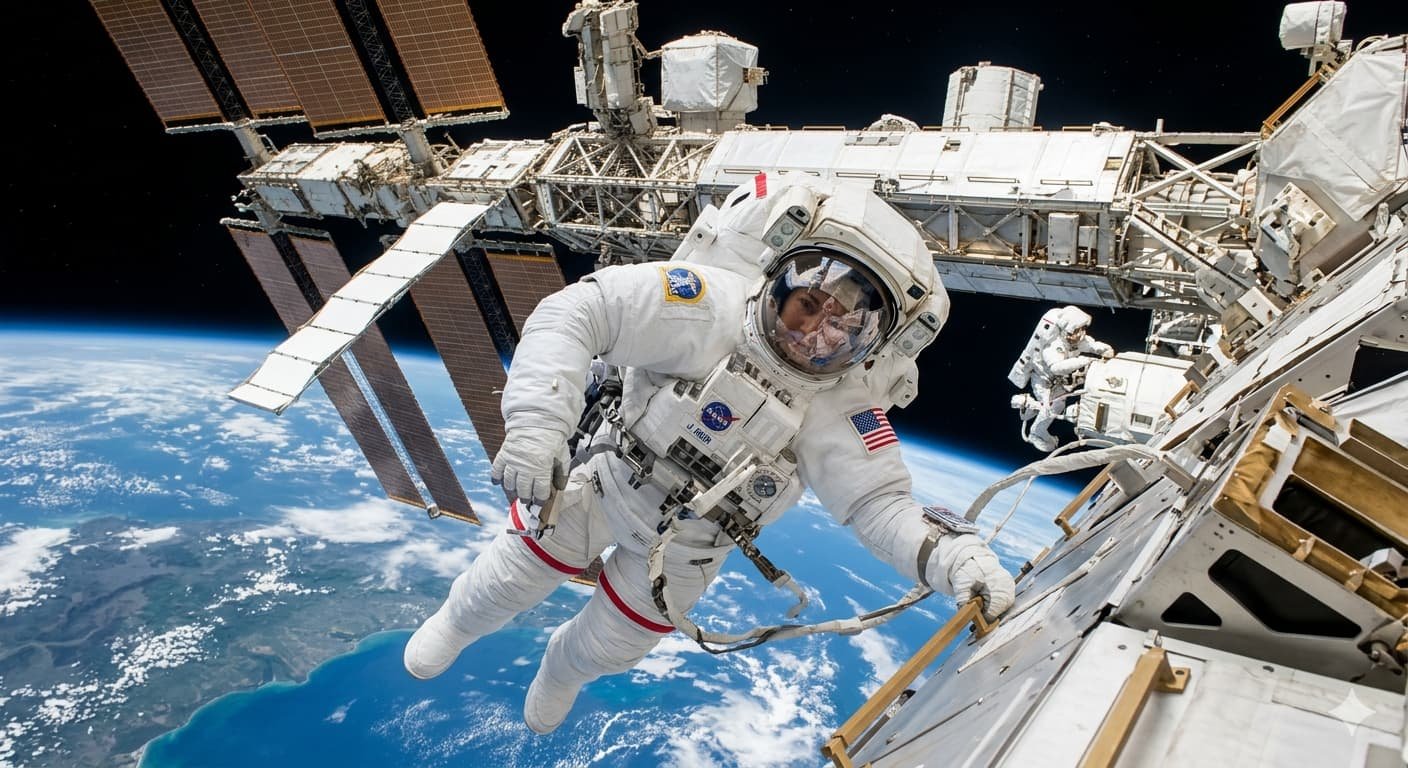
NASA astronaut Jessica Meir and NASA astronaut Chris Williams exited the ISS’s Quest airlock at approximately 8:00 AM ET this morning, beginning what NASA calls U.S. Spacewalk 94 — the 278th spacewalk in the history of the International Space Station and the first of 2026.
The mission: install a modification kit and route cables on the port side of the station to prepare the 2A power channel for the upcoming installation of new Roll-Out Solar Arrays (IROSAs). The upgraded solar arrays will significantly increase the station’s power generation capacity, supporting a new generation of scientific experiments and commercial activities aboard the orbiting laboratory. Meir and Williams also collected surface sample swabs from the exterior of ISS modules to test for microbial life on the outside of the spacecraft.
For Williams, 38, it is his first-ever spacewalk. For Meir, it is her fourth — having previously walked in space during her historic 2019 missions. Live coverage of the spacewalk began at 6:30 AM ET on NASA+, Amazon Prime Video, and NASA’s YouTube channel.
A 10-Week Delay Caused by the First-Ever ISS Medical Evacuation
This spacewalk was originally scheduled for January 8 — nearly ten weeks ago. The original crew assigned to the task was NASA astronaut Mike Fincke and NASA astronaut Zena Cardman. That plan was scrapped when an unnamed member of the SpaceX Crew-11 mission required an emergency medical evacuation from the space station — the first medical evacuation in the ISS’s 25-year history.
The early departure of Crew-11 reshaped the entire schedule aboard the station. The spacewalk was rescheduled, the crew assignments were changed, and both Fincke and Cardman were replaced by Meir and Williams. A second spacewalk — U.S. Spacewalk 95 — will follow in the coming days, targeting the station’s 3B power channel for a similar IROSA preparation task.
ISS Spacewalk Fast Facts
| Detail | Information |
|---|---|
| Spacewalk Number | U.S. EVA 94 — 278th overall |
| Astronauts | Jessica Meir & Chris Williams |
| Start Time | 8:00 AM ET, March 18 |
| Duration | ~6.5 hours |
| Mission | Prepare 2A power channel for IROSA |
| Williams’ Spacewalk Count | First ever |
| Meir’s Spacewalk Count | Fourth |
| Original Date | January 8, 2026 |
| Delay Reason | First-ever ISS medical evacuation |
Meanwhile in Florida: The Moon Rocket Is Moving
While Meir and Williams worked in space, a decision was being made on the ground that could change America’s history. NASA announced Wednesday that it may roll the Artemis II Space Launch System rocket from the Vehicle Assembly Building to Launch Pad 39B at Kennedy Space Center as early as Thursday, March 19 — one day ahead of the previously revised schedule.
The rollout had originally been set for March 19 but was pushed back to March 20 after engineers discovered an electrical harness on the flight termination system of the rocket’s core stage that needed to be replaced. Teams worked faster than expected and recovered the lost time, giving NASA the option to resume the original March 19 target. A final decision was to be made Wednesday.
Once on the pad, the 322-foot tall rocket will undergo final launch preparations ahead of its April 1 launch window — the date NASA has confirmed as its target for Artemis II, the first crewed lunar mission since Apollo 17 in December 1972.
Four Astronauts. Ten Days. The Moon.
The Artemis II crew has been ready and waiting for months. Commander Reid Wiseman, Pilot Victor Glover, and Mission Specialist Christina Koch — all NASA astronauts — along with Mission Specialist Jeremy Hansen of the Canadian Space Agency, will fly aboard the Orion spacecraft on a free-return trajectory around the Moon and back to Earth.
The mission will make history on multiple fronts. Victor Glover will become the first person of color to reach deep space. Christina Koch will become the first woman to travel to the Moon’s vicinity. Jeremy Hansen will become the first non-American to venture into deep space. At its farthest point, the spacecraft will travel roughly 5,000 miles beyond the Moon before swinging back toward Earth — a distance no human has reached since the Apollo era.
The 10-day mission will not land on the Moon. Its purpose is to test every system Orion needs to support a crew in deep space — life support, navigation, communications, heat shield performance at lunar return speeds — before NASA commits astronauts to an actual lunar landing on Artemis III, currently targeted for mid-2027.
America has not sent humans beyond low Earth orbit in 54 years. On April 1, 2026 — if all goes as planned — that changes.
Why This Matters
For most Americans, space news is background noise. Artemis II is not. This is the mission that determines whether humans return to the Moon in this decade — and whether the United States maintains its leadership in space at a moment when China has publicly stated its goal of landing taikonauts on the Moon before 2030. The technology being tested on Artemis II is the same technology that will eventually carry humans to Mars. What happens in the next two weeks at Kennedy Space Center is not a science story. It is a national story.