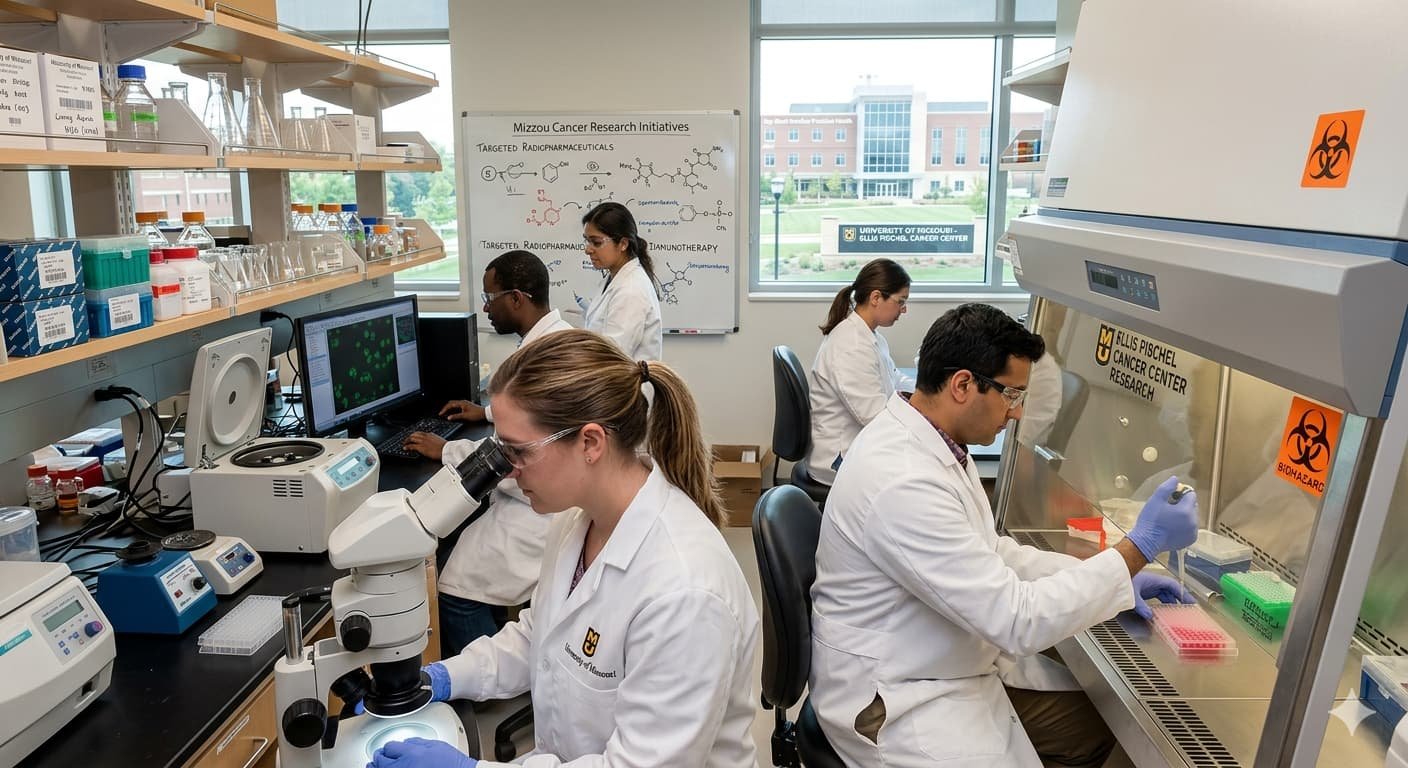

COLUMBIA, MARCH 16, 2026 — Every year, oncologists make one of the most consequential decisions in medicine: which cancer treatment is right for which patient. Get it wrong and a patient endures months of toxic therapy that was never going to work. Get it right and you save not just time and money — you save lives. A new breakthrough from the University of Missouri may have just made that decision dramatically easier.
Researchers at Mizzou have developed what they are calling a cancer flashlight — a tiny engineered antibody that seeks out a specific protein found in cancerous tumors and makes those tumors light up during a standard PET scan. The technique, published in the journal Molecular Imaging and Biology, could transform how doctors identify which patients will respond to targeted cancer therapies — and which ones won’t.
How It Works
The science behind the flashlight is elegant in its simplicity. Barry Edwards, an associate professor of biochemistry at Mizzou’s School of Medicine, engineered a miniature antibody designed to locate and bind to EphA2 — a protein that is frequently overexpressed in many solid tumors and has become an increasingly important target for precision cancer therapies.
Once the antibody finds its target, a radioactive marker attached to it makes the molecule visible during a positron emission tomography scan. The result is striking. In preclinical tests using mice, tumors containing EphA2 glowed clearly and brightly on PET scans within hours of the antibody being injected. Healthy tissue showed no signal. EphA2-negative tumors showed no signal. Only the cancerous cells carrying the target protein lit up — like a flashlight illuminating exactly what doctors need to see in an otherwise dark room.
Why This Matters
The problem the cancer flashlight solves is one that has frustrated oncologists for decades. Targeted cancer therapies — treatments engineered to attack specific proteins on cancer cells — can be extraordinarily effective. But they only work when the patient’s tumor actually expresses the protein the therapy is designed to target. Giving an EphA2-targeted treatment to a patient whose tumor doesn’t carry EphA2 doesn’t just fail to help — it exposes the patient to side effects for no benefit while valuable treatment time is lost.
Currently, determining whether a patient’s tumor carries a specific protein requires a biopsy — an invasive procedure that takes days to process, provides limited molecular detail, and in some cases cannot be safely performed at all depending on the tumor’s location. The cancer flashlight offers a fundamentally different approach. It is noninvasive. It works within hours rather than days. And it can assess the entire tumor rather than the small sample a biopsy captures.
Edwards put it plainly: there is no sense in giving a treatment that won’t work to a patient. His flashlight tells doctors, clearly and quickly, whether it will.
The Broader Picture
EphA2 is not a rare or obscure cancer marker. It is overexpressed in a wide range of solid tumors — including lung, breast, prostate, ovarian, and colorectal cancers — making it one of the most broadly relevant targets in precision oncology. A diagnostic tool that can rapidly identify EphA2-positive tumors across all of those cancer types has the potential to affect millions of patients.
The technique also points toward a broader future for molecular imaging in cancer care. Edwards and his team are already working to develop similar flashlights for other cancer-specific proteins — a research pipeline that could eventually give oncologists a library of molecular imaging tools, each calibrated to a different tumor marker, each capable of guiding treatment decisions within hours.
Getting the technology from preclinical mouse models to human clinical trials is the next step. Edwards estimates that timeline at approximately seven years — meaning widespread clinical use remains a decade away. But in cancer research, a clear proof of concept published in a peer-reviewed journal is precisely how that decade-long journey begins.
For the roughly 2 million Americans diagnosed with cancer every year, a future where the right treatment is identified faster, with less invasion, and with greater precision is not a distant dream. It is the direction this flashlight is pointing.