
By Harshit
NEW YORK, NOVEMBER 7 / 7 AM EDT
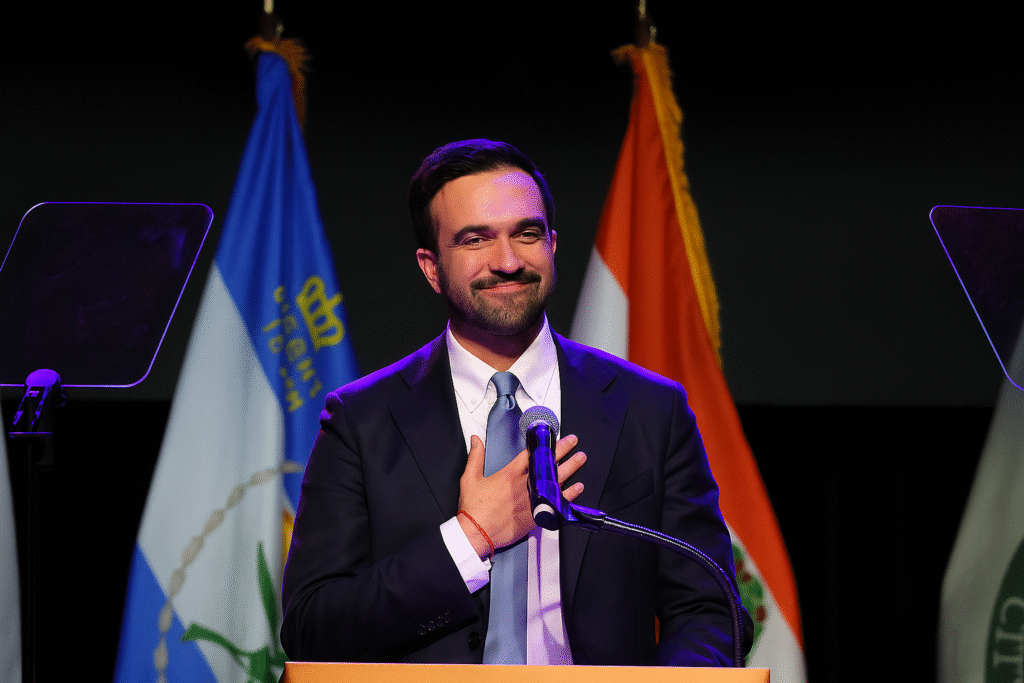
When Zohran Mamdani stepped onto the stage this week to deliver his victory speech as the newly elected first South Asian mayor of New York, it marked far more than a political transition. His win symbolized a cultural realignment, a rewriting of who gets to occupy one of the most visible leadership positions in America’s political and cultural capital. The speech was defiant, the tone was assured, and the identity he embraced onstage — Muslim, Indian-origin, democratic socialist — was not softened or repackaged to comfort mainstream palates.
And when he walked off the stage to the thundering beat of “Dhoom Machale”, the symbolism was undeniable. Here was a mayor claiming his cultural belonging without apology — not performing Americanness, but expanding it.
Yet the ripples of this moment extend far beyond New York City. They stretch across oceans into the cities, living rooms, WhatsApp chats, and political discourse of India — where the victory is being celebrated, debated, and dissected in equal measure.
A Victory That Challenges Narratives
Mamdani’s win stands in sharp contrast to political forces that have long shaped immigration and identity in the United States. For years, former President Donald Trump and the Republican establishment mobilized rhetoric portraying immigrants, especially Muslims, as outsiders or threats. In the wake of 9/11, Islamophobia entrenched itself into New York’s policing, surveillance, and public consciousness.
To see a Muslim mayor now take office in this same city is not merely historic — it is symbolically restorative.
For diaspora communities watching from abroad, especially in India, Mamdani’s ascent reads like vindication of a quieter truth: that South Asians have always been more than silent contributors. They have always been capable of leading.
“This is not just a win,” said Mumbai resident Gulfam Khan Hussain, reacting to the election from thousands of miles away.
“We have been denied the limelight for a long time. It feels like one of us has finally arrived.”
Artist Tanya Lalwani echoed the sentiment:
“It’s really nice to see someone from a South Asian background come this far. It gives all of us hope.”
A Product of Multiple Worlds
Mamdani’s biography reads like the embodiment of global identity:
- Born to Indian parents living in Uganda,
- Raised partly in post-apartheid Cape Town,
- And politically shaped in Queens, New York — one of the most diverse districts in the world.
He is the son of two well-known cultural figures:
- Mahmood Mamdani, respected scholar of colonial and post-colonial politics.
- Mira Nair, internationally acclaimed filmmaker known for diasporic storytelling.
In his victory speech, Mamdani declared:
“I am young. I am Muslim. I am a democratic socialist. And most damning of all, I refuse to apologize for any of this.”
Then he quoted Jawaharlal Nehru’s iconic “Tryst With Destiny” speech.
Moments later, the room erupted as “Dhoom Machale” blasted from the speakers.
“That moment stirred something in our hearts,” said Hussain.
“And Dhoom Machale? Bollywood rocks.”
A Symbol of Diaspora Political Maturity
Mamdani’s win places him alongside other diaspora leaders:
| Country | Leader | Role |
|---|---|---|
| United States | Kamala Harris | Vice President |
| United Kingdom | Rishi Sunak | Prime Minister |
| United States | Zohran Mamdani | Mayor of NYC |
| United Kingdom | Sadiq Khan | Mayor of London |
| Ireland | Leo Varadkar | Prime Minister |
| Scotland | Humza Yousaf | First Minister |
But Mamdani is different.
He does not distance himself from his heritage.
He politicizes it.
The India Debate
Mamdani has been sharply critical of:
- The Citizenship Amendment Act
- The revocation of Article 370
- Narendra Modi’s handling of the 2002 Gujarat riots
To the BJP, this is unforgivable.
Their spokesperson Sanju Verma labeled him:
“A Hinduphobic bigot.”
But many Hindus disagree.
Ria Chakrabarty of Hindus for Human Rights said:
“Zohran is moving beyond symbolic identity to real community issues.”
The debate is not Hindu vs Muslim.
It is pluralism vs nationalism.
In India, Pride Still Dominates
Indian media celebrated him as:
“New York’s First Mayor of Indian Descent.”
For many, this is evidence of India’s global cultural footprint.
“We are a country of leaders,” said Hussain.
“Gandhi. Sunak. Mamdani. This is just the beginning.”