
By Harshit
NEW YORK, JAN. 2, 2026 —
If 2025 was the year of pilot programs, 2026 is the year of deployment.
The U.S. technology sector has stopped trying to impress consumers with conversational novelty and has pivoted decisively toward systems that execute real work. Chatbots that write poetry are fading into the background. In their place are autonomous agents, robots, and infrastructure investments that operate continuously, invisibly, and at industrial scale.
Three forces now dominate the 2026 technology roadmap: Agentic AI, the energy–compute collision, and the return to deep space.
1. The Death of the Chatbot, the Rise of the Agent
In 2026, users no longer “chat” with AI. They assign tasks.
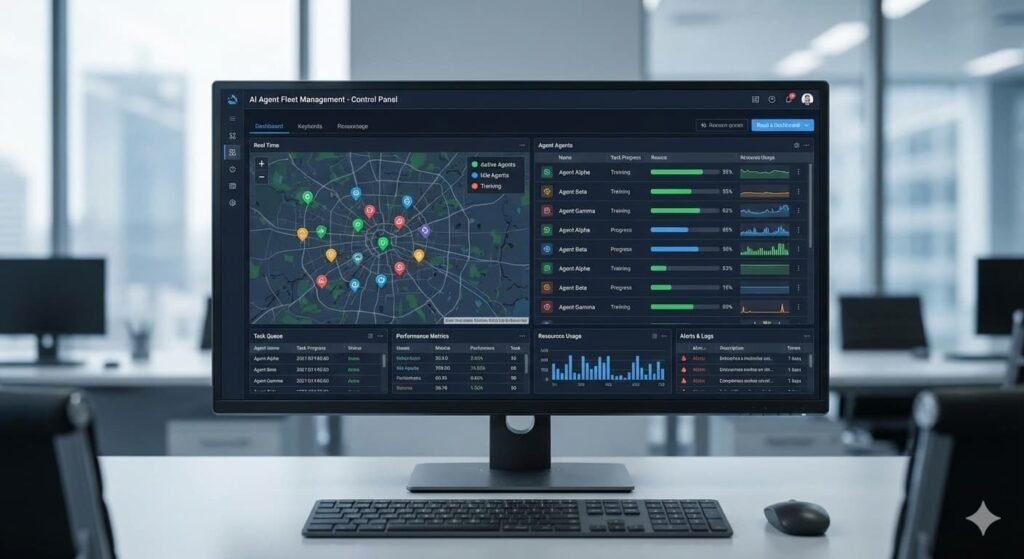
This shift marks the rise of Agentic AI—systems capable of planning, reasoning, and executing multi-step workflows without constant human prompting. Inside enterprises, the interface has moved away from text boxes and toward orchestration layers that coordinate fleets of autonomous agents.
A new operational model is emerging, often referred to as AgenticOps, replacing traditional DevOps in many workflows. Instead of managing infrastructure, teams manage intent.
A practical example already in production: an insurance AI agent that independently logs into claims systems, verifies submitted images, checks policy thresholds, approves payouts, and initiates bank transfers—escalating to humans only when edge cases arise.
This transformation is reshaping the workforce. Entry-level roles are increasingly supervisory rather than productive. The defining professional skill of 2026 is agent orchestration: knowing how to chain, monitor, and govern multiple AI agents to complete complex business processes reliably.
2. The Energy Reality Check
The illusion of an “infinite cloud” has ended.
U.S. data-center electricity consumption has roughly doubled over the past four years, driven by AI inference workloads that run continuously rather than episodically. In 2026, energy availability has become a binding constraint on innovation.
In response, major technology companies—including Amazon, Microsoft, and Google—are no longer relying solely on renewable energy credits. They are investing directly in physical generation.
This year is expected to see the first groundbreakings for tech-owned power assets, including small modular nuclear reactors and dedicated geothermal facilities in states such as Nevada and Utah. Energy procurement has moved from a sustainability function to a strategic imperative.
At the same time, compute efficiency is regaining priority. As power costs rise, enterprises are shifting away from massive, general-purpose models toward smaller, vertically trained AI systems optimized for law, medicine, finance, and engineering. In 2026, inference cost is no longer abstract—it appears explicitly on corporate profit-and-loss statements.
3. Robotics and the Blue-Collar Bot
While software agents automate white-collar workflows, physical robots are entering blue-collar environments.
General-purpose humanoid robots are moving beyond demonstration videos into early production deployments. Companies such as Tesla and Figure AI are transitioning from prototypes to pilot manufacturing runs.
In 2026, initial deployments are expected inside automotive and logistics facilities across states like South Carolina and Michigan. These robots are not performing theatrical feats. They are lifting totes, sorting components, and handling repetitive or hazardous tasks that human workers increasingly avoid.
The economic rationale is straightforward: humanoid robots offer flexibility that traditional automation lacks, allowing a single machine to perform multiple tasks within existing human-designed environments.
4. Space: The Artemis Era Begins
Beyond Earth, 2026 marks a pivotal moment for U.S. spaceflight.
The Artemis II mission, targeted for launch in February, will send four astronauts—Reid Wiseman, Victor Glover, Christina Koch, and Jeremy Hansen—on a crewed journey around the Moon.
This is the first human mission beyond low Earth orbit since 1972, and it serves a purpose far beyond symbolism. Artemis II will validate life-support systems, deep-space navigation, and optical communications critical to LunaNet, the planned lunar communications infrastructure for permanent surface operations in the 2030s.
For the technology sector, Artemis represents the ultimate expression of “physical AI”: software, hardware, energy systems, and autonomy working together in an unforgiving environment.
Conclusion
In 2026, technology stops being performative and starts being practical.
AI leaves the chat window and enters workflows. Power generation becomes a core competency for software companies. Robots move from labs into factories. Humans return to lunar orbit.
The digital transformation is complete.
The physical transformation has begun.