
By Harshit
Anchorage, Alaska | November 14, 2025 | 10:45 PM AKST
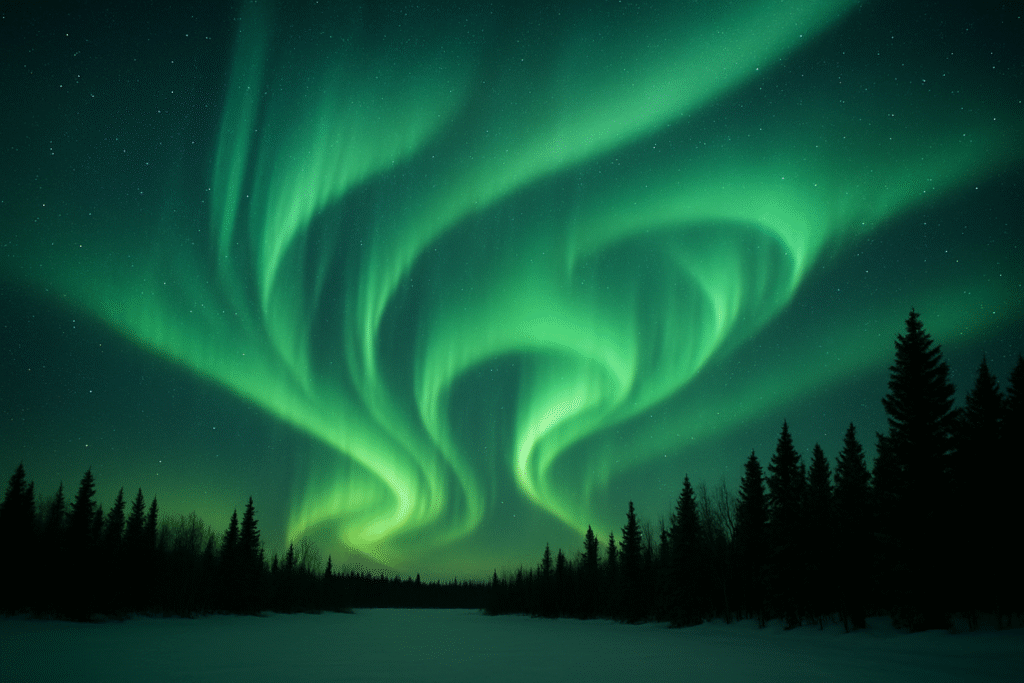
Auroras — the shimmering green, pink, red, and violet lights that dance across polar skies — have fascinated humans for thousands of years. From ancient legends of sky spirits to modern scientific discoveries, these luminous displays remain one of nature’s most beautiful and mysterious phenomena. But behind their beauty lies a remarkable story of physics, solar storms, magnetic fields, and the deep relationship between Earth and the Sun.
Today, auroras are seen not only in the Arctic and Antarctic but occasionally far south into the United States, Europe, and even Asia during strong solar storms. Understanding how they form helps scientists track space weather, protect satellites, and predict when these dazzling celestial shows may appear.
So, what exactly causes auroras?
To understand them, we must begin 93 million miles away — at the Sun.
The Sun: Engine of the Auroras
Auroras are triggered by energy released from the Sun.
Our star constantly emits a stream of charged particles known as the solar wind, made of:
- electrons
- protons
- ionized gases (plasma)
This solar wind flows outward in all directions at speeds between 300 to 800 km/second. But during periods of heightened solar activity — such as solar flares or coronal mass ejections (CMEs) — the Sun ejects billions of tons of plasma in a single burst.
A CME traveling toward Earth carries:
- intense magnetic fields
- high-speed charged particles
- massive energy
When this solar storm reaches Earth, it collides with our planet’s magnetic field. This is where the aurora begins.
Earth’s Magnetic Shield: The Guardian
Earth has an invisible protective barrier known as the magnetosphere — a vast magnetic bubble created by the planet’s iron core.
This magnetic shield:
- blocks harmful solar radiation
- directs solar particles toward the poles
- shapes the aurora zones near the Arctic and Antarctic
Think of the magnetosphere like a giant funnel.
When solar particles strike it, Earth’s magnetic field redirects them toward the north magnetic pole (aurora borealis) and south magnetic pole (aurora australis).
This is why auroras typically appear in:
- Alaska
- Canada
- Scandinavia
- Russia
- Antarctica
In these regions, the magnetic field lines dip downward, allowing charged particles to enter the upper atmosphere.
When Solar Wind Meets Earth: The Light Show Begins
Once solar particles travel along magnetic field lines into Earth’s atmosphere, they encounter atoms of:
- oxygen
- nitrogen
These atmospheric gases absorb energy from the incoming particles. When the atoms become “excited,” they jump to higher energy states — and when they relax back down, they release light.
This process is called atmospheric excitation, and it produces the magical glow we see as auroras.
Different gases create different colors:
| Color | Gas | Altitude |
|---|---|---|
| Green | Oxygen | ~100 km (the most common) |
| Red | Oxygen | Above 200 km |
| Blue | Nitrogen | ~100 km |
| Purple/Violet | Nitrogen | Lower altitudes |
The shape of the aurora — arcs, curtains, ripples, spirals — depends on how solar particles flow along magnetic field lines. Stronger solar storms create brighter, wider, and more colorful displays.
Why Auroras Move and Change Shape
Auroras appear as shimmering waves because:
- the solar wind is constantly changing
- Earth’s magnetic field lines are dynamic
- charged particles accelerate in bursts
- collisions with atmospheric gases vary over time
This produces familiar auroral behaviors:
- Pulsating Glows: Faint pulses every few seconds
- Curtains: Vertical sheets of light waving like fabric
- Arcs: Smooth bands stretching across the sky
- Coronas: Explosions of light radiating outward
During intense storms, the auroras can expand far south into:
- the continental United States
- central Europe
- China and Japan
- even Australia
These events occur during solar maximum, an 11-year period when the Sun becomes more active.
Auroras and Space Weather: More Than Beauty
Auroras are not just beautiful — they are also indicators of space weather, the conditions in space caused by solar activity. Strong solar storms can affect Earth in several ways:
✔ GPS interruptions
Charged particles disrupt satellite signals.
✔ Radio blackouts
High-frequency communications can drop unexpectedly.
✔ Power grid disturbances
Large storms can overload transmission lines.
✔ Satellite damage
Energetic particles can fry electronics.
Scientists at NASA, NOAA, ESA, and other agencies watch auroras closely because they reveal how much energy the Sun is sending toward Earth. Tracking auroras helps protect:
- aviation routes
- communication systems
- astronauts aboard the ISS
- critical infrastructure
Auroras are beautiful — but they’re also warnings.
Can We Predict Auroras?
Yes — but with limitations.
NOAA’s Space Weather Prediction Center (SWPC) monitors solar activity using:
- solar telescopes
- space-based observatories
- magnetometers
- real-time solar wind data
They produce:
- Kp Index forecasts (global geomagnetic activity measure)
- Aurora visibility maps
- Solar wind alerts
But unlike weather forecasting on Earth, space weather prediction is still growing.
Scientists say we are decades behind in solar storm forecasting compared to climate or meteorology models.
Why Auroras Fascinate Us
Beyond their scientific importance, auroras inspire awe because they connect us to forces far beyond Earth. Every aurora is a reminder that:
- our planet is part of a vast solar system
- the Sun constantly interacts with Earth
- magnetic and electric forces shape our environment
For many, witnessing an aurora is a once-in-a-lifetime experience — a natural display that blends science, beauty, and cosmic power.
Conclusion: The Sun–Earth Dance
Auroras are the result of a powerful chain reaction:
- Solar storms send charged particles toward Earth
- Earth’s magnetosphere redirects them to the poles
- The particles collide with atmospheric gases
- These collisions release stunning colors of light
This cosmic interaction — happening hundreds of miles above us — creates one of the most breathtaking phenomena in nature.
Whether seen in Alaska, Canada, Scandinavia, or during rare storms across the United States, auroras continue to inspire wonder and push scientists to learn more about our dynamic Sun and its influence on life on Earth.