
By Harshit
WASHINGTON, NOVEMBER 25, 2025
The relationship between the United States and Venezuela has entered one of its most precarious moments in decades, as an unprecedented U.S. military buildup, sweeping sanctions, and a newly issued terrorist designation have collectively intensified fears of direct confrontation. What began as diplomatic estrangement early in 2025 has grown into a complex geopolitical crisis involving regional militarization, contested elections, airspace hazards, covert operations, and sharp exchanges between Washington and Caracas.
At the center of the latest escalation is Washington’s move to designate the so-called “Cartel de los Soles” as a foreign terrorist organisation (FTO). The Trump administration claims the network—long used informally in Venezuela to describe corrupt officials—is led by President Nicolás Maduro, though it has publicly offered no evidence. Venezuela has denounced the designation as a “ridiculous lie” designed to legitimise potential intervention. Combined with U.S. naval deployments and the suspension of commercial flights into the country, the diplomatic freeze has turned into a tense standoff with global implications.
A Long, Turbulent Road: How US–Venezuela Relations Reached This Breaking Point
To understand the present crisis, observers point to a 25-year arc of hostility and mistrust that began well before Trump’s second presidency. The roots stretch back to 1999, when Hugo Chávez launched the Bolivarian Revolution, an anti-establishment, anti-imperialist platform that dramatically altered Venezuela’s foreign policy posture.
1999–2013: Chavez Reshapes Venezuela and Confronts Washington
Hugo Chávez’s ascent to power marked a seismic shift in Latin America. He moved to rewrite the constitution, consolidate state control over the oil industry, and align Venezuela more closely with Russia, China, Iran, and Cuba. U.S. officials criticized his government for restricting press freedom, suppressing dissent, and eroding democratic norms.
The relationship nearly collapsed in 2002, when Chávez was briefly removed in a coup that Caracas accused Washington of supporting. Though the U.S. denied involvement, the incident left a lasting scar that defined Venezuelan politics for years to come.
2013–2024: Maduro’s Rise and the Era of Sanctions
After Chávez’s death in 2013, Nicolás Maduro inherited a deteriorating economic landscape. As oil prices dropped and mismanagement intensified, Venezuela slid into hyperinflation, shortages, and large-scale migration.
Between 2014 and 2019, the U.S. imposed severe sanctions targeting Venezuelan officials, state-owned oil enterprises, and financial systems. Maduro’s disputed 2018 re-election prompted further international condemnation. The U.S. recognized opposition leader Juan Guaidó as interim president, leading to the most severe diplomatic rupture in years.
When Maduro again won a contested election in 2024—despite evidence suggesting opposition candidate Edmundo González had prevailed—the U.S., United Nations observers, and several Latin American governments questioned the legitimacy of the vote. By early 2025, relations between the two nations were already at a historic low.
Trump’s Return Ushers in a New Phase of Confrontation
President Donald Trump’s return to office in January 2025 dramatically accelerated the collapse of diplomatic engagement.
January–March 2025: Deportations, Sanctions, and Oil Pressure
Just weeks after returning to the White House, Trump revoked Temporary Protected Status (TPS) for about 600,000 Venezuelans residing in the U.S. Deportation coordination between Washington and Caracas began almost immediately, with the first batch of migrants arriving in Venezuela in February.
Other rapid escalations followed:
- February 20: Washington designated the Tren de Aragua gang as an FTO, despite U.S. intelligence agencies acknowledging no evidence linking it to Maduro.
- February 26: Biden-era oil concessions to Venezuela were rescinded.
- March 24: Trump imposed 25% tariffs on countries purchasing Venezuelan oil, further squeezing the Maduro government’s only significant revenue stream.
These moves set the tone for a far more aggressive U.S. posture aimed at isolating and weakening the Venezuelan state.
A Region on Alert: The 2025 Military Build-Up
By late summer, the U.S. strategy became increasingly militarized. In early September, Washington launched a major maritime “anti-narcotics” campaign across the Caribbean and Pacific. Since the operation began, 21 targeted strikes on alleged drug-carrying vessels have killed more than 83 people. No narcotics have been publicly confirmed as recovered, raising concerns among legal scholars that the actions could violate international law.
Key Escalation Milestones
- August 8: U.S. doubles its bounty on Maduro to $50 million, labeling him the “global terrorist leader” of the Cartel de los Soles.
- September–November: U.S. forces initiate one of the region’s largest naval operations in decades.
- October 15: Trump confirms he has authorized CIA covert operations inside Venezuela.
- October 28: Venezuela suspends a gas accord with Trinidad and Tobago after a U.S. warship visit.
- November 12: Caracas launches nationwide military drills across all branches of its armed forces.
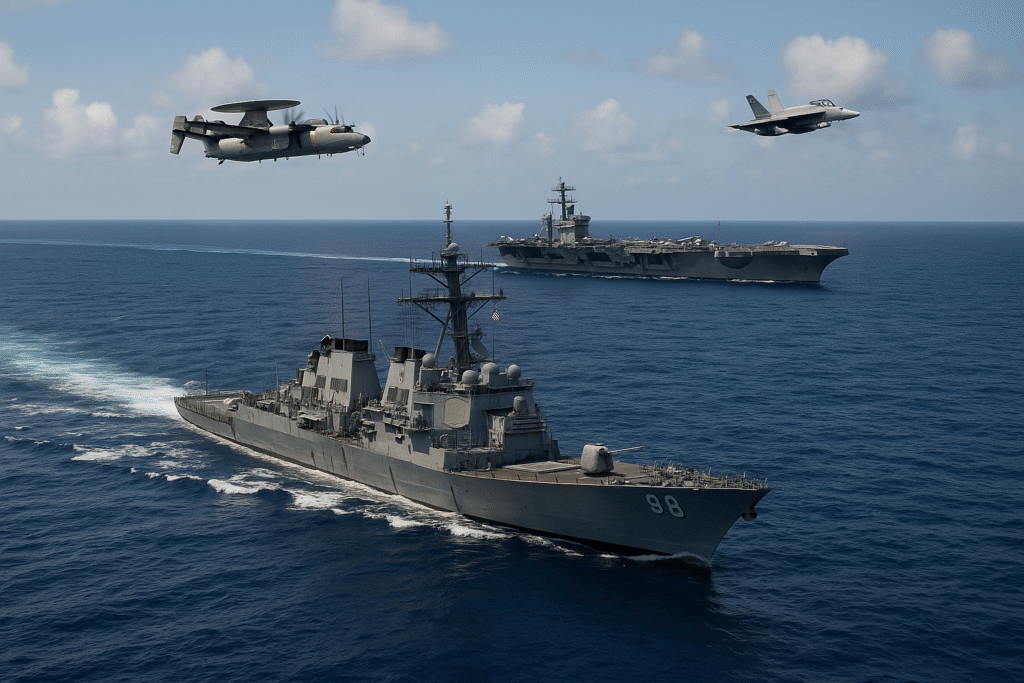
- November 14–16: The U.S. deploys the USS Gerald R. Ford, additional warships, F-35 fighter jets, and thousands of personnel to the Caribbean under “Southern Spear.”
- November 22: The FAA issues a NOTAM warning airlines of hazards in Venezuelan airspace due to GPS interference and “heightened military activity.” Many airlines suspended flights immediately.
Approximately 15,000 U.S. personnel are now stationed in or near the Caribbean—including 5,000 troops in Puerto Rico—alongside Marines operating from amphibious assault ships.
This week, Joint Chiefs Chairman Dan Caine visited Puerto Rico and the U.S. carrier group, marking his second trip to the region since operations expanded. He is expected in Trinidad and Tobago next, signaling Washington’s commitment to reinforcing its regional presence.
The Terrorist Designation: A Legal and Political Flashpoint
On Monday, Washington formally classified the “Cartel de los Soles” as an FTO, claiming it is a narcotics-trafficking network tied directly to Maduro and senior officials. Venezuelan authorities argue the term is colloquial and refers broadly to corrupt individuals rather than a structured cartel.
Criminal researchers support this distinction. InSight Crime describes the network as a “system of corruption” rather than an organized cartel, noting that the FTO narrative “oversimplifies the reality” of illicit activity in Venezuela.
Does the FTO Label Allow Military Action?
Legally, no.
The FTO designation triggers tough financial and material-support sanctions but does not authorize U.S. military operations.
Yet mixed signals from senior officials have fueled speculation. Defense Secretary Pete Hegseth said the designation opens “a whole bunch of new options,” refusing to rule out strikes “inside Venezuela.” Analysts warn that such ambiguity risks further destabilizing a region already on edge.
In the U.S., public opinion appears divided. A Reuters poll shows only 29% of Americans support lethal action against suspected traffickers without judicial oversight.
Caracas Responds: Mobilization and Defiance
Maduro’s government has dismissed U.S. allegations as fabrications designed to justify intervention. Venezuelan officials argue that Washington has long sought regime change to control the country’s oil, gas, and mineral reserves.
“They want Venezuela’s oil and gas reserves. For nothing, without paying,” Venezuelan Oil Minister Delcy Rodríguez said on state television. “They want Venezuela’s gold, diamonds, iron, bauxite—our natural resources.”
Foreign Minister Yvan Gil added that the FTO designation revives an “infamous and vile lie” meant to legitimize an illegal intervention.
Meanwhile, Venezuela has expanded military drills, increased coastal defenses, and strengthened diplomatic ties with Russia, China, and Iran.
Trump has stated he plans to speak directly with Maduro, though no date has been set. Analysts say a call could temporarily reduce tensions—but only if accompanied by concrete diplomatic steps.
Where the Crisis Stands on 25 November 2025
As of today, several risk factors remain active:
- Heightened U.S. military posture in the Caribbean
- Suspended commercial flights due to FAA warnings
- Nationwide Venezuelan military mobilization
- Diplomatic silence despite hints of future communication
- Confusion over the legal impact of the FTO designation
- Regional unease, particularly among Caribbean governments wary of spillover effects
Though neither government has committed to military action, the environment is increasingly unpredictable. Analysts warn that a single miscalculation at sea or in the air could trigger consequences far beyond the intentions of either side.
For now, the world watches as Washington and Caracas navigate one of the most dangerous chapters in their modern history.