
By Harshit
NEW YORK, DECEMBER 22, 2025
U.S. Treasury yields moved slightly higher on Monday as investors positioned themselves for a holiday-shortened trading week that includes several closely watched government debt auctions. With bond markets set to close early midweek and remain shut for Christmas Day, trading volumes were subdued, but attention remained focused on demand for U.S. government debt heading into 2026.
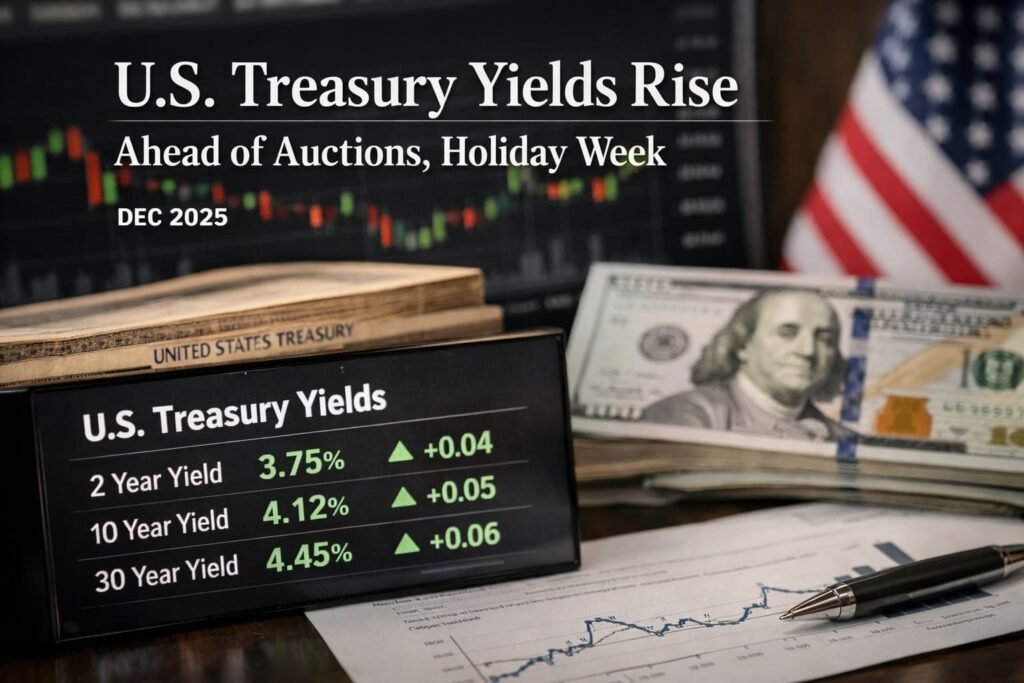
By mid-morning, the 10-year Treasury yield, the benchmark for U.S. government borrowing costs, was up less than one basis point at 4.157%. The 2-year Treasury yield, which is more sensitive to Federal Reserve policy expectations, rose by more than one basis point to 3.496%. Meanwhile, the 30-year Treasury bond yield gained fractionally, reaching 4.831%.
Bond yields move inversely to prices, and one basis point equals 0.01%, or one-hundredth of a percentage point.
Current Treasury Yield Levels
- 10-Year Treasury: 4.163% (+1.2 bps)
- 2-Year Treasury: 3.505% (+2.0 bps)
- 30-Year Treasury: 4.834% (+0.6 bps)
- 1-Year Treasury: 3.522% (+0.8 bps)
- 6-Month Treasury: 3.613% (+0.7 bps)
The modest uptick in yields reflects a cautious market tone rather than a significant shift in rate expectations.
Heavy Auction Schedule in Focus
The Treasury Department is scheduled to hold several large note auctions this week, which will offer a timely snapshot of investor appetite for U.S. debt amid easing inflation and lingering uncertainty over the timing of future Federal Reserve rate cuts.
- $69 billion 2-year note auction: Monday
- $70 billion 5-year note auction: Tuesday
- $44 billion 7-year note auction: Wednesday
Demand at these auctions will be closely scrutinized for signals on how domestic and foreign investors view inflation risks, fiscal conditions, and interest-rate trends as the calendar turns to 2026.
Inflation Data and Rate Expectations
The auction cycle follows the latest inflation data from the Bureau of Labor Statistics, which showed the Consumer Price Index rising at a 2.7% annual rate last month. The reading reinforced the view that inflation pressures are continuing to ease, though they remain above the Federal Reserve’s 2% target.
Despite the moderation in inflation, market expectations for an interest-rate cut at the Fed’s January meeting remain low. Futures pricing suggests investors largely expect policymakers to hold rates steady early in the new year as they assess whether disinflation continues.
Fed Commentary Signals Patience
Adding to the cautious tone, Federal Reserve Bank of Cleveland President Beth Hammack said Sunday that interest rates should be maintained at their current level for several months. She emphasized that inflation risks still outweigh signs of softening in the labor market.
Her remarks align with recent guidance from other Fed officials who have argued for patience, warning that easing policy too quickly could reignite price pressures.
Economic Data Watch: Chicago Fed Index
Investors are also awaiting the release of the Chicago Fed National Activity Index (CFNAI) later Monday. The index, which aggregates 85 monthly indicators of economic activity and inflationary pressure, is expected to come in at -0.4, an improvement from its prior reading of -0.12 in August.
While still in negative territory, an uptick in the index would suggest slightly firmer economic momentum as the year draws to a close.
Holiday Trading Conditions
Bond markets will close early at 2:00 p.m. ET on Wednesday and remain closed on Thursday for Christmas Day, limiting liquidity and potentially amplifying price moves during auction results.
Outlook
With inflation easing but not yet fully contained, and with Fed officials signaling a steady-hand approach, Treasury markets are likely to remain range-bound in the near term. This week’s auctions may set the tone for investor sentiment heading into early 2026, particularly as fiscal concerns and interest-rate expectations continue to shape demand for U.S. government debt.