
By Harshit, New York | October 18, 2025 10 AM EDT
Markets React to Banking Sector Shocks
Every week, it seems U.S. financial markets are rattled by fresh waves of anxiety. The latest jitters have originated from the banking sector, following warnings from two regional lenders that alleged fraud on their books could lead to losses. The news has heightened concerns among investors already wary of lingering systemic risks.
Earlier in the month, bankruptcies at car parts supplier First Brands and subprime auto lender Tricolor had triggered a flurry of market nervousness. Adding to investor unease, U.S.-China tensions over tariffs, advanced technology, and access to rare earths have continued to weigh on sentiment, fueling worries about potential disruptions to trade and supply chains.
Stock Market Resilience Masks Underlying Concerns
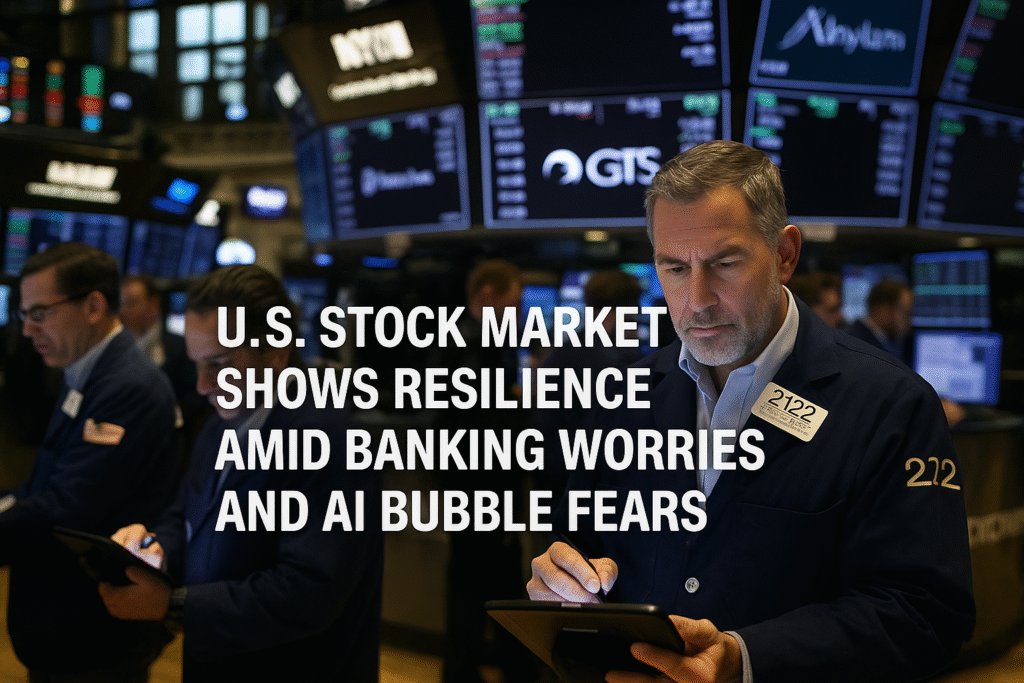
Despite these shocks, the U.S. stock market has largely held steady. While major indexes experienced brief drops of around 3%, they remain significantly higher than the start of the year. The S&P 500 has gained roughly 13% year-to-date, signaling solid performance, albeit slightly lower than the previous year.
“The market has done surprisingly well so far this year, driven by corporate profits and enthusiasm surrounding AI,” said Sam Stovall, chief investment strategist at CFRA Research.
Ironically, this very resilience is contributing to current jitters. Analysts note that U.S. share prices remain elevated relative to earnings, raising concerns about overvaluation in certain sectors, particularly artificial intelligence. The vast amounts of capital being deployed in AI development have prompted debates over whether some valuations are sustainable.
Warnings From Global Financial Authorities
Global financial institutions have sounded alarms about the potential for a sharp correction. The Bank of England highlighted “stretched valuations” and the risk of abrupt market declines. Likewise, JP Morgan CEO Jamie Dimon and Federal Reserve Chair Jerome Powell have warned of heightened market vulnerability, albeit in different contexts.
This week, the International Monetary Fund emphasized these risks in its Financial Stability Report, pointing to trade disputes, geopolitical uncertainty, and rising sovereign debt as potential triggers for volatility.
Investors Remain Alert but Optimistic
According to James Reilley, senior markets economist at Capital Economics, the market declines linked to regional banks reflected investors’ quick response to risk. The brief nature of these drops suggests that while investors are cautious, fear-driven volatility may be temporary.
Analysts at major firms such as Goldman Sachs and Wells Fargo have maintained a positive outlook, raising their year-end S&P 500 forecasts. David Lefkowitz, head of U.S. equities at UBS Global Wealth Management, expects the S&P 500 to end the year around 6,900 points, roughly 4% above current levels. He noted that while banking sector issues and fraud allegations pose risks, the overall default environment remains healthy, and demand for AI technologies shows little sign of abating.
Bubble Concerns vs. Bull Market Fundamentals
The question of whether the U.S. is in an AI-driven bubble remains unresolved. “I’m not saying we’re in a bubble. I’m not saying we’re not,” said Lefkowitz. “The question is what will drive the downside. Things don’t usually spontaneously decline.”
Historically, a typical bull market lasts around four and a half years, according to Stovall. This year, despite a “sticky” inflation environment and ongoing political uncertainties — including the government shutdown and debates over Federal Reserve independence — the market rally has been largely “unloved”, he noted.
Corrections and bear markets have not disappeared, Stovall cautioned, but they may simply be delayed amid resilient growth and strong corporate earnings.
Looking Ahead
As investors navigate regional bank turbulence, AI valuations, and geopolitical frictions, market watchers emphasize that volatility is part of the natural market cycle. While short-term drops may capture headlines, the U.S. stock market’s overall trajectory remains positive, supported by earnings growth, investor confidence in AI innovation, and continued economic expansion.
For now, market participants are taking a measured approach, balancing enthusiasm for long-term growth with caution over potential triggers for correction.