
By Harshit
WASHINGTON, D.C., Nov. 10, 2025
The United States Senate is edging closer to a critical vote that could end what has now become the longest government shutdown in the nation’s history. After 40 days of halted operations, furloughed workers, and deepening economic strain, a bipartisan framework has begun to emerge. The deal, driven largely by centrist Democrats and Senate Republicans, aims to reopen the federal government through January while guaranteeing a future vote on expiring healthcare subsidies under the Affordable Care Act (ACA).
The Senate is expected to consider the Republican stopgap funding package as early as Sunday evening, according to multiple congressional aides briefed on the discussions. The proposal would secure temporary funding for key government agencies until January 31, alongside longer-term allocations for food support programs and the legislative branch through the end of the fiscal year.
A Deal Shaped by Pressure and Public Fatigue
The breakthrough comes amid mounting pressure across the country. As the shutdown dragged into its sixth week, the effects have extended far beyond Washington. Federal workers have gone without pay, air travel has been disrupted, and access to essential food assistance programs has narrowed for millions of low-income families.
Senator Angus King, who played a key role in negotiations, said the Senators backing the agreement believe the shutdown has already gone on too long. “We are seeing real consequences ripple throughout the country,” King told reporters. “There is bipartisan agreement that the government must reopen, and that the American people cannot be used as leverage.”
When asked whether the bill has enough support to pass, King responded: “That’s certainly what it looks like.”
However, the bill is not without opposition from within the Democratic caucus. Some Democrats say the compromise is too weak, particularly because it ties reopening the government to only a promise of a future vote rather than a concrete commitment to extending ACA marketplace subsidies.
Healthcare Subsidies at the Center of the Standoff
At the core of the shutdown is the question of healthcare affordability. Democrats are pushing to extend ACA subsidies for another year, citing data showing enrollment doubled to 24 million people after the subsidies were expanded in 2021. Republicans, who hold a narrow Senate majority, insist that discussions on subsidies must come after the government is reopened rather than as a precondition.
Senator Richard Blumenthal of Connecticut voiced frustration on Saturday, saying he would oppose the stopgap even while acknowledging it may still pass. “I am unwilling to accept a vague promise of a vote at some indeterminate time,” he said. “Healthcare is not a bargaining chip.”
Other Democrats echoed that sentiment, particularly in the House. Representative Greg Casar of Texas, chair of the Congressional Progressive Caucus, called the deal “a betrayal” of working Americans.
“Accepting nothing but a pinky promise from Republicans isn’t a compromise — it’s capitulation,” Casar wrote on X. “Millions of families would pay the price.”
Shutdown Fallout Widens Nationwide
The effects of the shutdown have touched nearly every part of daily life. Travel disruption has been especially severe. According to data from FlightAware, at least 2,300 flights within, into, or out of the U.S. were canceled on Sunday due to air traffic control staffing shortages, with more than 8,000 experiencing significant delays.
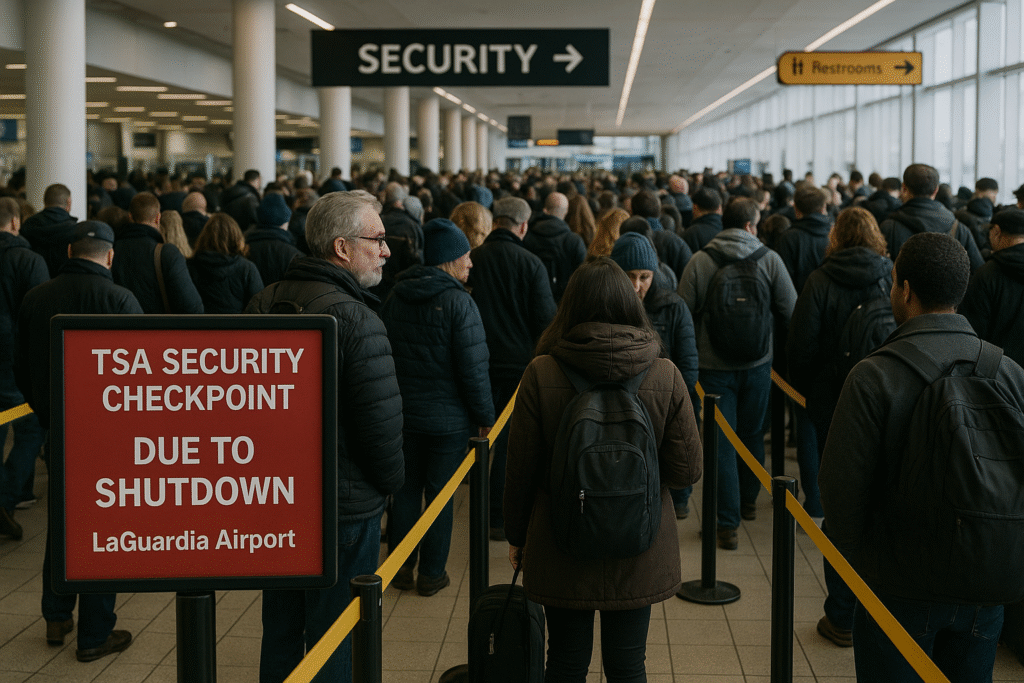
Airports in New York City, Chicago, and Atlanta were among the hardest hit. Travelers reported hours-long lines at security checkpoints staffed by exhausted Transportation Security Administration (TSA) officers, many of whom have been working without pay.
Meanwhile, the food assistance crisis is deepening. The Supplemental Nutrition Assistance Program (SNAP), which supports 42 million Americans, is now entangled in court battles. Despite two lower court rulings ordering full disbursement of benefits, the U.S. Supreme Court temporarily blocked one decision, raising uncertainty about how much aid will be paid this month.
“For Americans, this is really beginning to bite home,” reported Al Jazeera’s Mike Hanna from Washington, D.C. “Families are worried. Workers are worried. The pressure is immense.”
Trump Weighs In
Former President Donald Trump, whose stance has strongly influenced Republican strategy, has proposed replacing ACA marketplace subsidies with direct cash payments to individuals. In a post on Truth Social, Trump described the subsidies as “a windfall for Health Insurance Companies, and a DISASTER for the American people.”
Senator Adam Schiff of California pushed back, arguing that Trump’s plan would effectively dismantle protections for individuals with pre-existing medical conditions. “He is saying: ‘I’m going to give insurance companies more power to cancel people’s policies,’” Schiff said in an interview with ABC News.
What Comes Next
If the Senate passes the stopgap bill, it must then clear the House of Representatives before being sent to Trump’s desk. Even if all procedural hurdles are met quickly, it could take several days before furloughed federal workers return to their offices and government services resume.
For now, millions of Americans wait — some grounded at airports, others calculating shrinking grocery budgets, many simply exhausted. Whether Sunday’s vote ends the shutdown or extends the standoff remains uncertain.
But the pressure on lawmakers has never been clearer.