
By Harshit, WASHINGTON — October 23, 2025 9 AM EDT
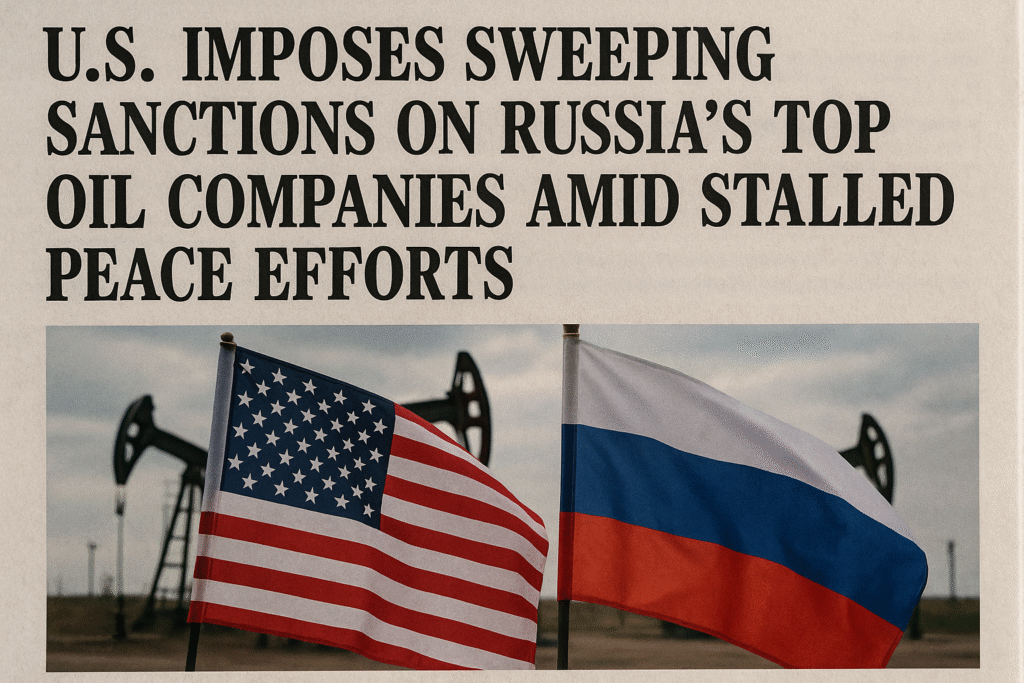
The United States has unveiled sweeping new sanctions targeting Russia’s two largest oil producers, Rosneft and Lukoil, in an effort to push Moscow toward ending its prolonged war in Ukraine. The move marks a significant shift in President Donald Trump’s foreign policy approach, signaling a growing frustration with Russian President Vladimir Putin over the lack of progress in peace negotiations.
A Turning Point in Trump’s Russia Policy
The sanctions were announced on Wednesday, just a day after President Trump canceled a planned summit with Putin in Budapest, citing “unproductive” talks. “Every time I speak to Vladimir, I have good conversations, and then they don’t go anywhere,” Trump told reporters at the White House.
The sanctions come after months of hesitation from the Trump administration, which had resisted such measures in hopes of maintaining diplomatic leverage. For much of his presidency, Trump positioned the U.S. as a “neutral mediator” in the conflict, moving away from his predecessor Joe Biden’s overt support for Kyiv. But officials now admit that approach has yielded little progress.
U.S. Treasury Secretary Scott Bessent called the sanctions “a necessary step,” saying they were designed to hit the Kremlin’s “war machine” directly. “Putin’s refusal to end this senseless war leaves us with no choice but to act,” he said.
Targeting the Heart of Russia’s Energy Industry
Rosneft and Lukoil, the targets of the new sanctions, form the backbone of Russia’s energy sector, exporting around 3.1 million barrels of oil per day — roughly 6% of global supply. The sanctions freeze U.S. assets belonging to both companies and restrict transactions with American financial institutions.
Rosneft, which produces nearly half of Russia’s total oil output, is a critical source of state revenue. According to the U.K. government, oil and gas exports make up more than 40% of Russia’s budget income. The Kremlin, however, brushed off the new restrictions, with a spokesperson claiming that Russia was “immune to sanctions.”
Despite the bravado, Western analysts say the measures could tighten financial constraints on Moscow in the coming months. “While immediate economic damage may be limited, the long-term signal is clear — Russia’s global oil dominance is being systematically isolated,” said Daniel Harper, a senior fellow at the Center for Strategic Energy Studies in Washington.
Global Reactions and Ripple Effects
The sanctions come amid a coordinated Western effort to squeeze Russia’s economy. The United Kingdom imposed similar sanctions earlier this week, and the European Union announced plans to ban Russian liquefied natural gas imports by 2027.
EU Commission President Ursula von der Leyen welcomed Washington’s decision, saying it sends “a clear signal from both sides of the Atlantic that we will maintain collective pressure on the aggressor.”
Not all nations, however, are aligned. China, one of Russia’s biggest oil buyers, condemned the U.S. sanctions, calling them “unilateral and destabilizing.” India, another major customer, is reportedly considering a sharp reduction in Russian oil imports, according to Reuters.
Kyiv Welcomes the Move
Ukrainian President Volodymyr Zelensky, who has repeatedly urged stronger U.S. action, hailed the sanctions as “a good signal” and expressed hope they might accelerate peace efforts. “If the world unites economically, peace becomes possible militarily,” Zelensky said in a televised address from Kyiv.
Zelensky’s optimism came despite continued violence on the ground. Overnight Russian strikes killed at least two civilians in the Ukrainian capital, while earlier bombardments across the country left seven dead, including children.
The Ukrainian leader recently visited Washington seeking advanced long-range Tomahawk missiles to strike Russian territory, but Trump declined the request, citing “complex training requirements.” Analysts believe the sanctions may serve as a substitute pressure tactic in lieu of direct military support.
Peace Talks Stalled, Frustration Grows
Trump’s diplomatic overtures to Moscow appear increasingly strained. A much-anticipated second meeting between Trump and Putin — after their August talks in Alaska — was shelved indefinitely. According to U.S. officials, Secretary of State Marco Rubio’s call with Russian Foreign Minister Sergei Lavrov failed to yield progress.
“I just felt it was time. We waited long enough,” Trump said of the sanctions. He added that he hoped they could be “swiftly withdrawn” if Russia agreed to a ceasefire.
Kremlin spokesman Dmitry Peskov reiterated Russia’s demand that Ukrainian forces withdraw from parts of the Donbas region still under Kyiv’s control — a condition Kyiv and its allies have rejected.
A Coordinated Western Front
The U.S. move aligns with broader transatlantic efforts to choke off Russia’s war financing. Earlier this year, both Washington and London sanctioned Gazprom Neft and Surgutneftegas, two other major Russian energy firms.
At the White House during Wednesday’s announcement, NATO Secretary-General Mark Rutte praised the sanctions for “putting more pressure on Putin.” Rutte said Europe and Kyiv had formulated a 12-point peace plan that includes freezing the front lines, exchanging prisoners, returning deported children, and setting up a Ukraine reconstruction fund.
Trump has privately expressed support for the plan but insists that any agreement must be accompanied by an immediate halt to hostilities. “A ceasefire first, then we talk peace,” Trump told reporters.
Energy Markets and Global Consequences
The global oil market reacted cautiously, with prices rising slightly on fears of supply disruptions. Energy experts say that while Russia may divert some oil to Asia, tightening Western sanctions will make transactions riskier and less profitable.
“The walls are closing in on Moscow’s energy exports,” said economist Marie Fontaine of the Paris Institute for International Affairs. “Even if they find buyers, financial channels are shrinking fast.”