
By Harshit, WASHINGTON, Nov. 1, 2025 2 AM EDT
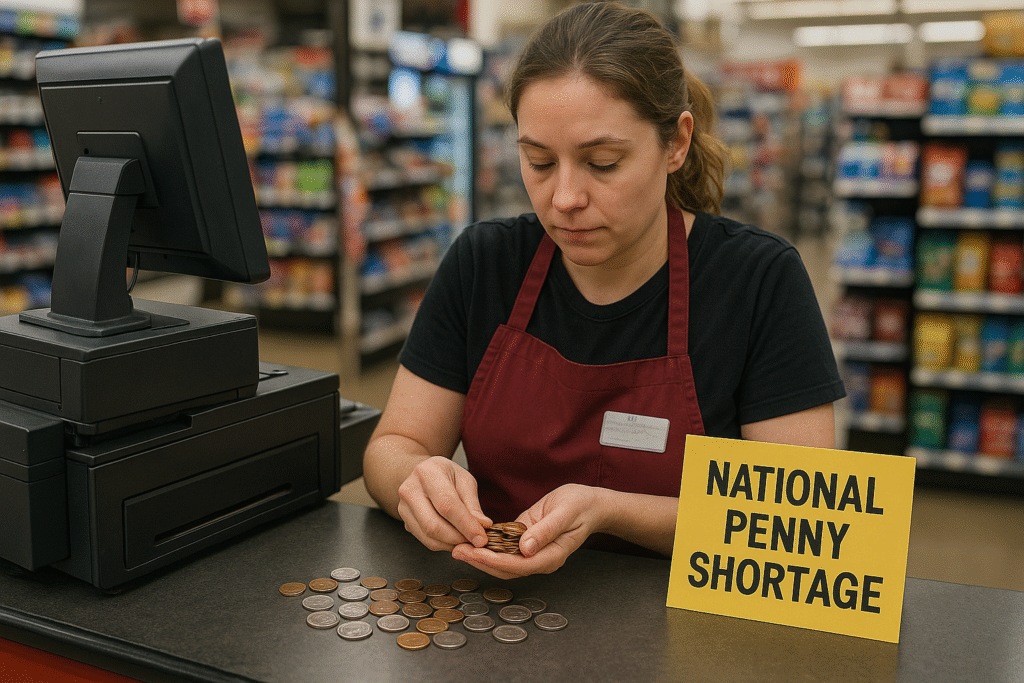
The humble U.S. penny, once seen as an afterthought in daily commerce, has suddenly become a major problem for retailers nationwide. Since the Trump administration officially ended minting of one-cent coins earlier this year, businesses are finding themselves short on change — and short on solutions — as they scramble to adapt to life without the penny.
A Nation Running Out of Change
The U.S. Mint halted penny production in May 2025, following President Donald Trump’s decision to eliminate the coin from circulation to cut government spending. “We’re ripping the waste out of our great nation’s budget — even if it’s a penny at a time,” Trump declared on social media in February.
At the time, the Treasury Department projected that any shortage would not be felt until early 2026. Instead, the consequences arrived months early. By late summer, banks began running out of one-cent coins, and retailers suddenly found themselves unable to make exact change for cash customers.
“We first started hearing about the issue in late August, early September,” said Dylan Jeon, senior director of government relations with the National Retail Federation. “It’s really impacting any business that deals with cash payments.”
Rounding Becomes the New Normal
With pennies disappearing from circulation, thousands of businesses have begun rounding cash sales up or down to the nearest five cents. But this quick fix has sparked widespread confusion — and in some cases, financial losses.
“Some cities require exact change, and others don’t allow differences between cash and card prices,” Jeon explained. “So, many stores are simply rounding down to avoid complaints or legal risk.”
That decision comes with a cost. “You’re talking about losing up to four cents on every cash transaction across thousands of stores. It’s unsustainable,” Jeon warned.
Kwik Trip, one of America’s largest convenience store chains, has already confirmed it will round transactions down to the nickel — a move expected to cost the company up to $3 million this year.
Some stores have turned to creative solutions, urging customers to pay in exact change or offering small discounts to those who bring in jars of leftover pennies. Others, however, are considering going cashless altogether to avoid the hassle.
A Historical Turning Point
While coin discontinuations aren’t new — the half-cent, three-cent, and 20-cent coins all disappeared in the 1800s — ending the penny marks a significant break from U.S. tradition. Introduced in 1793, the penny has been a fixture of American currency for more than 230 years.
“It costs nearly four cents to make a single penny,” said Jeff Lenard of the National Association of Convenience Stores. “People don’t want the penny — until they can’t get it back in change.”
Economists argue the change could have unintended consequences. Mark Weller, executive director of Americans for Common Cents, warned that eliminating the penny could hurt lower-income Americans, who rely more heavily on cash transactions.
“These are people who don’t have access to credit cards or online banking,” Weller said. “You’re hurting lower-income groups when you start rounding transactions.”
Ironically, while eliminating the penny saves money, it might actually cost more in the long run. Producing a nickel costs nearly 14 cents, meaning the demand for more nickels could wipe out any government savings from discontinuing the smaller coin.
Calls for Federal Guidance
Business groups are now calling on the Treasury Department and Federal Reserve to issue nationwide rounding guidelines to standardize how cash prices should be adjusted. Without clear policy, they argue, inconsistencies across states could lead to consumer confusion and retailer losses.
“There will always be pennies out there,” Jeon noted. “But they’re sitting in jars, couches, and drawers. Those coins aren’t making it back into circulation — and that’s the real issue.”
As the holiday shopping season approaches, retailers fear the penny shortage could worsen, complicating transactions at a time when foot traffic spikes. Economists say the episode highlights a broader need to modernize U.S. currency systems — balancing the shift toward digital payments with fairness for those who still depend on cash.