
By Harshit, U.S. Labor & Economic Strategy Review
As of December 2025, the dominant economic challenge transcending political cycles and quarterly earnings reports is the radical, accelerating transformation of the United States labor market. This shift is defined by the convergence of three structural forces: the exponential adoption of Artificial Intelligence (AI) and robotics, wage polarization, and a widening misalignment between the skills demanded by industry and those produced by the education system. This challenge is evergreen because it shapes productivity, income inequality, and the future solvency of America’s social safety nets.
I. The Automation Imperative and Labor Displacement
The most significant driver of labor market transformation is the declining cost and rising capability of automation technologies. Where economists once distinguished between physical automation (robotics in manufacturing) and informational automation (software replacing clerical roles), modern Generative AI collapses these boundaries. It now threatens highly skilled non-routine white-collar professions once assumed to be automation-proof.
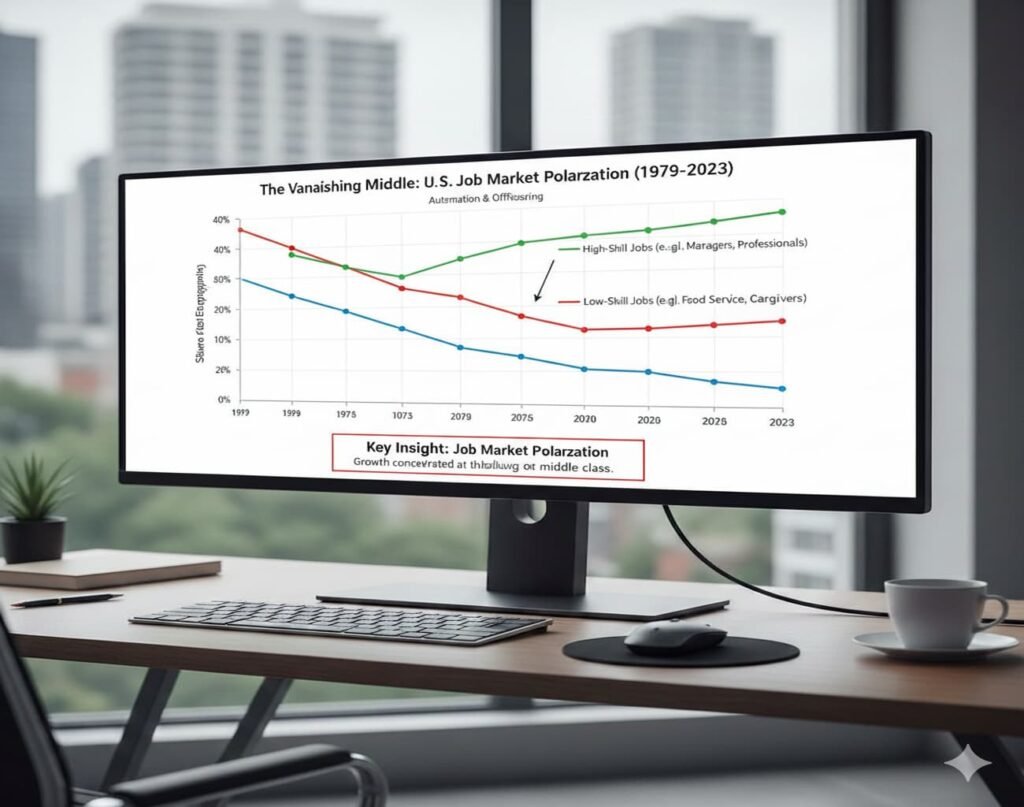
A. The Hollowing Out of Middle-Skill Jobs
The U.S. continues to see the erosion of middle-wage, routine jobs across both cognitive and manual domains. Automation excels at repetitive, predictable processes, making roles like data entry, paralegal support, customer service, assembly line work, and basic logistics especially vulnerable.
Impact on Productivity:
From 2020 to 2025, early AI adoption produced measurable productivity gains in finance, logistics, and software development. But overall economic output has not fully reflected these investments due to transition costs, workforce dislocation, and a growing skills gap.
Shifting Economic Sectors:
The long-term trend away from manufacturing (secondary sector) toward services (tertiary sector) continues. Yet the service sector itself is splitting into:
- High-skill analytical services enhanced by AI
- Low-skill physical services that AI cannot easily replicate
B. The Rise of “Augmented” Labor
The most successful adaptation strategy so far is labor augmentation, not replacement. In this model, AI functions as a co-pilot. For instance, AI increasingly performs diagnostic analysis in medicine, leaving physicians to handle complex decisions, care coordination, and patient communication.
This shifts worker responsibilities from execution toward:
- Validation
- Collaboration
- Complex reasoning
- Human-centered problem solving
Demand rises for hybrid roles combining technical fluency and advanced human skills.
II. The Deepening Skills Gap and Educational Misalignment
The persistent gap between job openings and unemployed workers is not cyclical but structural. It reflects a mismatch between what the economy needs and what the education system produces.
A. The Challenge of Tacit Knowledge
The modern economy increasingly prizes tacit knowledge—skills that are difficult to codify or automate:
- Critical thinking
- Complex communication
- Creativity
- Emotional intelligence
These are the skills that complement AI rather than compete with it.
Yet the U.S. education system—from K-12 through universities—lags behind in adapting curricula to emphasize:
- Data literacy
- Advanced programming
- Human–machine collaboration
- Digital problem-solving
This mismatch exacerbates inequality.
B. Wage Polarization and the K-Shaped Recovery
AI-driven transformation is producing stark wage divergence, contributing to the ongoing K-shaped recovery of the 2020s.
High-Wage Segment (Top of the K):
Highly skilled professionals—engineers, analysts, designers—whose productivity is multiplied by AI.
Low-Wage Segment (Bottom of the K):
Workers performing non-routine physical service jobs with low productivity growth (home health aides, hospitality workers).
The Eroding Middle:
Middle-wage, routine occupations shrink, pushing workers either upward (through retraining) or downward into low-skill roles.
This is a primary driver of the long-term rise in U.S. income inequality.
III. Policy Implications and Future Adaptation
This evergreen economic transformation requires generational policy solutions rather than short-term fiscal or monetary interventions.
A. Investment in Human Capital and Continuous Reskilling
The old model of lifetime employment after a single educational investment is obsolete. The new economic reality demands continuous learning.
Key policy and industry priorities:
Micro-Credentialing
Short, fast, standardized skill certifications in:
- Prompt engineering
- Data visualization
- Robotics maintenance
- AI operations and oversight
Public–Private Partnerships
Incentivizing employers to fund workforce reskilling programs so the cost of automation-driven transition is shared.
B. The Debate on Social Safety Nets
As automation risk rises, debates intensify around how best to sustain displaced workers.
Universal Basic Income (UBI) vs. Universal Basic Services (UBS):
- UBI: direct cash transfers
- UBS: guaranteed essentials (healthcare, housing, education)
Automation Tax:
A proposed tax on robot utilization or automated systems to fund retraining and transition programs.
C. The Fiscal Burden of Entitlements
Automation threatens the long-term viability of Social Security and Medicare. These systems rely on:
- A broad working tax base
- Strong middle-class wage growth
If automation compresses middle-class wages or reduces total employment, tax revenues fall while commitments to retirees grow—producing a structural fiscal imbalance.
This transformation of the labor market is the most critical and enduring economic issue facing the United States. Addressing it requires sustained national commitment to adaptation, education reform, and large-scale human capital investment.