
WASHINGTON, MARCH 14, 2026 — They were called heroes on Friday morning, while two of them were still missing in the Iraqi desert. By Friday afternoon, there was nothing left to search for. All six crew members of the U.S. Air Force KC-135 refueling aircraft that crashed in western Iraq on Thursday have been confirmed dead, U.S. Central Command announced — pushing America’s military death toll in Operation Epic Fury to at least 13 service members in just two weeks of war.
“War is hell. War is chaos,” Defense Secretary Pete Hegseth said at the Pentagon Friday. “And as we saw yesterday with the tragic crash of our KC-135, bad things can happen. American heroes, all of them.”
What Happened
The aircraft went down at approximately 2:00 PM Eastern Time Thursday in the sparsely populated desert region of western Iraq, near the Jordanian border, while operating in support of Operation Epic Fury. A second KC-135 was involved in the same incident — that aircraft declared an emergency, transmitted a 7700 distress code, and landed safely at Ben Gurion Airport in Tel Aviv missing a large portion of its vertical stabilizer.
CENTCOM confirmed Friday that all six crew members aboard the downed aircraft were dead. “The aircraft was lost while flying over friendly airspace during Operation Epic Fury,” the command said in its statement. “The circumstances of the incident are under investigation. However, the loss of the aircraft was not due to hostile fire or friendly fire.”
The identities of the six service members are being withheld until 24 hours after their families have been notified. Hegseth said he would personally be at Dover Air Force Base in Delaware when the crew members are brought home for a dignified transfer ceremony.
A War’s Invisible Backbone
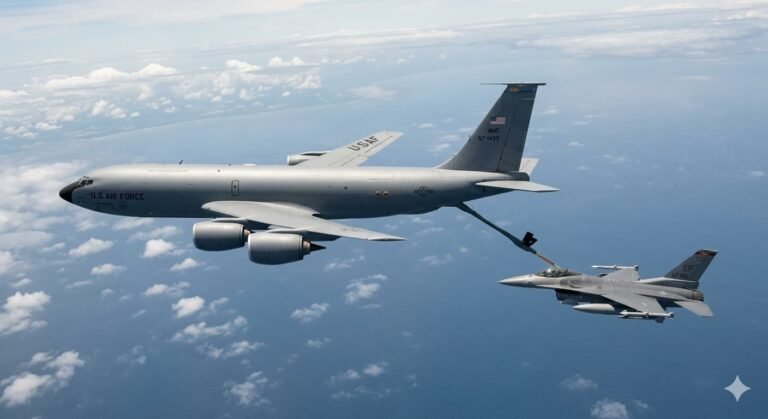
The KC-135 Stratotanker is one of the most essential — and least visible — aircraft in the American military’s arsenal. It is, in the simplest terms, a flying gas station. Without it, the fighter jets and bombers conducting strikes deep inside Iran cannot reach their targets, sustain long missions, or maintain the operational tempo that Operation Epic Fury demands.
The aircraft has been in service for more than 60 years — the last unit was delivered in 1965 — and is based on the same airframe as the Boeing 707 passenger jet. A standard flight crew runs three to four people: a pilot, a copilot, and a boom operator responsible for the mid-air refueling connection. The fact that six people were on board suggests some were backup crew for what was likely a long-duration combat support mission.
The loss marks the fourth U.S. aircraft downed since Operation Epic Fury launched on February 28. The first three were F-15E Strike Eagles, lost in a friendly fire incident on March 1 in which all six crew members ejected safely.
The Death Toll Climbs
The six deaths bring the total number of U.S. service members killed in connection with the Iran war to at least 13. Six Army Reserve soldiers were killed in a drone strike at Kuwait’s Port of Shuaiba on March 1. A seventh service member, Army Sergeant Benjamin Pennington of Glendale, Kentucky, died on March 9 after sustaining injuries in an attack at Prince Sultan Air Base in Saudi Arabia. An eighth died from a non-combat medical emergency during the conflict.
About 140 U.S. service members have been wounded, with eight facing severe injuries. General Dan Caine, Chairman of the Joint Chiefs of Staff, confirmed at Friday’s Pentagon briefing that the crash occurred over friendly territory while the crew was on an active combat mission.
The Questions That Remain
Iran-backed militias called the Islamic Resistance in Iraq claimed Friday that they had shot the aircraft down, adding they had targeted a second KC-135 as well. The Pentagon directly contradicted that claim — but offered no alternative explanation for why two aircraft flying in the same operation simultaneously suffered catastrophic damage over friendly airspace.
U.S. officials told CBS News they believed the incident may have involved a mid-air collision, though they stressed the investigation remained open. The KC-135, despite its age, does not always carry parachutes — a detail that drew sharp attention on Friday as the military confirmed there were no survivors.
Thirteen Americans have now come home from this war in flag-draped coffins. The president who launched it says it will end soon. The families of those thirteen are already living in the world that comes after.