
By Harshit
WASHINGTON, DECEMBER 4, 2026 —
Bureau of Labor Statistics delivered a November employment report on Friday that confirmed what many Americans already feel: the U.S. economy is stable on paper, but strained in practice.
The latest data shows the labor market continuing to cool without cracking—meeting the technical definition of a “soft landing,” even as households struggle with the lingering effects of elevated prices and high borrowing costs.
As 2026 nears its close, the economy is not in recession, nor is it accelerating. Instead, it remains stuck in what economists increasingly describe as “sticky stabilization”—a prolonged period of modest growth, stubborn inflation, and cautious monetary policy.
November Jobs Report: Stability Without Momentum
The U.S. economy added 145,000 jobs in November, modestly exceeding consensus expectations of roughly 130,000. The unemployment rate held steady at 4.4%, slightly above early-year lows but well below historical recession thresholds.
At first glance, the data supports policymakers’ long-standing goal: slowing demand without triggering widespread job losses. Beneath the surface, however, wage and cost dynamics tell a more uncomfortable story.
Average hourly earnings rose 3.1% year over year, barely keeping pace with inflation, which has hovered near 2.7%–2.9% for most of 2026. For millions of households, that means paychecks are growing—but purchasing power is not.
Economists note that the cumulative price increases of the past four years continue to weigh on consumer sentiment, even as monthly inflation readings remain controlled.
“Stagflation Lite” Has Become the Base Case
This was supposed to be the year inflation finally retreated to the Federal Reserve’s 2% target. Instead, it entrenched itself just above it.
Services inflation—driven by housing, insurance, healthcare, and labor-intensive sectors—has proven particularly resistant. While goods prices have stabilized, these core services continue to rise at a pace that limits real income gains.
The result is a K-shaped economy:
- Upper tier households, often asset-rich or employed in technology and finance, have benefited from equity markets and AI-driven productivity gains.
- Wage-dependent households continue to feel squeezed, not by sudden shocks, but by persistent everyday costs.
This slow erosion, rather than abrupt downturns, has become the defining economic experience of 2026.
Federal Reserve Faces a Narrow Path
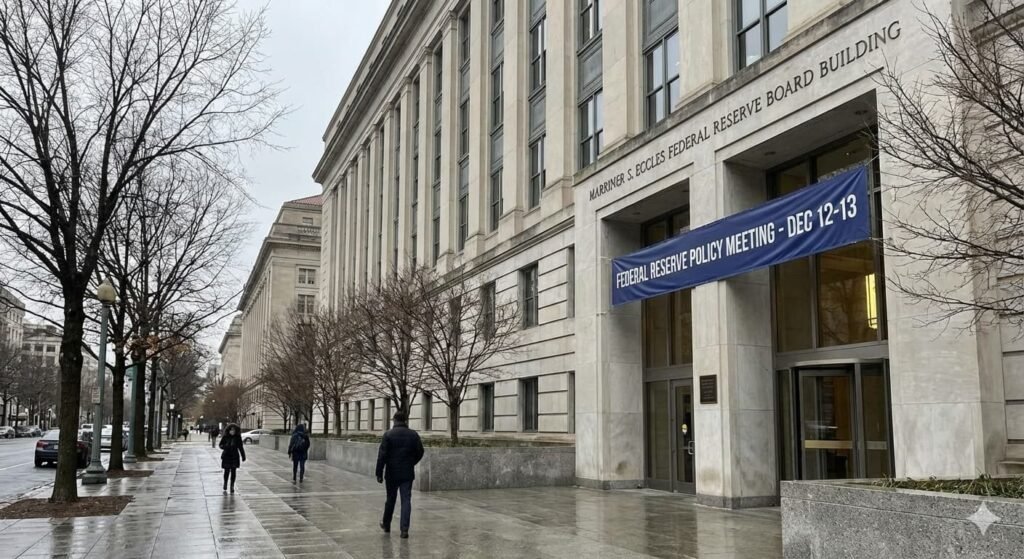
Attention now shifts to the Federal Reserve’s final policy meeting of the year.
Markets are currently pricing roughly a 60% probability of a 25-basis-point rate cut in December. The central bank has already reduced rates three times in 2026, bringing the federal funds target range down to 3.75%–4.00%.
Yet Friday’s solid jobs report complicates the decision.
A still-tight labor market gives policymakers reason to pause, particularly with inflation remaining above target. At the same time, housing activity remains constrained by mortgage rates near 6%, and business investment has slowed.
Federal Reserve officials are balancing two risks: easing too soon and reigniting inflation, or holding rates too high for too long and choking off growth in 2027.
Leadership uncertainty—whether Jerome Powell remains in place or transitions after mid-2026 political developments—adds another layer of caution.
Post-Election Gridlock Brings Policy Calm
The November midterm elections resulted in a divided Congress, reducing the likelihood of major fiscal shifts in the near term.
Markets have responded positively to the prospect of legislative restraint. With neither large stimulus packages nor sweeping tax overhauls on the immediate horizon, businesses can plan for 2027 with a clearer—if uninspiring—policy backdrop.
Historically, periods of divided government tend to favor investment stability, even when economic growth remains muted.
The AI Reality Check of 2026
This year also marked the first major audit of the artificial intelligence boom.
After massive capital spending in 2024 and 2025, investors and executives alike have begun asking tougher questions about returns. While major technology firms continue to report strong earnings, AI’s broader impact on productivity has been gradual rather than explosive.
Friday’s labor report reinforces that view. Output per worker is rising, but not yet at a pace sufficient to offset structural cost pressures or deliver broad-based deflation.
AI is improving efficiency—but it has not yet delivered the productivity windfall that optimists once promised.
An Economy That Endures, Not Excels
As Americans head into the final weeks of 2026, the economy remains resilient—but fatigued.
The country avoided the recession many feared. Unemployment stayed below 5%. Financial markets remained functional. Yet the cost of living continues to dominate public anxiety, and wage growth has failed to restore the sense of progress many households expected by now.
December 4, 2026, marks not a turning point, but a pause—a moment of endurance rather than relief.
The hope heading into 2027 is that productivity gains finally translate into real wage growth, allowing this era of heavy stability to evolve into something more tangible: shared prosperity.
U.S. Economic Snapshot — December 4, 2026
| Indicator | Latest Reading | Trend |
|---|---|---|
| Unemployment Rate | 4.4% | Slightly higher than early 2026 |
| Inflation (CPI YoY) | ~2.8% | Stubbornly above target |
| Fed Funds Rate | 3.75%–4.00% | Lower than 2025 peak |
| GDP Growth (Q3 final) | 1.9% | Cooling |
| 10-Year Treasury Yield | ~4.15% | Volatile |