By Harshit
WASHINGTON, JANUARY 24, 2026 —
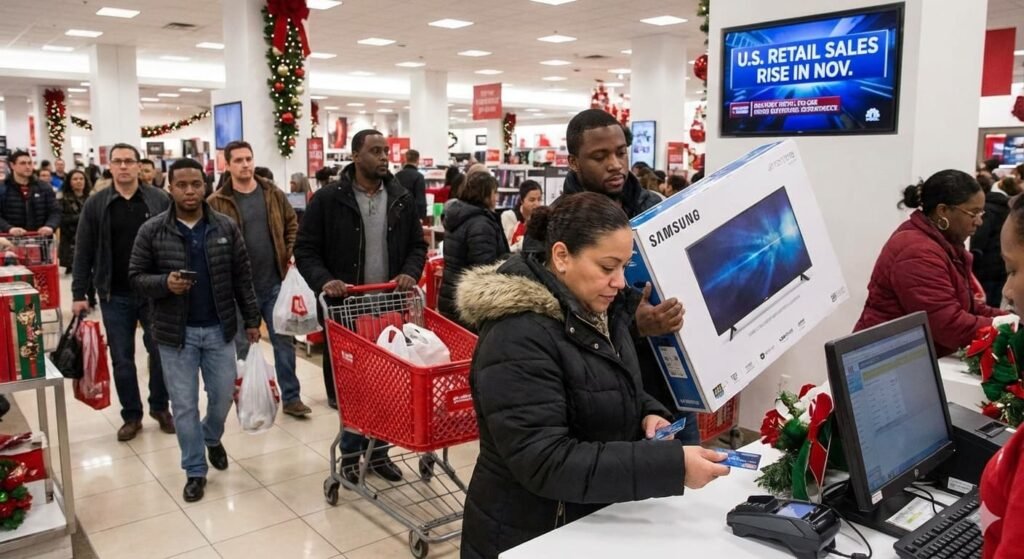
U.S. consumer spending accelerated in November as the holiday shopping season began, but new government data suggests the momentum is increasingly fragile, supported by shrinking savings and pressured by stubborn inflation.
A shutdown-delayed report released Thursday by the U.S. Department of Commerce showed that consumer spending rose 0.5% in November, exceeding economists’ expectations for a 0.4% increase. When adjusted for inflation, spending grew 0.3%, underscoring continued resilience in household demand.
However, nearly half of the month’s increase came from just two categories—health care and energy, including gasoline—raising questions about how much of the spending reflects discretionary strength versus rising essential costs.
Spending Holds Up Despite Growing Headwinds
The data highlights a central contradiction in the late-2025 U.S. economy: consumers are still spending even as confidence weakens, job growth slows, and uncertainty remains elevated.
Economists note that this dynamic is consistent with a K-shaped economy, in which higher-income households—buoyed by asset gains—continue to drive aggregate spending, while middle- and lower-income consumers face mounting financial pressure.
While the November report does not explicitly quantify that divide, analysts warn that the underlying support for consumer demand is eroding.
“I think the more striking thing in this report is just how flimsy the support for that growth is,” said Oliver Allen, senior U.S. economist at Pantheon Macroeconomics. “Income growth now is looking really, really weak.”
Income Growth Slows, Savings Hit a Two-Year Low
The November data revealed that personal income rose 0.3%, but after taxes, income increased by just 0.1%. At the same time, the personal savings rate fell to 3.5%, the lowest level since October 2022.
That decline suggests households are increasingly relying on savings to maintain spending levels—an approach economists say is not sustainable over the long term, particularly if job market conditions soften further in early 2026.
Consumer spending accounts for roughly 70% of U.S. economic activity, making the durability of household finances a key variable for growth prospects in the coming quarters.
Inflation Remains Stubbornly Elevated
The report also confirmed that inflation pressures remain sticky.
According to the Bureau of Economic Analysis, the Personal Consumption Expenditures (PCE) price index—the Federal Reserve’s preferred inflation gauge—rose 0.2% in November, leaving the annual rate unchanged at 2.8%.
Core PCE inflation, which excludes food and energy, also increased 0.2% for the fifth consecutive month, with the annual core rate holding at 2.8%. Those figures matched consensus forecasts and reinforce concerns that inflation is proving resistant to further decline.
Federal Reserve officials have repeatedly emphasized that sustained progress toward the 2% inflation target is necessary before interest rates can be reduced more aggressively.
Shutdown Disruptions Cloud the Data
Thursday’s Personal Income and Outlays report was heavily affected by the 43-day federal government shutdown, which halted most data collection throughout October and the first half of November.
As a result, the October and November reports—originally scheduled for late November and mid-December—were combined into a single release. Some inflation categories for October were estimated using averages from September and November due to incomplete data.
While the Commerce Department stressed that the report incorporates information from a broad range of sources, economists cautioned that the figures may be less precise than usual.
Still, the combined data offers a comprehensive snapshot of consumer behavior, income trends, savings, and price pressures heading into the final stretch of 2025.
What It Means for Early 2026
The November report reinforces the view that the U.S. economy entered 2026 with consumer demand intact but increasingly strained.
Rising spending is being sustained less by income growth and more by reduced savings, while inflation remains elevated enough to limit real purchasing power. If labor market conditions weaken further, economists warn that consumer spending could slow sharply in the first half of the year.
For policymakers, the data presents a familiar dilemma: growth remains resilient, but the foundation supporting it is thinning.