
By Harshit
NEW YORK, JANUARY 20 — Artificial intelligence spending in the United States continues to climb, with corporations allocating billions toward AI tools, cloud capacity, and automation platforms. Yet in 2026, a surprising trend has emerged: many U.S. companies are deliberately slowing the pace at which AI systems are rolled out across core business operations.
This hesitation is not driven by lack of interest or technical failure. It is driven by risk.
From Excitement to Caution
In the early stages of the AI boom, companies rushed to adopt new tools in order to stay competitive. Pilot programs were launched quickly, and productivity gains were widely advertised. By 2026, the tone has shifted from enthusiasm to evaluation.
Executives are asking harder questions:
- Can these systems be trusted at scale?
- How do we manage errors, bias, and accountability?
- What happens when AI decisions affect customers, finances, or compliance?
The result is a slower, more controlled approach to deployment.
Enterprise Risk Is the Primary Constraint
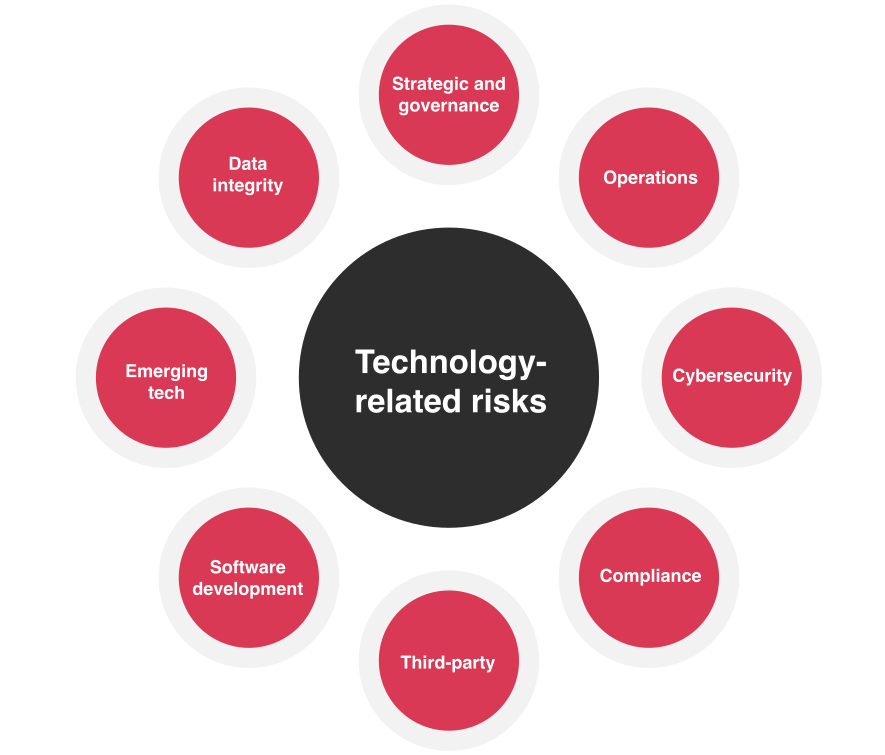
For large U.S. companies, the biggest barrier to rapid AI adoption is not cost—it is enterprise risk. AI systems increasingly touch sensitive areas such as pricing, hiring, credit decisions, cybersecurity, and customer data.
Mistakes in these areas carry legal, regulatory, and reputational consequences. Unlike consumer-facing apps, enterprise AI failures can expose firms to lawsuits, regulatory scrutiny, and loss of trust.
As a result, companies are spending more time testing, auditing, and validating AI outputs before integrating them into decision-making workflows.
Data Quality Remains a Major Bottleneck
AI systems are only as reliable as the data they are trained on. Many U.S. firms are discovering that their internal data is fragmented, outdated, or inconsistent across departments.
Cleaning, standardizing, and governing data has proven more time-consuming than anticipated. In many cases, companies are pausing AI expansion until data infrastructure is upgraded—a process that can take years rather than months.
This reality has tempered expectations about rapid productivity transformation.
Regulation Shapes Corporate Behavior
Regulatory uncertainty is another factor slowing AI deployment. U.S. companies operate across multiple jurisdictions, each with evolving rules around data privacy, algorithmic transparency, and consumer protection.
Rather than risk deploying systems that may later fall out of compliance, firms are choosing to wait. Legal teams are increasingly involved in AI strategy, signaling a shift from experimentation to long-term governance.
Workers Are Part of the Equation
Internal workforce dynamics also play a role. Employees remain cautious about AI systems that affect performance evaluation, scheduling, or job security. Companies are finding that successful AI adoption requires extensive training, communication, and trust-building.
Without employee buy-in, even technically sound AI systems face resistance that limits their effectiveness.
Where AI Is Moving Ahead
Despite the slowdown, AI adoption is accelerating in lower-risk areas:
- Internal analytics and forecasting
- Fraud detection and cybersecurity
- Supply chain optimization
- Customer support augmentation
These use cases offer clear benefits with manageable downside, making them easier to scale.
What This Means for the U.S. Tech Landscape
The AI revolution is not stalling—it is maturing. In 2026, success is measured less by how quickly AI is deployed and more by how responsibly it is integrated.
For U.S. companies, the competitive advantage will belong to those that balance innovation with governance, speed with trust, and automation with accountability.
A Longer Road to Transformation
AI’s impact on productivity and profitability remains significant, but it will unfold over years, not quarters. The companies that thrive will be those willing to move deliberately rather than recklessly.
In the long run, slower adoption today may lead to more durable gains tomorrow.