
By Harshit
SCIENCE — December 4, 2025
The United States has entered a new phase of climate science—one centered not only on understanding Earth’s changing systems, but on developing deployable, large-scale technologies capable of stabilizing them. As climate disruptions intensify, federal agencies, national laboratories, universities, and private-sector climate-tech firms are converging on three scientific priorities: carbon management, climate intervention science, and climate-resilient infrastructure.
These fields represent the backbone of U.S. resilience strategy. They are engineering-intensive, data-driven, and foundational to meeting national net-zero goals while protecting communities from increasing climate impacts. This article provides a deeply factual, research-focused overview of the scientific pillars shaping climate resilience across the United States in 2025.
I. Carbon Management Science: The Materials and Chemistry of Net-Zero
Carbon management is the most rapidly expanding research domain in U.S. climate science. It includes carbon capture, carbon removal, and carbon utilization, each supported by breakthroughs in materials chemistry and process engineering.
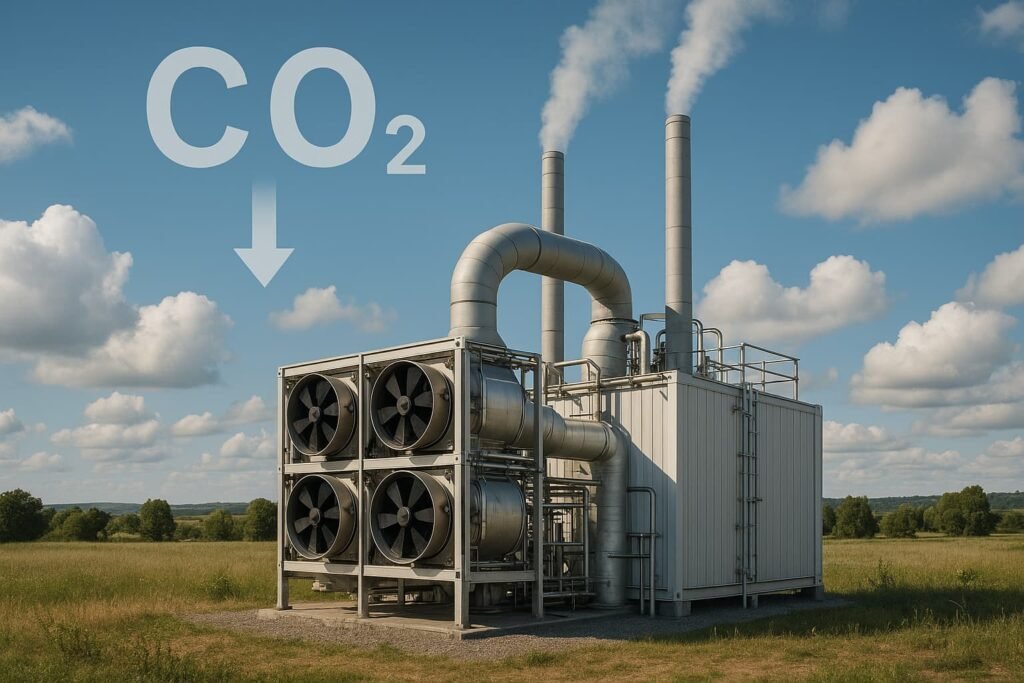
1. Direct Air Capture (DAC): Engineering Carbon-Selective Materials
DAC technologies remove CO₂ directly from ambient air (~425 ppm), a challenging task because CO₂ molecules are highly diluted. The scientific bottleneck is sorbent efficiency—creating materials that can bind CO₂ at low concentrations while requiring minimal energy to regenerate.
Metal-Organic Frameworks (MOFs)
U.S. national laboratories—including NREL, LLNL, ORNL—and university partners have accelerated MOF research due to their:
- ultra-high surface area
- tunable pore geometry
- strong, reversible CO₂ affinity
New generations of MOFs now integrate catalytic sites for both capture and in-situ conversion, lowering system energy consumption.
Polymeric and Amine-Functionalized Sorbents
Polymer sorbents offer:
- lower production cost
- high stability
- suitability for colder and humid climates
Researchers are optimizing cross-linking density and amine chemistry to minimize degradation and enhance CO₂ affinity.
Liquid Solvent Capture
Solvent-based systems remain a workhorse of U.S. carbon capture, particularly for industrial sources. The scientific effort centers on reducing the heat required to strip CO₂ from solvents. Advanced solvents (e.g., biphasic systems and non-aqueous amines) can cut regeneration energy by up to 30–40%.
2. Carbon Capture and Utilization (CCU)
To make carbon removal economically scalable, scientists are designing pathways to convert CO₂ into valuable products.
Electrochemical CO₂ Reduction (CO₂RR)
High-interest products include:
- methanol
- formic acid
- synthetic hydrocarbons
- carbon monoxide (syngas precursor)
U.S. researchers are engineering copper-based and nickel-based catalysts to maximize Faradaic efficiency, minimize catalyst poisoning, and withstand industrial current densities.
Mineral Carbonation
Geologic mineralization mimics natural rock weathering but accelerates it by orders of magnitude.
Research priorities include:
- CO₂-water-mineral reaction kinetics
- basalt carbonation in volcanic regions
- ultramafic rock injection stability
- carbon-negative cement formulations
Pilot-scale mineral sequestration projects in Montana, Oregon, and the Midwest validate long-term CO₂ storage security.
II. Intervention Science: Geoengineering and Earth System Control
Intervention science explores methods to modify Earth’s climate intentionally—an area once considered taboo but now vital for risk assessment. The U.S. does not deploy geoengineering technologies but is legally mandated to research their safety and feasibility through federal programs.
1. Solar Radiation Management (SRM)
SRM seeks to reflect a small fraction of incoming solar radiation. U.S. research focuses on:
A. Stratospheric Aerosol Injection (SAI)
Scientists model how sulfur dioxide (SO₂), calcium carbonate, or other aerosols behave at:
- 18–25 km altitude
- varying humidity
- different latitudes
Key scientific questions include:
- How do aerosols influence stratospheric chemistry?
- What particle size maximizes reflectivity while minimizing ozone risks?
- How do aerosols disperse globally?
Models at NOAA, NCAR, and DOE labs simulate transport mechanisms and precipitation shifts.
B. Marine Cloud Brightening (MCB)
MCB aims to increase cloud reflectivity by injecting microscopic sea-salt particles.
Scientific efforts include:
- understanding cloud microphysics
- quantifying droplet nucleation thresholds
- satellite-based cloud albedo measurement
MCB is being evaluated mainly for coastal heat-wave mitigation and coral reef cooling applications.
2. Earth System Modeling (ESM)
Modern climate resilience relies on hyper-detailed ESMs incorporating:
- atmospheric dynamics
- ocean circulation
- cryosphere behavior
- biosphere-atmosphere coupling
- methane release from permafrost
- wildfire aerosol feedbacks
The challenge is small-scale process resolution. Turbulence, cloud formation, and ocean heat mixing occur on scales too fine for global grids. Machine learning is now integrated into climate models to bridge this gap, significantly improving regional climate forecasts.
III. Climate-Resilient Infrastructure and the Water-Energy Nexus
Climate resilience extends beyond emissions—it requires reengineering the physical systems that support American life.
1. Smart Grid and Energy Resilience
As renewable penetration rises, the U.S. grid must withstand:
- extreme heat
- wildfire risk
- hurricanes
- cyber threats
- variable generation from solar/wind
AI-Driven Grid Control
U.S. power system labs are deploying:
- predictive demand algorithms
- automated fault isolation
- bidirectional flow management for rooftop solar
- real-time wildfire detection systems
These tools prevent cascading failures and stabilize voltage across multi-state networks.
Long-Duration Energy Storage (LDES)
Beyond lithium-ion, U.S. scientists are advancing:
- iron-air batteries
- sodium-sulfur batteries
- compressed air storage
- pumped thermal storage
- hydrogen storage in salt caverns
LDES technologies provide multi-day resilience when renewable output drops.
2. Water Resource Science
Water scarcity is the most immediate climate threat to U.S. cities and agriculture.
Advanced Desalination
Materials science breakthroughs include:
- graphene-oxide desalination membranes
- carbon nanotube channels
- antifouling polymer layers
- hybrid reverse-osmosis/thermal systems
These reduce energy consumption and enable large-scale deployment in drought-prone regions like the Southwest.
Hydrological Modeling and Watershed Engineering
U.S. scientists use satellite data (NASA SMAP, GRACE) and AI-enhanced hydrology models to:
- predict river flows
- assess groundwater decline
- simulate drought conditions
- design engineered wetlands
- optimize aquifer recharge
This enables cities to plan for floods, storm surges, and long-term water shortages.
Conclusion
U.S. climate resilience science in 2025 is defined by three interlocking pillars: carbon management, intervention science, and infrastructure adaptation. These fields represent the most urgent and scientifically complex components of national climate strategy.
Carbon management technologies reduce atmospheric CO₂; intervention science studies emergency climate control options; and resilient infrastructure protects society from worsening climate hazards.
These efforts are technologically demanding, but they form the foundation of climate security for the United States and the global community in the decades ahead.