The 2026 Business Playbook: How U.S. Companies Are Winning in the Era of Precision Scaling
By Harshit
NEW YORK, FEBRUARY 19, 2026 —
American businesses are entering 2026 with a fundamentally different mindset than the expansion-driven years that followed the pandemic. The era of “growth at all costs” has given way to what executives and economists increasingly call Precision Scaling—a strategy centered on profitability, efficiency, and operational resilience.
With the Federal Reserve maintaining interest rates at elevated levels to ensure inflation remains contained, access to cheap capital is no longer guaranteed. Companies are being forced to operate with tighter margins, greater discipline, and more strategic investment priorities.
Success in 2026 is no longer defined by how fast a company grows—but by how efficiently it scales.
Supply Chain Sovereignty Becomes a Competitive Advantage

The global supply chain disruptions of the early 2020s permanently altered corporate logistics strategies. U.S. companies have moved away from fragile, cost-optimized sourcing models toward resilience-focused supply networks.
North America’s Strategic Advantage
Mexico has emerged as the United States’ most important manufacturing and trade partner, benefiting from geographic proximity and reduced geopolitical risk. Near-shoring production closer to home has delivered measurable benefits, including faster delivery times and greater reliability.
Businesses shifting production to North America report:
- Shorter delivery timelines
- Lower exposure to shipping disruptions
- Reduced geopolitical risk
These changes are not temporary adjustments—they represent a structural shift in global commerce.
Inventory Is No Longer the Enemy
For decades, inventory was viewed primarily as a cost burden. Today, it is increasingly treated as a strategic asset. With inflation hovering near 3%, holding inventory can protect businesses from future price increases and supply interruptions.

Micro-Fulfillment Levels the Playing Field
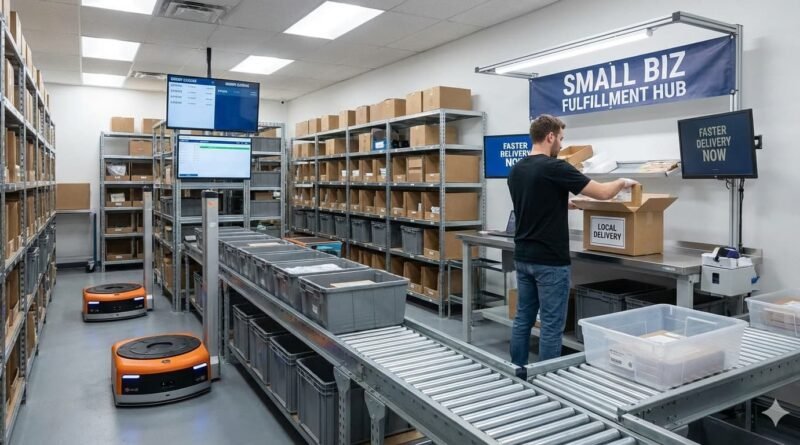
To compete with large retailers like Amazon, smaller businesses are investing in automated micro-fulfillment centers. These urban distribution hubs allow faster deliveries while reducing last-mile costs—one of the most expensive parts of logistics.
The Augmented Workforce Is Replacing the Traditional Workforce
The labor market remains relatively tight, but the nature of work itself has evolved.
The labor force participation rate remains near long-term averages, but businesses are increasingly focusing on automation and augmentation rather than hiring expansion.
The Rise of the “Citizen Developer”
Employees are no longer limited to their job descriptions. Using no-code and low-code software platforms, non-technical workers can now build internal automation tools.
This trend allows companies to:
- Reduce reliance on IT departments
- Improve operational speed
- Increase productivity without increasing headcount
Companies that empower internal automation often operate more efficiently than those relying solely on traditional workflows.
Fractional Talent Redefines Hiring
Instead of hiring expensive full-time executives, businesses are increasingly using contract-based specialists.
This model allows smaller firms to access high-level expertise—such as marketing strategists or data scientists—without carrying full-time salary costs.
The shift reflects a broader transition toward a more flexible, project-based workforce.
Capital Strategy Is Now a Core Competitive Skill
Money is no longer free, but it remains available for well-managed businesses.
Companies with strong balance sheets and stable revenue streams still have access to funding—but the terms are more selective.
New Funding Models Gain Popularity
Businesses are increasingly exploring alternative financing methods:
- Revenue-based financing tied to sales performance
- Asset-backed lending secured by physical or intellectual property
- Sustainability-linked financing with favorable terms
These approaches allow companies to raise capital while maintaining operational control.
Marketing Has Shifted Toward Direct Customer Relationships
The digital marketing landscape has undergone a major transformation.
Privacy regulations and technology changes have reduced the effectiveness of traditional tracking methods.
Instead, companies are focusing on building direct relationships with customers.
The Rise of Zero-Party Data
Zero-party data refers to information customers willingly share, such as preferences or interests.
Businesses are collecting this information through:
- Customer surveys
- Loyalty programs
- Interactive tools
This strategy helps companies build stronger, more reliable customer relationships.
Community Has Become a Strategic Asset
In an era where AI-generated content is widespread, genuine customer communities provide trust and brand loyalty.
Businesses are investing in private customer groups, events, and direct engagement channels to strengthen their brands.
Risk Management Has Become Essential
Companies in 2026 face several critical risks that require active management.
Cybersecurity Threats Continue to Grow
Cyberattacks remain one of the most serious operational threats.
Businesses are investing heavily in security infrastructure to protect sensitive data.
Regulatory Compliance Is Increasingly Complex
New privacy and data regulations require companies to improve compliance systems.
Failure to comply can result in significant penalties and reputational damage.
Energy Costs Remain Uncertain
Energy volatility continues to affect operating expenses, particularly for manufacturing and logistics companies.
Many firms are investing in long-term energy stability solutions.
The Bottom Line: Efficiency Is the New Growth
The defining characteristic of the 2026 U.S. business environment is discipline.
Companies are no longer rewarded simply for expanding. Instead, success depends on:
- Operational efficiency
- Strategic capital allocation
- Supply chain resilience
- Workforce productivity
The businesses that thrive in 2026 will not necessarily be the fastest-growing—but they will be the most efficient and adaptable.
Precision Scaling has replaced blind expansion.
And for American businesses, that shift is defining the future.