U.S. Business Landscape in 2026: AI Productivity, Supply Chain Shifts, and a New Capital Reality
By Harshit, NEW YORK, March 7, 2026 — The U.S. corporate environment in 2026 reflects a decisive shift from experimentation to consolidation. After several years of rapid technological adoption and economic volatility, businesses are now focused on operational efficiency, supply chain resilience, and sustainable profitability. Analysts describe the current phase as a structural reset, where artificial intelligence, evolving trade policies, and tighter capital markets are redefining how companies operate.
Across industries, executives are no longer asking whether new technologies or strategic changes are necessary. Instead, the central question in boardrooms has become how these shifts translate into measurable returns.
Artificial Intelligence Moves From Hype to Measurable Productivity
Artificial intelligence remains the dominant force shaping the business environment in 2026, but the focus has changed significantly compared with the early 2020s. During the previous decade, companies invested heavily in AI tools to explore their potential. Today, the emphasis is on measurable return on investment.
Many corporations have begun deploying agentic AI systems, autonomous software programs capable of managing complex workflows such as procurement processes, supply chain monitoring, and preliminary financial auditing. These systems go beyond simple chatbots, allowing businesses to automate entire operational chains.
At the same time, organizations are investing heavily in AI augmentation training for employees. Rather than replacing workers outright, companies are increasingly pairing human expertise with automated tools. The goal is to improve productivity while retaining critical institutional knowledge.
Data security has also emerged as a major concern. To protect intellectual property, corporations are rapidly adopting private large language models (LLMs) hosted within their own infrastructure or private cloud environments. This approach limits the risk of sensitive corporate data being exposed through public AI platforms.
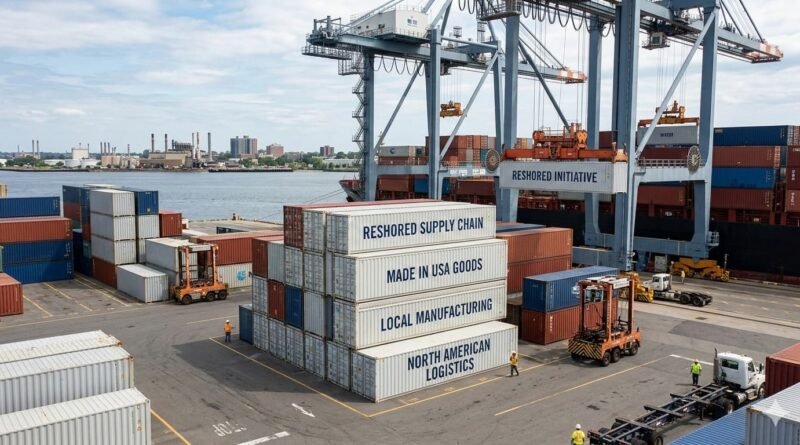
Supply Chains Reshape Around North America
Trade policy changes introduced during 2025 have begun reshaping global supply chains. The expansion of tariffs on certain imported goods, combined with domestic manufacturing incentives, has encouraged companies to relocate production closer to the United States.
Manufacturers are increasingly moving operations to Mexico and Canada, positioning themselves to maintain tariff-free access to the U.S. market while reducing reliance on East Asian production hubs. With the scheduled review of the U.S.–Mexico–Canada Agreement underway in 2026, businesses are closely monitoring regulatory developments that could influence regional trade.
Logistics strategies are also evolving. The long-standing “just-in-time” inventory model, designed to minimize storage costs, has been replaced by a more cautious “just-in-case” approach. Companies are holding larger inventories to protect against geopolitical disruptions, particularly concerns surrounding maritime shipping routes in regions such as the Red Sea and the South China Sea.
Environmental reporting requirements are adding another layer of complexity. Several federal and state-level mandates now require companies to track Scope 3 emissions, which include indirect carbon emissions throughout the supply chain. To meet these obligations, some firms are adopting blockchain-based tracking systems that verify environmental data across multiple suppliers.
Higher Interest Rates Reshape Corporate Finance
The financial landscape in 2026 is defined by a “higher-for-longer” interest rate environment. After years of extremely low borrowing costs during the pandemic era, companies now face more expensive access to capital.
Interest rates hovering around 3.5% to 4% have forced businesses to rethink expansion strategies. Investors are prioritizing profitability and stable cash flow over rapid growth.
This environment has triggered a renewed wave of strategic mergers and acquisitions. Large corporations with strong balance sheets are purchasing smaller artificial intelligence startups and financially distressed mid-sized companies struggling with higher debt servicing costs.
Small and medium-sized enterprises, however, face a more difficult situation. Traditional bank lending standards have tightened, pushing many businesses toward the rapidly expanding private credit market, which provides alternative funding outside conventional banking channels.
Workforce Trends Reflect Economic Caution
Labor market dynamics have also shifted. Employee turnover has dropped to its lowest level in several years as workers prioritize job security amid economic uncertainty. While this trend has helped moderate wage inflation, it has also made it harder for companies to recruit specialized talent.
Meanwhile, the debate over remote work has largely settled. Many American companies have adopted a hybrid work model, typically requiring employees to work in the office three days per week while allowing remote work on the remaining days. This arrangement has contributed to a rise in suburban co-working spaces designed to accommodate hybrid professionals.
Sector Outlook: Growth Opportunities and Challenges
Industry performance varies widely across sectors, though several clear trends have emerged.
In retail and e-commerce, companies are investing in AI-driven personalization tools to tailor product recommendations and marketing campaigns to individual customers. However, rising transportation costs continue to challenge last-mile delivery networks.
The manufacturing sector is benefiting from federal subsidies aimed at boosting domestic production, particularly in semiconductors and advanced technologies. Yet manufacturers face an ongoing shortage of skilled technical workers capable of managing increasingly automated factories.
Within energy and utilities, growing demand from data centers is driving major investments in power grid modernization. Regulatory delays, however, continue to slow the expansion of renewable energy infrastructure.
In the financial sector, fintech integration and digital payment innovations are expanding rapidly, though cybersecurity threats remain a significant concern.
Consumers Become More Selective
Consumer behavior in 2026 reflects persistent economic pressure. Rising living costs have led to a noticeable split in spending patterns.
Many households are turning toward ultra-value private-label products to reduce everyday expenses, while others are choosing fewer but higher-quality goods designed to last longer. As a result, mid-range brands are facing increased competition from both ends of the pricing spectrum.
At the same time, marketing strategies are evolving. With the internet increasingly saturated by automated content, businesses are finding that authentic, human-centered marketing generates stronger engagement. Live events, community-based loyalty programs, and transparent storytelling about brand operations are becoming more effective tools for building consumer trust.
Regulatory Scrutiny Intensifies
Regulatory oversight remains a critical factor shaping corporate strategy. U.S. antitrust authorities, including the Department of Justice and the Federal Trade Commission, continue to closely monitor acquisitions by major technology firms, particularly in the artificial intelligence and cloud computing sectors.
Cybersecurity regulation is also tightening. As AI-driven phishing attacks and ransomware operations become more sophisticated, companies are facing rising cyber-insurance premiums. Insurers now often require extensive security audits before offering coverage.
Strategic Outlook
The defining characteristic of the 2026 business cycle is operational discipline. Companies that entered the year with strong balance sheets, diversified supply chains, and integrated AI infrastructure appear best positioned to succeed.
For many executives, the era of experimental technology spending has ended. In its place, a new corporate strategy has emerged—one focused on measurable productivity, resilient logistics networks, and sustainable financial management in a more demanding global economy.