
By Harshit TUCSON, ARIZONA — October 23, 2025 10 AM EDT
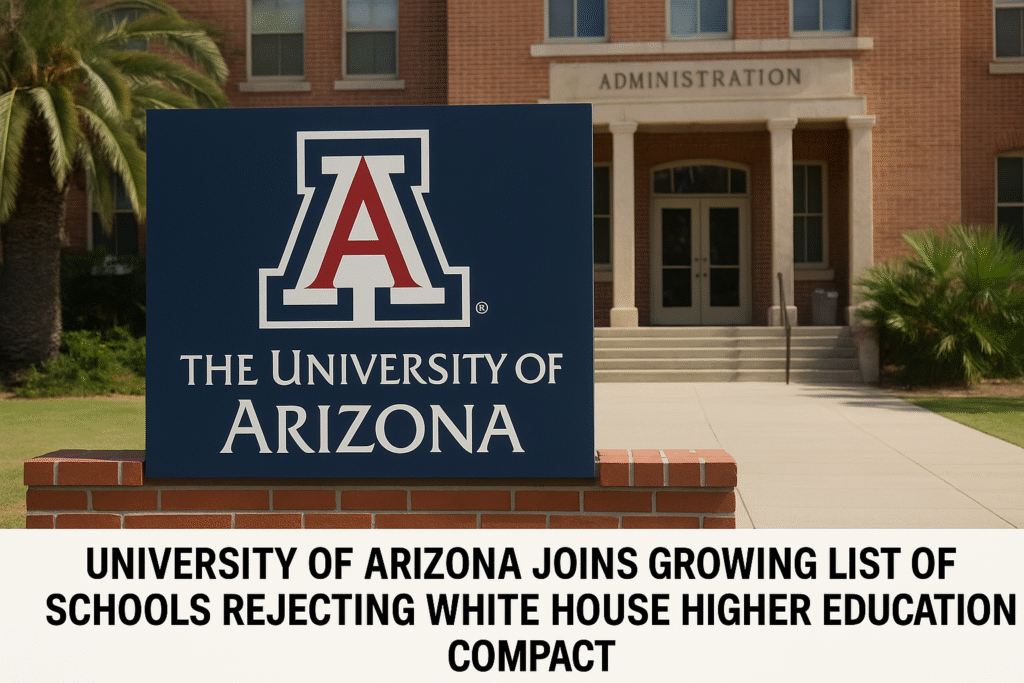
The University of Arizona has become the latest major institution to reject a White House proposal that would have expanded federal funding in exchange for a set of controversial policy changes on campus governance, admissions, and ideological oversight. The move underscores mounting resistance among America’s leading universities to what critics describe as an attempt by the Trump administration to exert unprecedented political control over higher education.
White House Proposal Sparks National Backlash
The proposed “compact,” first circulated on October 1, was sent to nine major universities, offering preferential access to federal grants and research partnerships if they agreed to a series of mandates. Among these were the removal of sex and ethnicity as admissions criteria, a freeze on tuition for five years, and a cap limiting international student enrollment to 15%.
The letter, signed by Secretary of Education Linda McMahon, stated the compact’s goal was to create “a vibrant marketplace of ideas on campus” where “no single ideology dominates.” However, the administration’s conditions have drawn sharp criticism from academic leaders and civil rights groups, who say the proposal threatens institutional autonomy and academic freedom.
University of Arizona President Suresh Garimella announced Monday that his institution had formally declined the offer, joining seven other schools—including the University of Virginia, MIT, Brown University, Dartmouth College, USC, and the University of Pennsylvania—that have already turned it down.
“We seek no special treatment and believe in our ability to compete for federally funded research strictly on merit,” Garimella wrote in a letter to Education Secretary McMahon. “A federal research funding system based on anything other than merit would weaken the world’s preeminent engine for innovation.”
Political Pressure Meets Academic Resistance
The administration framed the compact as part of a broader initiative to “improve the quality and accountability of American higher education.” Yet, university presidents have described it as an attempt to politicize research and governance.
Under the proposed agreement, participating universities would have been required to:
- Eliminate consideration of race, sex, and ethnicity in admissions and hiring.
- Define gender “according to reproductive function and biological processes.”
- Conduct annual anonymous surveys among students and faculty to monitor ideological “balance.”
- Reassess or close “institutional units that punish or belittle conservative ideas.”
In return, the White House promised priority access to federal research grants, higher overhead allowances, and invitations to official events.
While the proposal does not explicitly penalize universities that refuse to participate, federal officials have hinted at possible implications for institutions under existing funding investigations.
Other Universities Also Reject the Offer
The University of Virginia (UVA) was among the first to decline the compact last week, just hours after its leadership met with Trump officials in Washington. UVA interim President Paul Mahoney said in a statement that while there were “areas of agreement,” the university’s mission was best served by “open and collaborative conversation—not directives.”
UVA later negotiated a separate arrangement with the Department of Justice to end investigations into its admissions practices, agreeing to halt what the administration deemed “unlawful racial discrimination.”
MIT President Sally Kornbluth, in an earlier response, said her institution recognized the “importance of these issues” but warned that the compact “would restrict freedom of expression and our independence as an institution.”
Brown University President Christina Paxson echoed that sentiment, saying the compact’s conditions “would undermine the autonomy of Brown’s governance.”
USC Interim President Beong-Soo Kim cited similar concerns: “Tying research benefits to ideological criteria undermines the very values of free inquiry and academic excellence that the compact seeks to promote.”
Ideological Oversight and Federal Leverage
The proposed compact comes amid a broader campaign by the Trump administration to reshape American academia. Over the past two years, the administration has rolled back federal diversity and equity mandates, increased scrutiny of university foreign funding, and initiated Justice Department investigations into alleged “political bias” on campuses.
Education Secretary Linda McMahon has defended the compact, arguing it is designed to “restore balance” and “ensure that taxpayer-funded education serves the entire nation—not ideological factions.”
But legal scholars and university associations warn that conditioning federal funding on adherence to political standards may violate the First Amendment and long-established federal research laws.
“This compact represents an unprecedented intrusion into institutional governance,” said Dr. Emily Vargas, a higher education policy analyst at Georgetown University. “It blurs the line between accountability and coercion, potentially undermining the independence that defines American universities.”
Growing Concern Across Academia
The controversy has triggered intense debate across the higher education community. Faculty unions and student groups have condemned the administration’s approach as an assault on free thought. Meanwhile, state officials in Democratic-led states have vowed to protect universities that refuse the compact.
California Governor Gavin Newsom warned he would consider withholding state funding from any California university that signs the agreement, calling it “an ideological power grab disguised as reform.”
Federal lobbying data obtained by CNN shows that universities targeted by the compact have collectively increased their Washington lobbying expenditures by 122% in the second quarter of this year compared to last year—an indication of the growing tension between academia and the federal government.
What Lies Ahead
Three additional schools—Arizona State University, the University of Kansas, and Washington University in St. Louis—are still reviewing the offer after attending a White House meeting on Friday. Vanderbilt University Chancellor Daniel Diermeier confirmed his school was providing “feedback and comments as part of an ongoing dialogue” but stopped short of committing to any decision.
“Academic freedom, free expression, and independence are essential for universities to make their vital and singular contributions to society,” Diermeier said.
For now, the University of Arizona’s decision marks a powerful statement of defiance against federal overreach—and adds to the mounting pressure on the White House to revise or abandon the compact altogether.
As President Garimella wrote in closing his letter:
“We believe in a competitive system based on excellence, innovation, and merit—not one shaped by politics or ideology.”