
By Harshit
NEW YORK CITY, NOVEMBER 18, 2025 —
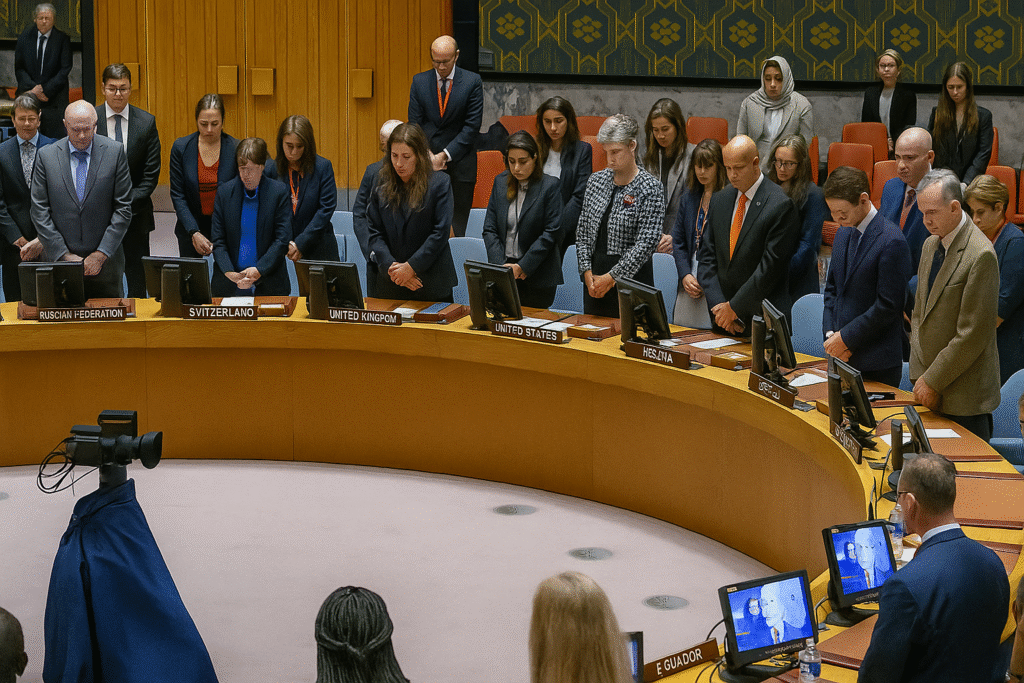
The United Nations Security Council has approved a landmark US-drafted resolution that authorizes a transitional administration and an International Stabilization Force (ISF) for Gaza, establishing what Washington calls a “credible pathway” toward eventual Palestinian statehood.
The measure, a central pillar of President Donald Trump’s 20-point Middle East plan, passed 13–0, with Russia and China abstaining. It is the most consequential diplomatic development since the fragile Gaza ceasefire took effect on October 10.
A Major Shift in Gaza’s Future Governance
The resolution authorizes a multinational force tasked with securing Gaza’s borders, supporting humanitarian aid operations, coordinating reconstruction, and overseeing the demilitarization of armed groups.
It also envisions a transitional civil administration in Gaza operating alongside a vetted Palestinian police force.
Arab and Muslim-majority nations — including Qatar, Egypt, Saudi Arabia, Jordan, Indonesia, the UAE, and Türkiye — had conditioned their willingness to provide troops on a formal UN mandate. US diplomats added stronger language on Palestinian self-determination to lock in their support.
The text now asserts that “conditions may finally be in place for a credible pathway to Palestinian self-determination and statehood,” pending reforms inside the Palestinian Authority and measurable progress on stabilization in Gaza.
Backlash From Israeli Leadership
The new language enraged Israeli Prime Minister Benjamin Netanyahu, who reiterated his government’s rejection of any Palestinian state and vowed to demilitarize Gaza “the easy way or the hard way.”
Israeli National Security Minister Itamar Ben-Gvir condemned the resolution outright, even urging the targeting of Palestinian Authority officials if the UN takes steps toward recognizing Palestinian statehood.
Despite the criticism, the resolution obligates Israel to withdraw its forces from Gaza under a jointly agreed timeline based on demilitarization benchmarks — coordinated among the ISF, Israel, the US, and ceasefire guarantor nations.
The US Position: Security for Israel, Stability for Gaza
US Ambassador to the UN Mike Waltz hailed the vote as “another significant step that will enable Gaza to prosper in an environment that will allow Israel to live in security.”
The resolution authorizes the stabilization force to “use all necessary measures” to carry out its mandate — giving it unusually broad operational authority.
It is expected to secure border crossings, assist in rebuilding critical infrastructure, ensure safe distribution of humanitarian aid, and maintain security alongside Palestinian police units.
President Trump celebrated the vote, saying the new peace oversight board would “include the most powerful and respected leaders throughout the world.”
Hamas Rejects the Resolution
Hamas sharply rejected the US-drafted measure, arguing that it undermines Palestinian sovereignty and imposes what the group calls “international trusteeship.”
In a statement, Hamas said the resolution:
- fails to protect Palestinian rights,
- attempts to force disarmament of resistance factions,
- makes the multinational force a “party to the conflict” instead of a neutral peacekeeping body.
The group warned that any attempt to strip Gaza of its weapons “will be considered aggression.”
Russia’s Rival Resolution and Geopolitical Tensions
Before the vote, Russia introduced an alternative draft emphasizing the creation of a fully contiguous Palestinian state in both the West Bank and Gaza under unified Palestinian Authority governance.
Russia also criticized the US resolution as rearranging Gaza’s occupation “under a different authority,” though it ultimately abstained instead of vetoing.
Al Jazeera analysts noted that the vote reflects deep geopolitical imbalances: US influence in the Middle East remains dominant, and Israel continues military operations inside Gaza despite the ceasefire.
Humanitarian Situation Still Dire
Even as diplomatic frameworks take shape, Israel has continued conducting lethal strikes inside Gaza, and humanitarian agencies report that aid restrictions remain severe.
As of November 17:
- Over 69,000 Palestinians have been killed since the war began — a figure major human rights groups describe as evidence of a genocide.
- Hundreds of thousands remain displaced.
- Only limited humanitarian supplies are entering, despite repeated international warnings of famine conditions.
The new ISF is expected to coordinate with Egypt and Israel to improve aid access, though implementation timelines remain unclear.
Regional Diplomacy and International Response
Algeria’s UN ambassador Amar Bendjama praised Trump’s personal involvement in securing the ceasefire but stressed that long-term peace “cannot be achieved without justice for Palestinians.”
Regional governments issued cautious statements, welcoming the ceasefire but warning that any political solution must involve genuine steps toward Palestinian statehood and reconstruction of the devastated enclave.
Analysts warn that while the resolution creates a new framework, its success depends on cooperation from Hamas, Israel, and regional powers — a daunting task after more than a year of unprecedented bloodshed.