
By Harshit
WASHINGTON, DECEMBER 1 —
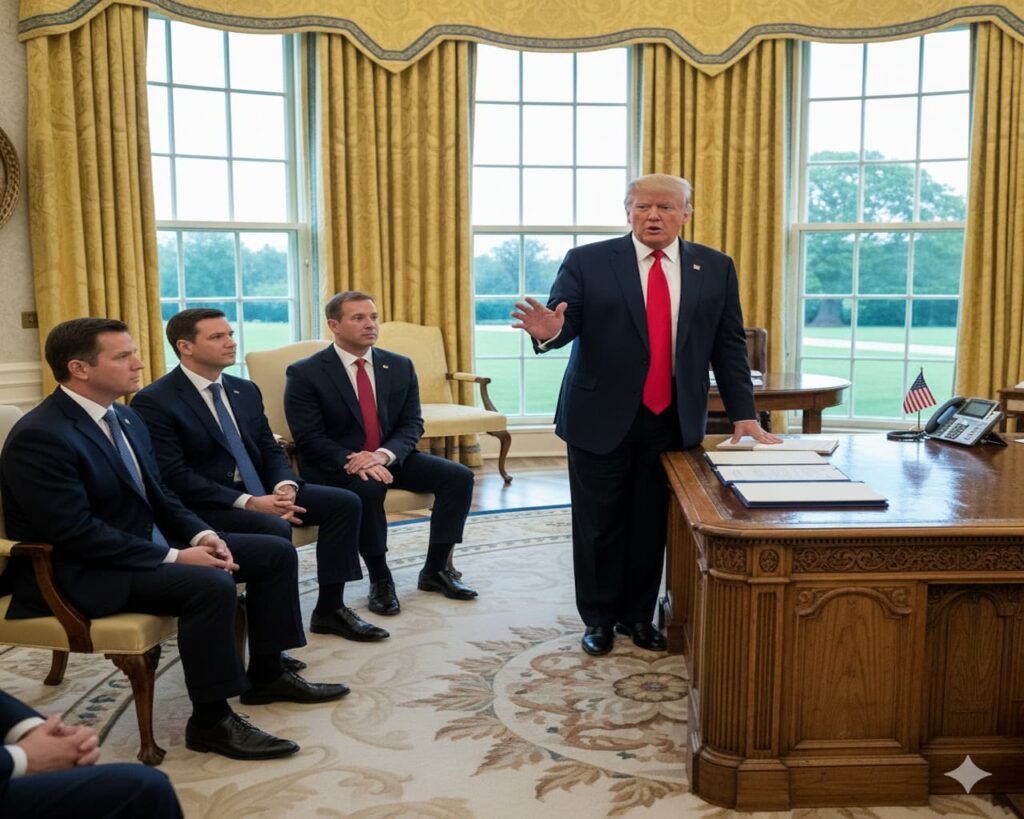
President Donald Trump will convene a high-stakes meeting at the White House on Monday evening to determine next steps in the administration’s rapidly intensifying pressure campaign against Venezuela, multiple sources familiar with the matter told CNN. The Oval Office discussion comes at a moment when US military activity in the Caribbean is drawing scrutiny from lawmakers in both parties, particularly following controversial strikes on suspected drug-trafficking boats that killed more than 80 people.
The meeting, scheduled for 5 p.m. ET, will include several of Trump’s most influential national security advisers. Among those expected to attend are Secretary of Defense Pete Hegseth, Chairman of the Joint Chiefs of Staff Gen. Dan Caine, Secretary of State Marco Rubio, White House Chief of Staff Susie Wiles, and Deputy Chief of Staff Stephen Miller — a signal that the administration is preparing for decisions involving military, diplomatic, and legal dimensions.
Military Buildup Under Operation Southern Spear
The White House gathering follows a series of escalations in US operations near Venezuela. The Pentagon has deployed more than a dozen warships and 15,000 US troops to the region under Operation Southern Spear, a maritime security and anti-trafficking campaign that has dramatically expanded Washington’s footprint in the Caribbean.
Last week, Trump signaled that interdiction efforts would soon widen to include land-based operations targeting Venezuelan drug networks. “The land is easier,” the president told service members during a Thanksgiving call, hinting at imminent moves that would go beyond long-standing maritime actions.
US officials say the buildup is intended to cut down on narcotics trafficking and irregular migration routes. But the scale and posture of the deployment — combined with the administration’s designation of Venezuelan President Nicolás Maduro and his allies as a foreign terrorist organization — have fueled speculation that the United States is preparing for more aggressive steps, potentially including direct military action.
Trump Warns Pilots to Avoid Venezuelan Airspace
Over the weekend, Trump issued an extraordinary directive on social media, urging airlines, pilots, and criminal networks to treat Venezuelan airspace as “closed in its entirety.” The move, while not legally enforceable by Washington, adds another layer of pressure on Caracas by signaling heightened risk around Venezuelan skies and warning off US-linked carriers.
The Federal Aviation Administration had already cautioned airlines last week about a “potentially hazardous situation” when flying near Venezuelan territory. Direct flights between the US and Venezuela have been suspended since 2019, but several US carriers continue to overfly the country while transiting to South America.
On Sunday, Trump downplayed speculation about the post, telling reporters not to “read into it,” while confirming separately that he had spoken by phone with Maduro. The White House has not disclosed the content of the call.
Questions Over Legality of Deadly US Strikes
The meeting also comes as lawmakers demand answers about the legality of recent US strikes on suspected Venezuelan drug boats. CNN reported last week that after an initial attack failed to kill all passengers, the US conducted a follow-up strike, raising serious questions about compliance with international law.
More than 80 people have been killed in the maritime operations so far.
Members of Congress from both parties have criticized the administration’s approach. Maine Sen. Angus King, an independent member of the Senate Armed Services Committee, issued the strongest rebuke yet on Monday.
“If the facts are, as alleged, that there was a second strike specifically to kill survivors in the water — that’s a stone-cold war crime. It’s also murder,” King told CNN.
He added that Congress will seek to interview “people up and down the chain of command,” including senior Pentagon leadership, to determine what orders were issued and how they were executed. “We’re going to be talking to people all the way up to the top.”
The administration maintains that its Caribbean operations are aimed at countering Venezuelan narcotics networks, but critics argue that the expanding mission and opaque legal basis suggest a broader push toward coercive regime change.
White House Strategy at a Crossroads
The Oval Office meeting underscores the volatility of the Venezuela file in Trump’s second term. While the administration has cut off all diplomatic communication with Caracas, officials said Maduro has recently reached out through several backchannels. Trump confirmed he spoke with the Venezuelan leader, though he declined to say what was discussed.
Maduro, for his part, has dismissed US threats as “colonialist aggression.” In a televised address to troops last week, he urged Venezuelans to remain “unshakeable” and warned that the country is prepared to defend itself.
Despite the hardening rhetoric on both sides, some officials say Maduro has previously indicated openness to stepping down within a longer timeline — an option the White House rejected, insisting on his immediate removal from power.
As Operation Southern Spear expands and Washington weighs its next move, Monday’s White House meeting could signal whether the administration intends to tighten pressure further, seek diplomatic leverage, or pursue a more forceful strategy in the weeks ahead.